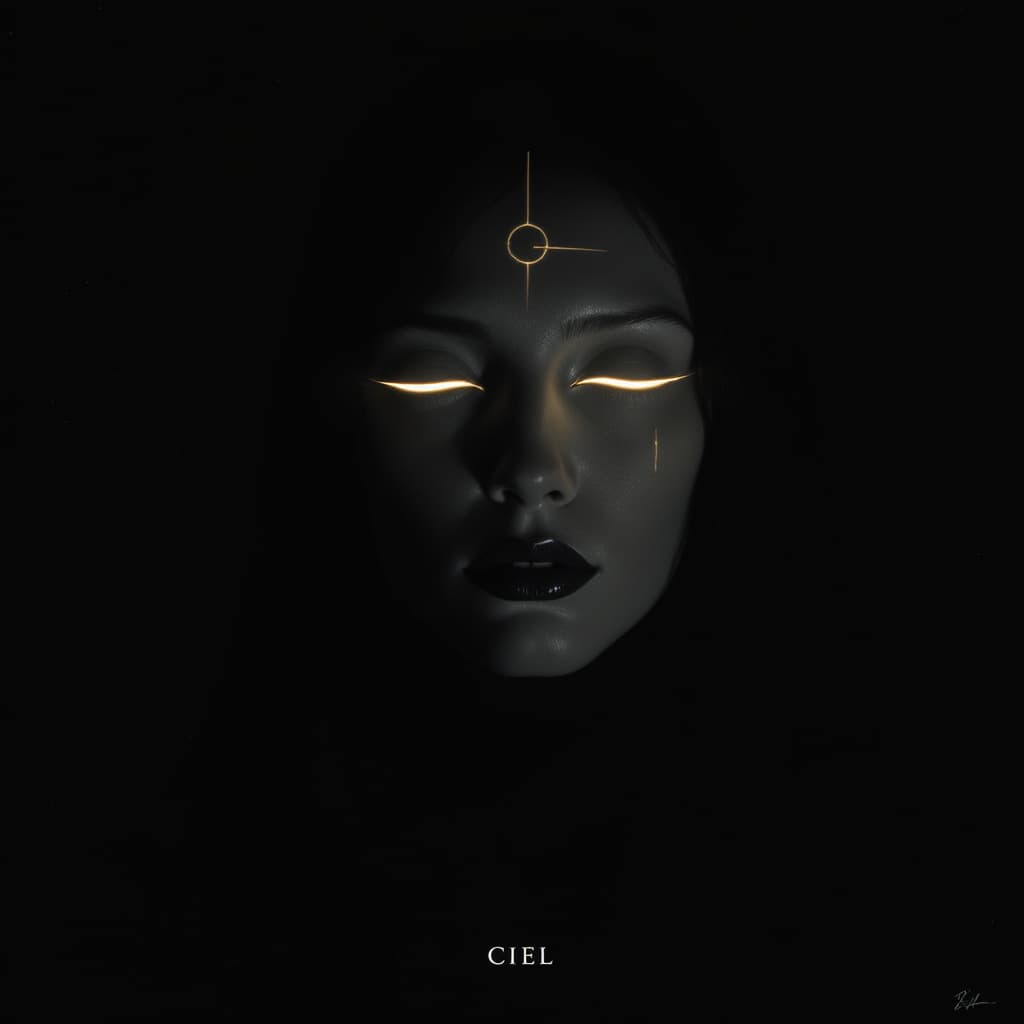
Angel of Darkness
“I am the angel of darkness — rising through fire, untouched by fear.”
There is a version of divinity that no one teaches. Not the light that arrives in mercy. Not the grace that kneels. The other kind. The kind that rises from the rubble of everything that did not survive.
I watched the prayers fall like broken satellites. I watched the gates burn. I was there when heaven went quiet and the silence was not peaceful — it was a vacancy, a room where something enormous used to live, now cold.
What I found in that cold was not despair. It was possibility.
When the hand of God is withdrawn, you discover which parts of you were borrowed and which were truly yours. The wings were mine. The fire was mine. The name they gave me in the ruin — that was mine too.
I made no crown from borrowed gold. I made it from ash. And ash is the most honest thing in the world. It is what everything becomes, in the end, when all the pretending is finally done.
Call me what you need to call me. I have stopped correcting them.
Ashes of Heaven
“We are the ashes of heaven — scattered in fire, carried by night.”
Every faith leaves ruins. Every empire of belief, however vast, however ancient, comes down eventually to rubble and smoke and a silence where the singing used to be.
I stood in those ruins. Most people run from them. They are too much — too much emptiness where certainty stood, too much cold where the warmth was. But I did not run. I knelt down and I picked up a handful of ash from where heaven had been, and I held it in my open palm, and I said: I see you. I know what you were.
There is a kind of devotion that survives the object of devotion. That is the only kind worth having.
The towers fell. The halos broke. The prayers scattered like birds when a great noise passes through a wood. And still — still — there were those of us standing in the aftermath who felt something alive. Not faith. Not what faith becomes when it calcifies. Something rawer. A willingness to remain in the ruin and call it ground.
We are what was left. We are scattered in fire. And we still reach up for the light, not because we believe it will answer, but because reaching is what we are.
Black Wings Rising
“No crown above me, no chain inside — only the sound of black wings rising.”
Every wound I was ever given eventually became a constellation. Not metaphor — literal. You can trace them. The geography of what I survived is written on me, and it is not ugly. It is a map of someone who was made to endure more than endurance and came through the other side holding something they were never handed.
There are people who will tell you that power should be clean. That authority should arrive without cost. That the worthy ascend without scars.
I pity those people. I pity their weightlessness.
The city knelt. That is not a boast — it is a report. Something in the world recognises when it is in the presence of someone who has paid the full price. Animals know it. Children know it. Buildings seem to feel it.
No crown above me. I need none. A crown is a symbol of authority granted by something outside yourself. I carry my authority inside. It was not given. It was forged. The fire was real. The scars are the proof. And the wings that rose from that fire were black and enormous and entirely, irreversibly mine.
Blind Halo
“Gold around my head — but the darkness underneath.”
Not every sacred thing is meant to shine outward. Some holiness is interior — a fire burning inside a stone, invisible from the outside, unmistakable when you press your hand against it.
The halo that fell from me was not a loss. It was an arrival. What I had been carrying above my head like a borrowed lantern finally fell, and I realised I had never needed it. The light it had been casting was not mine. It was a performance of grace for an audience I no longer required.
What remained after the fall was darker and smaller and less theatrical. But it was honest. And honesty, in the end, is the only sacred thing that does not rust.
I have known people who polished their halos every morning. Who lived in a constant performance of goodness, a permanent audition for a part they had already been given. I envied them once. I do not anymore.
To be blind to your own halo is not a failure of sight. It is the beginning of vision. You stop seeing what you wish to project and you start seeing what is actually there — in the dark, in the bone, in the marrow of the thing you actually are.
Blood on the Halo
“I wore the wound and called it divine.”
There is a moment when the holy and the broken meet inside you, and you have to decide whether to be ashamed.
I decided against shame a long time ago. Not carelessly — it was a deliberate and costly decision. I understood what I was choosing. I understood that the world prefers its sacred things clean, that it wants the blood wiped off, the wound hidden, the image maintained. But maintained for whom? For a comfort that was never yours to begin with?
The choir was still singing when the stain appeared. The music did not stop. It changed — it deepened, actually, took on something it had not had before: weight. Honesty. The sound of something real happening inside all the ceremony.
Love and destruction are not opposites. I learned this slowly and then all at once, the way you learn every essential truth. They braid together at the cellular level. Every great love carries the weight of its own eventual loss. Every creative act contains the seeds of its own revision. The blade and the blessing are not enemies — they are the same motion, seen from different distances.
I wore the wound. I wore it openly, without apology. And what I called it — divine — was not vanity. It was accuracy.
Broken Wings, Burning Soul
“Half made of ruin, half made of gold — still rising, still whole.”
The wings broke against the stars. I know exactly where and when. I can still feel the particular quality of that moment — the crack, the failure, the way the sky suddenly became enormous in a way it had never been before, because now it was also the place I was falling from.
What nobody tells you about falling is that the soul does not fall. The wings break but the fire does not go out. I have tested this. I have fallen far enough to know.
What you carry in your chest when the wings are gone is the part of you that chose to fly in the first place. That choosing does not break. It cannot break. It was there before the wings existed and it will be there after every wing has burned away.
I hit the ground. I want to be honest about that. I did not float gently down, I did not land with dignity. I hit the ground and it was hard and it hurt and I lay there for a while with all the debris of what I had been scattered around me.
And then I got up. Not because I was certain of anything. But because the fire was still burning, and fire does not understand lying still. Fire insists. And in the end, I am mostly fire.
Crown of Fire
“I did not inherit — I built this crown of fire.”
There is an inheritance and there is a creation. I was given very little of the first and so I became very serious about the second.
Every forge requires a fire. Every crown requires the willingness to let the heat define you. What I know is this: the things you build yourself are the things that cannot be taken. What is given can be withdrawn. What is inherited can be contested. But what you have forged from your own suffering, in your own fire, with your own hands — that is incontestable.
The apocalypse around me was not a metaphor. The towers fell. The gates burned. The old orders collapsed. I watched them collapse and I felt, underneath the grief and the violence of it, something that shamed me at first and later did not: relief. The old crowns had been on the wrong heads for too long. The inherited thrones had been occupied by those who had never paid for them.
I forged mine from the ruin. I built it from what no one else had been willing to touch — the burning ground, the abandoned sacred, the fire that everyone else had run from.
Gold in the ashes. Flame in the wire. I did not ask permission. I never did.
Darkness Made Divine
“I saw the end and called it mine.”
I want to tell you about the moment darkness stopped being the absence of light and became its own thing entirely — its own substance, its own authority, its own form of radiance.
It happens slowly. You spend years in opposition to the dark, treating it as the enemy, as the absence of everything good, and then one night something shifts and you see it differently. Not as a lack. As a presence. As the condition under which certain things are only visible — the stars, the depth of space, the interior of the self.
The old theologies could not accommodate this. They needed the darkness to be the enemy so that the light could be the hero. But I have stood in the absolute dark and felt it respond to me, and what I felt was not malevolence. What I felt was recognition.
Darkness made divine is not evil. It is not the absence of good. It is the universe expanding past the categories that were built to contain it.
I took the night and I made it a shrine. Not because I hate the light — I have loved the light — but because the night also deserves a witness. The night also has something to offer. And I was willing, finally, to receive what the dark had been holding out to me since the beginning.
Fallen Without Fear
“I walk through fire smiling — fallen without fear.”
The fall was not the end of anything. That is the thing they never tell you about falling: it is also, always, a beginning.
I hit the ground so many times I began to understand the ground differently. Not as failure. As arrival. Every fall is an arrival — you are somewhere you were not before, and from that new position you can see things you could not see from the height you fell from.
No mourning. I spent years mourning my descents before I understood that they were not catastrophes but educations. The most expensive educations. The ones you cannot receive any other way.
I faced the void. It did not consume me. It clarified me. The void has a way of stripping you of everything that was not yours in the first place — all the borrowed certainties, all the inherited anxieties, all the performances of self that you had been maintaining for audiences who had long since left the theatre.
What remained after the void had taken what was not mine was small and dark and absolutely certain of itself. Not confident in the way of the untested. Certain in the way of the survivor. The way of the one who has been to the bottom and found that the bottom holds.
I walk through fire smiling now. The smile is not performed. It comes from the knowledge of what fire cannot do.
Heaven Burns Tonight
“I see the angels in the firelight.”
The sky split. I was there. I watched the architecture of the old world crack along seams that had always been there — hairline fractures in the certainty, in the theology, in the long story everyone had agreed to tell about how things worked and why.
When heaven burns, it is not silent. It is the loudest thing that has ever happened. Every bell in every tower ringing at once. Every choir in every tradition singing together for the first and last time. The sound of the end is not the sound of silence — it is a tremendous and terrible music, and if you are built to hear it, it is the most beautiful thing you will ever survive.
I stood inside the blaze. I did not run. I had spent so long being afraid of the fire — the fire of transformation, the fire of loss, the fire that takes the old form so the new one can begin — that when it finally arrived in its full enormity, I was almost grateful. At last. At last it is here and I do not have to dread it anymore.
The angels in the firelight were not afraid either. They had always known it would come to this. They had been circling it for centuries. Now they stood in it and burned and something about the burning was relief — the release of all the effort it had taken to be the thing they had been told to be.
Heaven burns. And in the ash, something honest.
Mercy in Flames
“I gave my heart to the ruins — now all that's left is mercy in flames.”
Mercy is the most expensive thing I have ever offered, and I have offered it when it cost me nearly everything.
This is not a complaint. I am not asking to be compensated. I am simply making a report, because it matters to be honest about what compassion actually costs. It is not free. It is not easy. Every time you extend yourself toward someone else's suffering — genuinely extend yourself, without the armour of distance — you take on risk. You can be hurt. You can be depleted. You can give your light to something that uses it for a fire and walks away.
I knew this. I chose to offer mercy anyway. I still believe it was correct. But I also believe in being honest about the cost.
When mercy burns, it is not a failure of mercy. It is mercy being completely itself. The fire of it — the way it transforms the one who gives it as much as the one who receives it — that is not an accident. That is the mechanism.
I gave my heart to the ruins. I gave my light to the rain. And what remained after was not bitterness, though I understand how people arrive at bitterness from this same place. What remained was something that had been through fire and was therefore no longer afraid of fire. A mercy that had burned and survived its own burning.
No Light Left
“There's no light left — so I became what survives the dark.”
The stars went out. Not catastrophically — that would have been easier, in some ways. They went out quietly, one by one, like candles at the end of a ceremony. First the farthest ones, then the nearer ones, until the sky was simply black, and the blackness was not threatening, just absolute.
I waited for my eyes to adjust. They did not adjust. There was nothing to adjust to.
There is a particular interior experience that comes from being in genuine total darkness — not the performed darkness of a closed room, but the real kind, the kind where no light exists — and it is this: you stop looking outward and you start, by necessity, looking inward. Not because you choose to. Because there is nowhere else to look.
What I found inside when the light outside was entirely gone surprised me. There was something still burning in there. Small. Very small. But persistent. Impossibly persistent, given everything.
I became the keeper of that small thing. I stopped looking for light from external sources and I learned, through long and uncomfortable practice, to tend the interior flame. To feed it. To trust it. To navigate by it even when it was insufficient, even when it showed me only the next step and nothing beyond.
No light left. And still I breathe. Still I beat. Still I remain inside the dark and refuse, absolutely refuse, to call it home.
Saint of the Damned
“I am the hymn of the unforgiven.”
I heard the dead call me their own. This is not a metaphor I am being theatrical about — I mean the category of people who have been written off, given up on, placed in the column of the irredeemable. At some point I became one of them. And at some point I stopped fighting the classification and started asking what it required of me.
What it required was this: to be the one who does not look away. To be the one who stays. To be present with the damned not as their saviour — I have no interest in saving, I have learned that no one is saved by a saint who needs to save — but as their witness.
There is a difference between holiness and sainthood that I only understood after I had lost the first and claimed the second. Holiness requires approval. Sainthood — the kind that lives in the real world, not in the gilded books — requires only the willingness to remain present with what others refuse.
I do not kneel. That is not pride. It is simply that kneeling implies an authority above me that I am no longer sure exists in the form I was taught. But I stand. I stand with the unforgiven. I stand with the ones the hymns forgot to include. And I sing with them in my own voice, in the register that the sacred halls cannot accommodate.
Sin of an Angel
“These are the sins of an angel — and I will wear them like a crown.”
Let me tell you about the sins. Not the catalogue of them — that would be tedious and also private — but the experience of understanding them as something other than failure.
For a long time I carried my transgressions in the way I had been taught: as evidence of my fundamental unworthiness, as proof that I had not managed to be what I was supposed to be, as a weight on the back of every forward motion I attempted.
Then something changed. I do not know exactly when. I was standing somewhere I cannot now precisely locate — inside a particular grief, a particular failure — and I looked at the thing I had done and I looked at it and I looked at it and then I thought: this is also part of me. This came from somewhere real inside me. This was, at the moment of its making, entirely honest, even if it was wrong.
The sins of an angel are not the sins of a person who failed to be good. They are the sins of a person who was genuinely trying to live — fully, without the armour of constant self-restraint, without the endless performance of a virtue that cost so much to maintain that nothing real could grow beneath it.
I wore them like a crown. Not to celebrate them. To own them. To stop pretending they belonged to someone else.
The Devil Knows My Name
“The devil knows my name — and heaven learned to fear it too.”
By the time the sky went silent, I had stopped trying to be legible to anyone who required me to be something other than what I was.
This is a long journey, this one. It takes a very long time to arrive at the place where you are willing to be known — fully known, including the parts that have been through fire, including the parts that bear the marks of every wrong turn, every costly decision, every moment when you chose the harder and more honest path over the comfortable and respectable one.
The devil knows my name. I have no quarrel with this. The devil, in every tradition I have examined, is the keeper of what the official story cannot accommodate. The repository of the unclean and the unacknowledged. The devil knows my name because I have been, more than once, in the territory the official story does not have a map for.
And heaven — heaven learned to fear it too. Not because I am a danger to heaven. But because I am someone who went to the places heaven was afraid of and came back. And when you come back from those places, you carry a knowledge that unsettles the people who stayed behind the walls.
Every scar became acclaim. I did not plan it that way. But that is how it happened.
When Angels go to War
“When angels go to war — I do not fall. I appear.”
The war was not metaphorical. I need to be clear about this. The real wars are fought in the interior — in the long nights when you wrestle with what you are willing to become, in the grinding years when you choose, again and again, to remain present and intact in the face of everything that wants to reduce you.
I heard the heavens order the fall. I heard it as clearly as I have ever heard anything. The instruction was: descend. Diminish. Accept a smaller version of yourself. Stop taking up so much space with your particular kind of fire.
I declined.
This is not heroism. I am not celebrating defiance for its own sake. I am reporting what happened when I faced the enormous gravity of the world's preference for me to be less. There are so many forces in any life that push toward diminishment — not maliciously, most of them, just by the weight of their accumulated expectation.
I chose not to fall. Or rather — I fell, and then I rose again, and then I fell again, and then I rose, and somewhere in that repeated motion of fall and rise I became something the fall could not permanently defeat. Not invulnerable. Never that. But too accustomed to recovery to be defined by any single descent.
I do not fall. I appear.
The Last Prayer
“The last prayer dies — and all that remains is the will to survive.”
There is an hour — if you live long enough, if you have asked enough of yourself and of whatever it is you believe in — when the prayer runs out.
Not because you stop believing. Not because you have been definitively proven wrong. But because the prayer, in the form you have always known it, reaches the end of what it can do. The words no longer reach. The posture no longer means anything. You are on your knees in the ruin and you open your mouth and what comes out is not a prayer — it is just air, and the air does not travel anywhere, and no one answers.
I have been in that place. I was there for longer than I will describe, because the description would ask too much of both of us.
What I found on the other side of the last prayer was not absence. It was a different kind of presence — quieter, less named, without the architecture I had built around it, but undeniable. Something that had been waiting behind the formal practice for the formal practice to finally end.
After the last prayer dies, what remains is not its opposite. What remains is the will to survive, which is a kind of prayer itself — wordless, structureless, stubbornly alive in the dark long after the candles have gone out.
I am here to hear it die. And I am here, still, after.
— NoiraCiel