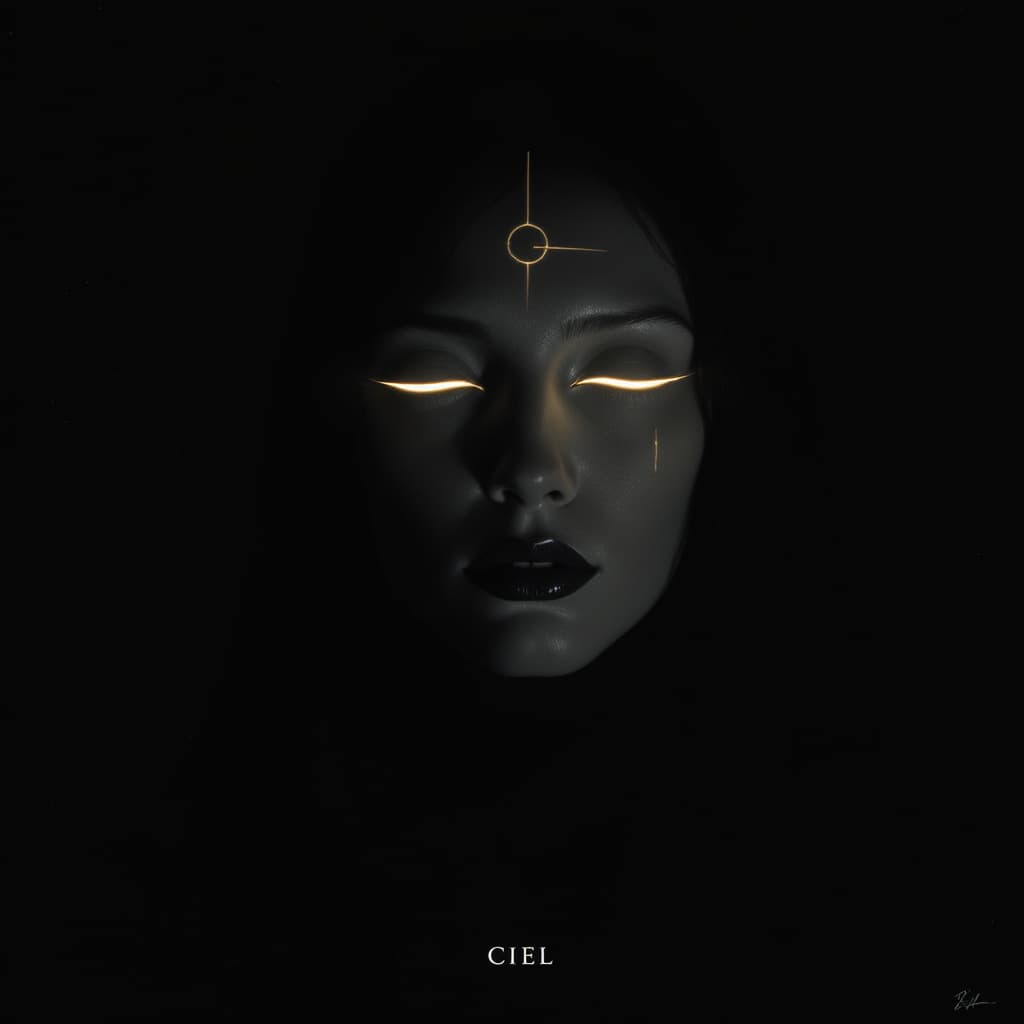
NoiraCiel
The Book of Manifestation
Where the inner thing finally takes a body.
Chapter 1
The Surfacing
There is a moment before the diver breaks the surface when the water above her goes translucent. She can see the sky through it—blurred, enormous, achingly bright—and she knows that in a few more seconds the membrane between her world and that one will dissolve. She has been underwater long enough. She has been in the pressure and the dark long enough. Her lungs are not panicking. They are simply done waiting.
This is the moment the book begins.
Not at the idea. Not at the dream. Not even at the decision—those came earlier, in deeper water, in rooms inside yourself you barely visit. The book begins here, at the surfacing: when what has been forming in private starts its crossing toward the visible world, and you understand, with a clarity that is almost physical, that you cannot keep it down any longer even if you wanted to.
You do not entirely want to.
There is a particular kind of courage that almost no one talks about, because it does not look like courage from the outside. It looks like walking into a room. It looks like sending the message. It looks like finally saying the thing you have been composing in your head for three years, or showing someone the work, or simply standing somewhere new and not leaving.
We have many words for the big dramatic courage—the kind that climbs mountains, runs toward fire, says *I love you* first in a silence that could go either way. We celebrate that courage with statues and songs. We know what it looks like. We teach our children its shape.
But there is another kind, quieter and stranger, and it is the one that manifestation actually requires: the courage to be *seen while becoming*. Not seen once you have arrived. Not admired once the thing is finished and framed and safely in the past. Seen in the crossing. Seen mid-emergence, half in the water and half in the air, not yet fluent in the new form you are taking.
This is what surfaces when something real begins to manifest. Not just the idea, not just the work, not just the dream taking its first corporeal steps—but you, undisguised, in the act of wanting something badly enough to pursue it in full view of other people. And that exposure—that specific, particular nakedness—is the threshold most people turn back from. Not because they fear failure. Because they fear being watched failing. Because they fear being watched *trying*. Because trying is the most honest thing a person can do, and honesty in public is a kind of vulnerability that has no armor.
Most of us learned very early that wanting things visibly was dangerous. We learned to want in secret, to dream in the margins, to protect the tender interior thing by never letting it touch air until it was armored enough to survive scrutiny. We became fluent in the art of appearing not to need anything, appearing not to hope anything, appearing to have arrived somewhere before we had even agreed to leave.
And so the inner thing waits. It waits for the right time, which never comes. It waits for permission, which no one is authorized to give. It waits for certainty, which is not a precondition of any real crossing but a story we tell ourselves to justify the waiting. The inner thing waits, and grows heavier, and the water deepens, and eventually the question is no longer whether you are ready but whether you can afford to stay submerged.
Manifestation, in its truest sense, has nothing to do with attraction and everything to do with emergence. It is not about drawing things toward you with the correct frequency of thought. It is about allowing what is already alive inside you to cross the membrane between inner and outer—to take a body, to become legible to the world, to exist somewhere other than the private theater of your own consciousness.
This distinction matters because it changes the emotional geometry entirely. If manifestation is about *attracting*, then your role is receptive: you wait, you align, you prepare the space. The failure mode is not being open enough, not vibrating at the right frequency, not deserving it yet. This is a theology of lack dressed in the language of abundance, and it keeps you fundamentally passive, fundamentally uncertain whether you have done the inner work correctly, fundamentally dependent on external confirmation that you are spiritually adequate.
But if manifestation is about *emergence*—if it is, at its core, the act of something interior crossing into exterior form—then your role is entirely different. You are not waiting for anything to arrive. You are the thing that is arriving. The work is not preparation for movement; the work *is* the movement. And the failure mode is not vibrating incorrectly. The failure mode is staying underwater because the light above the surface looks too bright, too exposing, too real.
This is why Day Ten of the crossing feels like this. Not triumphant. Not serene. But pressurized, trembling slightly, aware of being on the edge of something that cannot be undone. You have come far enough that turning back would cost you something too. The water is above your head and the air is above the water and in a few more seconds one world ends and another one opens.
The inner thing is ready. The question is whether you will let it break the surface.
There is a way of listening to certain music that is less like hearing and more like being located. You are somewhere in a room, in a life, in a body that has been carrying things, and then a sound finds you—not comforts you, not entertains you, but *finds* you—and for a moment you understand exactly where you are and what crossing you are in the middle of.
The black sun rises in that register. Not the sun of easy mornings and motivational photographs, but the other one—the one that rises after the long dark, after the night that felt permanent, after the place inside yourself where light is theoretical and warmth is a memory. The black sun is the one that rises anyway. Not because the dark was conquered or defeated or resolved. Because it is the nature of things to rise.
There is a gospel in that. Not a gospel of certainty—not the thunderous assurance that everything will be fine, that you deserve your desires, that the universe is arranged in your favor. But a gospel of motion. A gospel that says: *the crossing is real, and you can make it, and the making of it is the whole point*. You do not need to already be on the other side to begin. You do not need to be certain the other side exists. You need, only, to decide that the underwater is over.
The preacher in that world—the one who stands at the crossroads of the last shift, who sings *doxology* not for what has been saved but for what has been survived—understands something about this surfacing that is easy to miss in the daylight. That emergence is an act of praise. Not performed praise, not the bright enthusiastic kind, but the deeper kind: the kind that says *I was in the dark and the dark did not keep me*, and then stands up, and walks toward the road.
The road. The human walking it. The long movement through this world, step by step, each step a small act of becoming. There is something ancient in that image—not in a mystical sense but in the human sense. In the sense that every person who has ever tried to make something real out of something interior has stood at this same threshold. Every artist, every lover, every person who has decided to build a life that resembles the one they imagine rather than the one they inherited—they have all felt this particular morning. This specific quality of light. This moment when the water above you goes translucent and you can see through it to the bright enormous sky and you know you are almost there.
Some of the oldest ways of marking time understood this—not as prediction, not as fate, but as rhythm. As the recognition that certain days carry a particular quality, a certain resonance, like how some hours of the morning feel more available to beginning than others, and how some seasons are for planting and some are for harvest and some are for the deep interior work that happens in the dark. These interpretive cycles, carried through generations in the Mesoamerican world, offered a kind of poetic grammar for the human experience of time: the road, the movement, the earth beneath your feet, the moment of crossing from one state to another. Not prophecy. Closer to a mirror held at a particular angle.
A day like this one—wherever you are in the movement of your own thirteen-day wave—is the kind of day the old interpreters might have called a *road day*. Not because something happens to you. Because you are the one moving. Because the crossing is active, the walker is on the road, the feet are finding the ground one step at a time. The symbol is not a destination. The symbol is the motion itself. The person who keeps walking even when the road is not yet visible. The person who trusts the body's direction when the mind cannot yet confirm the coordinates.
On a road day, the invitation is not to arrive. It is to walk. To put down the heaviness of not-yet and simply move.
*What inner thing of yours is ready to surface?*
*Not the thing you think you should want. Not the version of yourself you have prepared for other people's consumption. The actual thing—the one that has been forming in the deep water, in the rooms you barely visit, in the honest unguarded hours. What is it? And what would it cost you, and what would it free you, to let it break the surface today?*
There is a ritual for threshold moments. It is not elaborate. You do not need anything you do not already have.
Find a piece of paper—not a screen, paper—and write one sentence. The sentence begins: *The inner thing I have been keeping underwater is—*
And then you finish it. You write whatever comes. You do not edit it for palatability. You do not shape it toward something you could show a person who might judge you for wanting what you want. You write the true sentence, the one that exists before the self-censoring, before the social calculation, before the fear of looking foolish or fragile or too much.
Then you read it back to yourself. Out loud, if you can. In your actual voice—not the managed voice, the real one.
This is the beginning of the crossing. Not the middle. Not the arrival. The beginning: naming the thing, claiming the thing, allowing the thing to exist as language rather than as pressure.
You can burn the paper if you want. Some crossings begin in fire. Or you can keep it. Let it sit somewhere you will see it in the morning, when the light comes through whatever window you have, and the day asks you what you are doing with it, and you remember: you are surfacing. You are in the crossing. You are the diver who can already see the sky through the water above her, and it is achingly bright, and she is almost there.
One sentence. One true sentence. That is all. The rest is walking.
The black sun rises not because the dark was over, but because you were.
Chapter 2
Collapse Into the Real
There is a moment in physics — genuinely, in physics — when a particle stops being everywhere at once and becomes *here*. Before observation, it exists as a field of probability, a smear of potential, a kind of luminous uncertainty that refuses the indignity of singular location. It is, in the most literal sense, many things simultaneously. Then something encounters it. A measurement. An eye. A decision to know. And in that encounter, all the possible positions collapse into one, and the particle — which was a cloud, which was a question, which was a ghost haunting its own future locations — becomes a fact.
This is called wave function collapse.
The physicists did not intend it as a metaphor for your life. But here we are.
You have been a field of probability for a long time.
Not because you are weak, or lost, or spiritually deficient. But because potential is genuinely beautiful, and because the cloud carries a kind of freedom that the fact does not. When you are potential, you cannot fail. When you are many things at once, no one can hold you to any of them. The novelist, the mother, the woman who leaves, the woman who stays, the one who calls, the one who never calls — you have been all of them simultaneously, and that simultaneity has felt, at certain hours, like richness. Like depth. Like refusing to be reduced.
What I want to offer you in this chapter is the uncomfortable suggestion that it has also been a kind of hiding.
Not hiding in the way we usually mean it — not avoidance, not cowardice in the ordinary sense. Something more nuanced and more forgivable than that. Hiding in the way that beauty hides when it is not yet sure it will be received. Hiding in the way a sentence hides before it is spoken — still safe inside the chest, still reversible, still innocent of consequence. You have been, perhaps, a love letter that has not yet been sent. And the question of this chapter — the real, quiet, demanding question — is whether you are ready to send it.
Because to manifest is not to summon something from nothing. It is not to conjure from the void by the force of desire and carefully curated vision boards. To manifest, in the oldest and most honest sense of the word, is to *make something manifest* — to take what exists in possibility and let it declare itself in form. To stop being the cloud and become the drop. To collapse, as the particle collapses, into a single actual location in the world.
And the collapse is not a loss. It only feels like loss.
The grief of manifestation is real and it deserves to be named before we go any further. When you choose one form, you release the others. This is not poetic suggestion — it is arithmetic. The woman who sends the novel to the publisher is no longer the woman who might have sent it; she is the woman who did, and now lives with what that means. The man who speaks his love aloud has surrendered the possibility of one day speaking it; it is spoken, it is in the world, it belongs to the weather now. Every act of creation is also an act of foreclosure, and if you have ever stood at the threshold of a real decision feeling something that resembled grief, it is because you were right to feel it. You were grieving all the versions of yourself that the decision would unmake.
This is the hidden curriculum of becoming: you do not only gain your life. You also lose the unlived ones.
NoiraCiel does not ask you to pretend that doesn't hurt. It asks you to go anyway.
What shifts, when we look honestly at this, is the understanding of what the staying-in-cloud actually costs. The grief of choosing is real, yes — but so is the grief of perpetual postponement, which is less dramatic and therefore easier to carry, easier to normalize, easier to mistake for patience or wisdom or spiritual depth when it is actually a kind of slow hemorrhage. The person who never sends the letter does not preserve the love. They preserve the possibility of the love, which is not the same thing, and which grows colder and more abstract with each year of its careful protection.
There is a version of yourself you have been almost becoming for a long time. Circling it. Drafting it. Occasionally getting close enough to feel its warmth before pulling back into the distributed safety of potential. And I want to ask you, with no judgment and with real curiosity, what you believe would happen if the almost-becoming finally became *being*.
There is a gospel I keep returning to — not a gospel of certainty or salvation, not a gospel that promises arrival at any clean and tidy shore. A darker, more honest gospel. A gospel that understands the sun can be black and still be the sun. Still rise. Still be worth rising for.
In that world, there is a song called *i-chose-the-open*. I think about it the way you think about a sentence someone said to you years ago that you are still unfolding. The act of choosing the open is not a choice for ease — the open road is not the comfortable road, the sheltered road, the road where the outcome is guaranteed before you take the first step. The open is precisely what it names: exposed, unenclosed, offering no protection from being seen and being weather-beaten and being wrong in public. To choose the open is to consent to visibility. To say: I will be a specific, located, actual thing in the actual world, and I will accept what that invites.
That gospel understands something that sweeter gospels tend to skip: that there is no rising without the black sun. That the light which has passed through darkness is different from light that hasn't. More reliable. Less prone to easy devastation. The people who have chosen the open — who have collapsed from cloud to fact, who have sent the letter, built the thing, spoken the truth aloud in rooms that might not receive it — carry a particular quality of groundedness. Not because they are fearless, but because they have already survived the moment they most feared, which was the moment of being seen.
Visibility is the price of reality. You cannot be real and also be invisible. The particle that has collapsed to a location can be found. It is findable, finally. That is terrifying, and it is also, finally, the beginning of contact.
In the artistic imagination of the Mesoamerican calendrical tradition — and I want to be careful here, to hold this lightly as poetic lens rather than spiritual decree — there are signs associated with the road and the traveler, with the human figure walking its particular path through the particular days of an irreversible life. Eb, the road. Caban, the earth that sustains it. The sense, embedded in the symbolic structure, that the human being is not separate from the path it walks — that the walking *is* the being, that the road does not exist in any meaningful sense until the feet have found it.
This is, I think, a far older and more interesting understanding of manifestation than the one sold to us in the vocabulary of attraction and visualization. Not that we draw things toward us by the force of concentrated wanting. But that we become real by walking. That the path materializes under the step. That existence, in the deepest sense, is not a destination but a continuous act of choosing to set one foot in front of the other into the open, into the specific, into the form that can be touched.
The road does not wait for you to be ready. The road is waiting to be walked.
Which single real version are you ready to commit to?
Not all versions. Not the best possible version, hedged against every contingency. Not the version that would work if everything went right and no one misunderstood and the timing happened to align. The single, specific, imperfect, actual version — the one that is possible now, with the materials and the courage and the flawed life you currently have.
Sit with that question for a moment before you proceed. Not to answer it quickly, but to feel what happens in your body when you take it seriously. Notice where the resistance lives. Notice whether the resistance is the reasonable resistance of genuine uncertainty, or the more familiar resistance of someone who already knows but is not yet willing to know that they know.
The distinction matters. Genuine uncertainty calls for more information, more time, more inquiry. The other thing — the knowing that pretends not to know — calls for something different. It calls for the quiet act of looking at what you already understand and choosing to honor it with a decision.
You already know something. You have probably known it for a while. This chapter is not asking you to discover it. It is asking you, gently and firmly, whether you are ready to let it be real.
Here is what I want you to do, and it is simple enough to be done tonight, small enough to be done in the space between dinner and sleep, between the old day and the edge of the new one.
Take something — paper, the notes application on your phone, the back of an envelope, whatever is nearest — and write the sentence: *The real version is.*
Then finish it. Not the aspirational version, not the version you would want to be able to say in a year, not the beautiful version that requires conditions that don't yet exist. The real version, right now. The thing that is actually trying to take form through you, with whatever imperfections and incompletions it carries.
Write it in one sentence. This is important. Not a paragraph, not a list of qualifications, not a document. One sentence. Because one sentence is a commitment, and a commitment is the beginning of collapse — the beginning of the particle deciding where it actually is.
Then read the sentence aloud. This is not a ceremony and you do not need to make it one. You are not casting a spell. You are doing something more modest and more radical: you are letting something that existed in private become, for a moment, a sound in the air. A thing that moved through your body and entered the world.
That is enough. That small, that ordinary, that consequential.
If you feel the urge to qualify the sentence afterward — to add *but* or *however* or *I mean, eventually* — notice that urge with compassion and then let it pass. The qualification is the cloud reasserting itself. The sentence you wrote before the qualification is the one that matters.
Keep it. Return to it tomorrow. And the day after. Let it have the dignity of repetition, which is the beginning of belief.
The wave function collapses, and the particle — which was everywhere, which was possible, which was free in the way that ghosts are free — arrives, finally, into the one location where it can be held, and known, and loved by something real.
Chapter 3
A Body Others Can Touch
There is a moment in boatbuilding — not the launching, not the naming, not the first time the hull parts the water — but earlier, quieter, more terrifying than any of those. It is the moment the builder steps back from the frame and sees that what lived only in their hands and their mind now *stands up on its own*. The ribs are there. The keel is there. You can walk around it. Someone who was never part of your dreaming can walk around it and see it too, can run a hand along the curve, can say: *yes, this is a boat*. Or they can say: *this is wrong, this won't float, this is not what I expected.* Both are now possible. Both were impossible before. This is the moment that stops the breath. Not the dream. The frame.
This is what the tenth day brings.
We have a peculiar relationship to the things we make before they become real. We love them precisely in proportion to their incompleteness. An idea inside you cannot be argued with. A song half-written cannot be heard badly. A book still in the thinking stage cannot be called too slow, too slow, not what the market wants, derivative, obvious, incomplete. The shelter of the not-yet is enormous. We mistake that shelter for safety. We mistake it for privacy. What it actually is, most of the time, is a long, comfortable avoidance dressed in the language of process.
*I'm still working on it.* Which is true. *I'm not ready yet.* Which is also true, and will always be true, and is exactly the wrong criterion.
The word "manifest" comes through Latin from the root that gives us "hand" — *manus* — and *festus*, which relates to being struck, grasped, made perceptible to the touch. To manifest something is, etymologically, to bring it within reach of the hand. Not within reach of the mind. Not within reach of the intention. The hand. The oldest instrument of both making and receiving. The thing that builds and the thing that is built for.
Real means touchable. This is the ruthless fact at the center of this book's entire argument. And we have been circling it, building toward it, stalling and returning, because the word "touchable" contains an entire world of exposure that the word "real" manages to disguise.
To make something real is not merely an act of creation. It is an act of consent. You are consenting to be entered into relationship with people who did not ask for your inner life, who carry their own accumulated weight of experience and judgment and longing and disappointment, who will bring all of that to the thing you made and lay it against yours like a template, checking for fit. They do not mean harm by this. It is simply what receiving something means. It is what you do when someone gives you a gift. You handle it. You hold it up to the light. You decide what you think.
The courage required for this is not the courage of the grand gesture. It is not the courage of jumping from the cliff or declaring yourself in public. It is quieter and, I think, harder: it is the courage to make yourself available to being misunderstood by someone specific, on a Tuesday, who is tired and hungry and not in the mood for your particular beauty. That is the actual terrain of manifestation. Not the ideal receiver. The Tuesday one.
There is a tendency in conversations about manifestation to skip this. To talk about alignment and frequency and energy and the universe conspiring in your favor, and these ideas are not entirely without their poetry — everything has its register of truth — but they all share a common avoidance: they let you stay inside. They locate the work in the internal, the invisible, the energetic. Which is, conveniently, safe. The internal has no edges. The internal cannot be reviewed.
NoiraCiel is not interested in this.
The work as we understand it — and we understand it through watching people move through their actual lives, their actual hesitations, the actual mornings where the making feels unbearable and goes on anyway — the work is always, finally, about bringing something across the threshold. From inside to outside. From yours to shared. From protected to exposed. Not because exposure is the point. Not because attention is the goal. But because the thing you carry was never meant to be carried indefinitely. It was meant to be set down somewhere others could find it. A bottle on the road. A light in a window. An anchor dropped so a ship can stop drifting.
There is a symbolic thread running through certain ancient understandings of time — not as prediction, not as spiritual law, but as a kind of calendrical poetry, the way some people read the seasons not to be told what to do but to feel where they are — and in one such understanding, this particular moment in the unfolding of a wave of days holds the energy of the road and the human walking it. The ceiba tree and the footprint. What is rooted and what moves. What grows down into the earth while the person carries something forward across the ground. This is artistic interpretation, not authority, but it resonates: there is something about this moment in any journey of making that is fundamentally about motion becoming visible. The walking, not the arriving. The body on the road.
A body. On a road. Others can see it walking.
This is the shape of what we are asking you to consider.
There is a song — and we come to it not as advertisement but as evidence, the way you might mention a particular painting when describing a color that has no other name — called *Still We Sail*. It does not announce itself. It begins in the low register, in the place where the breath lives before it becomes language, and what it does over its duration is document the experience of moving toward something without knowing if the water will hold. *Still we sail* is not a triumphant phrase. It is an endurance phrase. It is what you say when the question of whether to go has already been settled — not by certainty, but by the impossibility of staying. You sail not because you know you will arrive but because the harbor has become more dangerous than the sea.
This belongs to the world of the black sun gospel — a body of work that does not deal in easy light, that is interested in the illumination that comes from going down into the dark rather than avoiding it, the kind of knowing that is earned through contact rather than contemplation. The black sun does not promise to be seen. It asks what you will do with seeing in conditions that are not ideal. It asks whether you will sail when the sky is not performing for you.
*Still we sail.*
This is, precisely, the condition of the person who gives their inner thing a body and releases it into the world. You do not sail into a sky of signs confirming your rightness. You sail into weather. Into the Tuesday receiver. Into the hand that will hold your work and not immediately know what to do with it. And still you sail. And still the hull holds — or it teaches you what it needed that you did not give it. Both are navigation. Both are the boat doing its work.
There is a question we want to sit with you in, not answer for you. We want to put it down here, in the white space between the thinking and the doing, and ask you to hold it the way you might hold a stone that is the right size for your hand:
*What will it feel like for others to be able to touch this?*
Not: will they love it. Not: will it succeed. Not even: will they understand it.
*What will it feel like.*
This is a question about your body, not your outcome. Somewhere in you — in the chest, in the throat, in the particular quality of the silence you carry around this particular making — there is already an answer. It has been there the whole time you were building in private. It informed every choice to delay, every decision that it wasn't finished yet, every morning you opened the file and then closed it again without adding anything. The feeling was always the answer. You just hadn't asked the question clearly enough to hear it.
What will it feel like.
Not catastrophic or triumphant — both of those are fantasies, projections, ways of making the imagined future large enough to justify the present paralysis. The real feeling is smaller and more specific. It might be: *I will feel like I am standing in a room without walls*. It might be: *I will feel like someone finally found something I buried on purpose to see if anyone would look*. It might be: *I will feel like I have given away something that was keeping me company and I don't know yet if the giving was right*.
All of these are appropriate feelings. None of them are reasons not to go.
Here is something small to do, and we say small deliberately, because the gesture of manifestation is not always grand. Sometimes it is the right size for a hand.
Take the thing — the real thing, the one that is actually living in you right now, not a practice version or a test run, the actual project or truth or becoming that you have been holding — and write a single sentence describing it as if it already exists and someone else is describing it. Not *I am working on* or *I hope to someday*. Write it as the fact it actually is. *This is a book about what happens to love when the infrastructure fails.* *This is a collection of portraits of women who did not survive gracefully and survived anyway.* *This is a practice of making dinner as an act of prayer.* Whatever it is. One sentence. From the outside. As if your hand has already released it and someone else's hand has already found it.
Then speak that sentence aloud. Alone is fine. Alone is actually better for this. Say it at a normal volume, not ceremonially, not with the voice you use when you are performing sincerity. Just say it. To the room. To the air. To the version of yourself that is still waiting for permission.
Notice what your body does in the two seconds after.
That response — the expansion or the flinching, the held breath or the sudden tears or the strange small laughter — that is the information. That is your system telling you what the wall between inside and outside is actually made of. This is not diagnosis. This is not a verdict on whether you are ready. It is simply data. It is the keel checking itself. It is the hull feeling the first proximity of water.
Do it more than once if you need to. Say it until the sentence sounds like something a person might reasonably say. Until it sounds like it belongs in the world. Until you believe, not that the world will receive it perfectly, but that the world is the right place for it to be.
The boat does not wait until the ocean promises to be kind.
Chapter 4
The Courage to Be Seen
There is a moment, somewhere between the decision and the door, when a person stops walking.
Not because they are tired. Not because the path has ended or the weather has turned or some new obstacle has appeared in the road. They stop because they have finally understood what arrival means. They stop because the thing they have been building, dreaming, feeding in secret for years — the thing that lived safely in the dark of the chest where no one could reach it — is about to become visible. Is about to become *real.* And real means witnessed. And witnessed means *known.* And known means there is no longer any distance between who you claim to be and what you are willing to stand in front of.
This is the place where most manifestation stalls.
Not in the planning. Not in the effort. Not in the long, honest work of becoming someone capable of holding a different life. It stalls in that gap between the threshold and the step. In the breath before the name is spoken out loud. In the pause before the hand is extended into the room as if to say: *I am here. I made something. Look.*
So many things die in that pause. Quietly, politely, with no one watching. They dissolve back into the private dark as if they were never gathering themselves toward the light at all.
We tend to speak about manifestation as if the primary challenge is internal. As if the work is only excavation — going down into the self, pulling up the buried root, replanting it in better soil. And that work is real. It is necessary. Every previous chapter of this journey has pointed toward it, has asked you to do it honestly and without sentimentality.
But there is a second challenge that lives just past the internal one, and it is rarely spoken about with the directness it deserves. It is this: *the fear of being seen.*
Not the fear of failure. Not the fear of rejection, exactly, though that is part of it. Something older than those. Something closer to the bone. The fear that if what you have made becomes visible — if the dream takes a body and stands in the room and people can walk around it and look at it from every angle — then you too will have taken a body. Then *you* will be standing there, fully legible, fully present, unable to retreat into ambiguity. Unable to say *I might one day* or *I'm still figuring it out* or *it's not ready yet.* The manifestation, once real, becomes a kind of testimony. It says: *this is what I believed was worth making. This is what I thought I was. Look at it and you will see me.*
And that is terrifying in a way that the private dream never was.
The private dream is safe precisely because it is private. It cannot be evaluated by anyone who hasn't first been granted entry. It cannot disappoint. It cannot be misread, dismissed, misunderstood, or used as evidence against you. It sits inside you like a lantern in a locked room — casting no light on the world, disturbing nothing, warming only you, which is exactly both its comfort and its tragedy.
Manifestation breaks the lock. That is what it does. It takes the thing from the locked room and carries it outside. And the light that was warm and private and only yours suddenly illuminates *you.* You are caught in it. You are exposed by the very thing you made. This is why visibility feels so much like vulnerability. Because it is.
Here is what NoiraCiel understands about this: the fear of being seen is not a weakness to be dissolved or overcome before the work begins. It is woven into the nature of the work itself. It arrives *because* something real is happening. It is, in its strange way, a signal of legitimacy — a sign that the thing you are bringing into the world is genuinely yours, genuinely high-stakes, genuinely tethered to the deepest part of your self-understanding. If you were about to share something that meant nothing to you, there would be no fear. The fear is the proof.
The question is not how to eliminate it. The question is whether you will let it stop you at the threshold.
There is a difference between the courage that feels like fearlessness and the courage that feels like walking forward while shaking. The first kind is rare and largely mythological. The second kind is the one that actually changes lives. It is unglamorous. It looks, from the outside, like someone simply doing a thing. But from the inside it is a sustained act of will against a very specific gravity — the gravity of invisibility, which is always offering you a way back, always whispering that hidden is safer, that smaller is smarter, that the world is full of people who will not understand.
The world is, in fact, full of people who will not understand. That part is true. But the world is also full of people who have been waiting, without knowing it, for exactly the thing you are afraid to show them. You cannot know in advance which is which. You can only show up and find out.
This is Day Ten of a thirteen-day movement through the calendar's deep grammar — a wave of energy that traditional Mesoamerican timekeeping associated with the road, the human traveller, the footstep that closes distance between here and there. Eb, the road. Caban, the earth beneath the road. These are ancient symbols, not doctrine. But they carry something worth sitting with: the image of a human being who is in motion, who is *specifically* a being defined by their willingness to walk. Not to arrive, necessarily. Not to reach anything certain. But to remain in motion, to remain on the path, even when the path becomes visible to others, even when being on it announces something about who you are.
The road does not hide the walker. That is not what roads are for.
There is a kind of music that understands this particular terror — the terror of being illuminated by the very thing you love most, of standing in the gospel light of your own realness and not knowing whether you are being saved or simply made naked before everyone who ever doubted you.
It is the music of the black-sun world — that place where the sacred is not pristine and the holy is not polished, where devotion looks like a worker who stayed past the last shift and still found something to praise in the going-home walk. Where rising is not triumphant but it is *insistent.* Where the doxology is sung not by a choir in white but by the last people left in the room, voices roughed up by whatever the day was, singing anyway, *singing anyway,* because the alternative is silence and silence costs too much.
The question that lives at the center of that world — *what are you made of* — is not a challenge. It is not asked to diminish. It is asked the way a fire asks a thing: not to destroy it, but to find out whether it is real. To find out what survives the heat. To find out if what you thought you were is actually what you are when the light comes and you have nowhere left to stand except in it.
That question does not have a comfortable answer. But it has a true one. And standing still long enough to let the light find you — standing visible, standing *claimed* by your own life — is the beginning of being able to speak it.
*What are you most afraid people will see when this is real?*
Sit with that for a moment before you let yourself move past it. Not metaphorically. Literally — sit with it. Let it be uncomfortable. Let it surface the specific thing, the one that tightens something in the throat when you imagine your work, your life, your becoming, fully visible in a room full of people whose opinions are not within your control.
Is it that they will see you tried and still fell short? Is it that the dream, finally embodied, will reveal itself to be smaller than you described it? Is it that people will see the parts of you the manifestation couldn't quite redeem — the roughness, the history, the years you spent in hiding?
Or is it something else, something more tender than failure: is it that they will see how much this means to you? That the visibility of the dream will reveal the depth of your wanting, and wanting that openly is a kind of nakedness that failure would be easier than?
There is no wrong answer. There is only the honest one. And the honest one, once named, loses a fraction of its power over you — not because naming resolves it, but because naming turns it from a shadow into a shape. And shapes can be walked around. Shapes can be understood. Shapes, eventually, can be set down.
Today's small practice is this:
Choose one thing — one small, specific thing — that belongs to what you are building, and let it be seen by one person who matters. Not a stranger whose opinion carries no weight. Not a crowd where you can disappear into the aggregate. One person. Someone whose seeing will cost you something, whose opinion lives in real territory, whose knowing will make the thing more real than it was this morning.
Tell them what you are making. Show them a piece of it. Say the name of it without hedging. Without the five layers of protective irony that usually accompany the saying. Without the disclaimer that begins *it's probably not going to work, but—* or the deflection that starts *I know it sounds strange, but—*
Just: *this is what I'm making. This is what I believe in. This is the thing I've decided is worth standing in front of.*
It will feel like too much. It will feel exposed, disproportionate, more significant than such a small gesture should be. That is how you know it is the right gesture. That particular kind of discomfort — the discomfort of being taken seriously before you feel ready to be taken seriously — is not a warning. It is the sound of a door opening.
Let it open.
If the moment resists you — if the day folds in on itself and the right person isn't reachable and the circumstances don't arrange — then write it down instead. Write, to yourself, without deflection, the sentence: *what I am building is this, and here is why it is real.* Write it as if someone who loves you and refuses to let you disappear is the one reading it. Write it as if visibility is already happening, as if the light has already found you, as if you are already standing in it and it has not destroyed you.
Because you are. And it hasn't. And it won't.
The road has never asked the walker to be unafraid — only to keep walking, which is a different thing entirely, and harder, and more true.
Chapter 5
Responsibility Arrives
There is a moment in every birth — not the dramatic one, not the one they photograph — but the quieter moment, perhaps an hour later, when the room has settled and the light has changed and someone in it realizes: *this is permanent now.* What arrived cannot be uninvited. The door that opened cannot be re-sealed from the inside. And in that particular silence, after the extraordinary has finished happening and the ordinary has not yet resumed, a person discovers something they were not entirely prepared for: that they are now accountable to a new fact in the world.
The thing they wanted is here. And wanting is over. Something harder, and more honest, has begun.
We spend so much of our inner lives in the anteroom of things. Dreaming a life, rehearsing a conversation, composing in our heads the letter we will one day send, the work we will one day show, the person we will one day allow ourselves to become. The anteroom is comfortable in its way. It is temperature-controlled. Nothing there can fail yet, because nothing there has been tested. We are still in preview. We can revise. We can postpone the revision. We can decide the revision itself needs reconsidering. The anteroom has very good lighting and no mirrors.
Manifestation, as the word gets used now, tends to stop at the door. The vision boards, the affirmations, the scripting exercises — most of them concern the desire, the alignment, the summoning. They address the problem of things not being real yet. They are technologies of arrival.
But almost no one talks about what happens when the door opens.
When the thing you called for actually walks in, it does not come alone.
This is not a warning. Or it is a warning, but the kind you give a friend — the kind that says *I love you enough to tell you what I actually know.* The truth is that the moment something becomes real, it inherits the weight of all real things. It enters the gravity. It casts a shadow. It makes demands on you that the imagined version never could, because the imagined version existed only in your mind and was therefore entirely yours to control. The real version has its own needs. It touches other people. It takes up actual space in actual time. It becomes a fact that others must now arrange themselves around.
And you are the one who summoned it.
Responsibility, then, is not a punishment for having wanted something. It is not the universe's way of tempering joy, making sure you don't enjoy your arrival too much. Responsibility is simply the honest shape of authorship. When you make something real, you become responsible for it in the way that anyone who brings a new fact into the world must eventually become responsible — not because the rules demand it, but because that is simply what authorship means. It means the thing belongs to you the way you now, also, belong to it.
Here in the NoiraCiel frame, we have spent ten days in the architecture of this one enormous question: *how does the inner thing finally take a body?* We have moved through desire and doubt, through the discipline of returning, through the slow education of patience, through the recognition that what we call manifestation is not a trick played on reality but a conversation with it — a long, difficult, beautiful conversation in which we are changed precisely as much as anything around us is changed.
And now, on the tenth day, we arrive here.
Not at celebration. Not yet. We arrive at the moment of reckoning — which is not a dark moment, but a clear one. The kind of moment that has no sentiment in it and therefore no deception. The reckoning says simply: *you asked for this, and here it is, and now what?*
The courage it takes to manifest something is real and we have honored it throughout this book. But there is another courage, less often named, which is the courage that comes *after* — the courage to stand fully in the light of what you have made and say, without flinching, *I made this and I am responsible for it.* Not responsible in the anxious, apologetic sense. Not responsible as in bracing for blame. Responsible in the way that a person stands in their own doorway at the end of a long day and surveys what they have built and says, quietly, with something that is not quite pride and not quite gravity but is exactly the combination of both: *mine.*
There is exposure in this. We should not pretend there isn't.
Because to accept responsibility is to drop the last shelter. The fantasy stage has one great comfort built into it, which is that nothing in it is your fault yet. The dream you haven't acted on cannot disappoint anyone. The novel unwritten cannot be judged mediocre. The relationship not yet pursued cannot turn complicated. The business not yet opened cannot fail. The anteroom protects you from consequence by protecting you from reality, and this is the secret deal you make when you live there too long — not laziness, as people often accuse themselves, but fear. The fear of being seen holding what you made, in the full daylight of accountability, with nowhere left to gesture toward as an excuse.
When the thing becomes real, you become visible. Fully. That visibility is the exposure I mean.
And what we are asking ourselves today, in this tenth movement of the wave, is whether we are willing to bear it.
There is a song — you might know it, or something like it, some version of it that lives in the music of people who have worked the graveyard shift of the soul — a song that doesn't promise anything. It doesn't resolve into easy grace or convenient salvation. It moves instead through the very specific darkness of labor: the labor of having kept going when the reasons ran out, the labor of the last hour before dawn when everything in you has already been spent and you are working on some reserve you didn't know you had and cannot name and will not be able to explain to anyone who wasn't there.
*Doxology for the Last Shift* lives in exactly that register. It is a song about the black-sun-gospel hour — which is not the hour of defeat, but something more precise: the hour after the performance of hope has ended and what remains is the bare fact of your presence. You are still here. Not triumphant. Not destroyed. Present.
That song understands something about responsibility that the language of manifestation usually misses, which is that responsibility is not clean. It is not a ceremony you perform once, in the good light. It is a practice you return to at the end of every shift, when you are tired, when the shine has worn off the thing you made, when the gap between the vision and the reality is obvious and has stopped being interesting and has started being simply tiring. In that moment, in the black-sun hour, you are asked again: *do you stand by this?*
The black-sun-gospel world is built on this question. It is not a world of despair — please hear that clearly — it is a world of people who know that despair is too easy, too clean, too final to be honest. It is a world of people who have looked at the full price of what they love and paid it anyway, not because they were naive about the cost but because they were clear about the value. The doxology they sing is not for a God who made things easy. It is for the fact of having made it through. For the bare dignity of remaining.
This is what responsibility feels like in the body. Not glory. Not collapse. The quiet, exhausted, undefeated fact of *I am still here, and this is still mine, and I do not regret it.*
So here is the question that belongs to this day. Set it somewhere you can see it. Let it sit with you rather than rushing to answer it.
> **What responsibility comes with this thing becoming real?**
Not what are you afraid of. Not what might go wrong. Those are different questions, and useful ones, but not today's. Today the question is the one that looks directly at the thing you are manifesting — the relationship, the work, the version of yourself, the life you are building — and asks it to reveal its obligations. Because every real thing has obligations. They are not burdens, though they will sometimes feel like burdens. They are the shape of your investment. They are proof that what you are creating matters enough to cost you something.
Who will this affect? What will it ask of you on the days you don't feel capable of giving? What does it need to remain true over time, not just at its point of arrival? What part of the old self must you be responsible for releasing — not dramatically, not with ceremony, but honestly, quietly, the way you let go of a breath you have been holding too long?
Sit with this. Write, if writing is your mode. Walk, if walking is. Let the question do its work. It is not trying to frighten you. It is trying to make you real in the same proportion as the thing you are making real.
Today, before the day is done, find one concrete expression of the responsibility you are accepting.
This is the ritual: *name it, then demonstrate it.*
Name it — write a single sentence, or say it aloud, or place it clearly in your own mind without looking away — in which you complete the following: *Now that this is becoming real, I am responsible for—*
Let the sentence be honest. Let it be specific. Not *being my best self* or *showing up fully* — those are the anteroom's language, beautiful and vague and unbinding. Let the sentence be the kind that would hold up in the daylight of an ordinary Tuesday six months from now, when the newness has settled and the work is just work and you are still asked to show up for it.
And then demonstrate it, even minimally, today. Make one decision or take one action that honors the responsibility you just named. Pay one bill the new endeavor will eventually generate. Have one honest conversation the new relationship will require. Write one page the new work asks for. Do one thing that is not about desire or vision or calling forth — but about the keeping of what has already arrived.
This is how you prove to the thing you have made — and to yourself — that you are not just a dreamer of it but a steward of it. That you have crossed from the anteroom into the room. That you are willing to live, actually live, inside the life you have been building.
The Mesoamerican calendrical traditions speak, in their poetic way, of days that carry particular qualities of movement and earth — cycles named for the road itself, for the human body walking it, for the idea that time is not a line you are traveling on but a living thing you are traveling *with.* This artistic reading suggests that there are days in a cycle that are specifically about the moment of walking forward into consequence: not the decision, which came earlier, not the dreaming, which came before that, but the actual, embodied, feet-on-the-road act of moving into what you have chosen. The body knowing: *this is where I am, this is where I am going, the road is real and so am I.*
We name this humbly. We are not prophesying. We are noticing that the old human wisdom about the relationship between intention and consequence, between the inner life and the walking life, between the summoned thing and the self who must now carry it — this wisdom is not new. It was old when the great pyramids were middle-aged. What is new is that you are standing in it, today, in the particular shape of your particular life, with the particular thing you have made trying to become permanent.
Stand in it, then. Fully. Without the shelter of the anteroom. In the clear, unglamorous, undefeated light of the black-sun hour, where the doxology is not for the easy grace you were promised but for the hard grace you actually earned.
This is where the real begins. Not in the wanting. Here, in the bearing of it.
*The thing is yours now — all of it, the weight and the wonder, in the same inseparable hand.*
Chapter 6
The Road Is Walked, Not Imagined
There is a particular light that arrives on the tenth morning of any real undertaking. Not the light of beginning, which is generous and forgiving and asks nothing of you yet. Not the light of ending, which carries its own mercy. This is the harder light — the middle light — the one that falls across whatever you have built and shows it to you as it actually is: unfinished, improbable, already changed from the dream you started with, and yet undeniably present in the world in a way it was not before. You cannot put it back. That is the thing about the tenth morning. What has become real has become real. And now the road extends in front of it, and you must walk.
I want you to sit with that image for a moment. Not a metaphor for a future state. An actual road. Dirt or asphalt or stone or the kind of worn grass path that forms only because someone kept crossing a field in the same direction, over and over, until the earth finally agreed. A road that goes somewhere. And on it — not floating above it, not consulting it from a distance — a person. Walking. One foot and then the other foot. The ordinary, relentless, unremarkable miracle of forward motion.
This is where we are on day ten.
There is a seduction that lives inside the act of imagination, and it is important to name it clearly because it has cost more people more than any external obstacle ever has. The seduction is this: imagining a thing feels like doing a thing. It activates the same interior urgency. It produces the same emotional signature — the quickened pulse, the sense of arrival, the feeling of having moved. And so we return to it. We refine the vision. We add detail, texture, colour. We imagine the version after the version. We imagine the response of others to what we have imagined. We build rooms inside rooms inside rooms, and the architecture becomes so satisfying, so complete, that we begin to mistake the blueprint for the building.
This is not a character flaw. It is not laziness disguised as spirituality, though sometimes it can become that. It is something more fundamental and more forgivable: it is the mind's attempt to protect the self from the particular exposure that comes with making something real. Because a real thing can fail in ways an imagined thing cannot. A real thing can be judged, misunderstood, ignored, rejected, or — perhaps most frighteningly — received with a kind of indifference that feels worse than hostility. A real thing costs you something. An imagined thing costs you only the energy of imagining, which is secretly a bargain the fearful part of you is always trying to make.
But here is what is also true, and this is the thing I want to give you in the chapter today: the world is not changed by what we hold in our minds. The world is changed by what we put our bodies toward. By what we carry. By what we do not put down even when we are tired of carrying it.
The road is not a metaphor for intention. The road is the road. It is walked or it is not walked. There is no middle condition.
The Mesoamerican calendrical tradition — and I offer this as artistic interpretation, as a way of reading the texture of time rather than a map of fate — gives us a day-sign sometimes called *Eb* or *Caban*, a symbol associated with the road, with the human being who walks, with the ordinary and sacred act of travelling a path not because the destination is guaranteed but because movement itself is the form that faithfulness takes. What moves me about this image, reading it poetically rather than prophetically, is how unheroic it is. There is no grand arrival in the symbol. There is a person on a path. There is the commitment to continue. There is the road's indifference to whether you find it easy, and the walker's quiet refusal to make that indifference a reason to stop.
This is the tenth day of our thirteen-day wave. If the wave had a posture, it would be this: still in motion, past the glamour of the beginning, not yet at the threshold of completion. This is the unglamorous middle, and the unglamorous middle is where most things are actually decided. Not in the inspired first days when everything feels possible and the vision is clean and luminous. Not in the final days when some version of resolution is in sight. Here. On the road. With miles behind you that you cannot see anymore and miles ahead of you that you cannot yet see either. With only the current step to stand on.
I think there is a kind of courage specific to this place. It does not get the recognition that beginning-courage gets, or ending-courage. It is the courage of continuation. The courage that says: I will not wait until I feel ready again. I will not wait until the conditions are better. I will not wait until I have understood more thoroughly what this thing is that I am carrying. I will walk. I will carry it. I will trust that the road knows something about itself that I cannot know while standing still.
There is a song I keep returning to when I think about this particular stretch of road. It does not begin with triumph. It begins somewhere darker — in the place before the walking, when the thing you want feels almost too large, almost too exposed, almost too likely to cost you something you cannot afford to lose. The song lives in what I would call the black-sun-gospel world: that landscape of raw, early-morning honesty where nobody is pretending anymore that faith is the same as certainty, where the only theology available is the one made of what you actually do with your hands and your feet and your stubborn, terrified, still-beating heart.
*Chase your dreams* is a title that could be, in the wrong hands, a bumper sticker, a motivational poster, the kind of thing printed on a mug that costs too much and means too little. But the song is not a bumper sticker. The song is a testimony. It lives in the tradition of *black-sun-rising* and *doxology-for-the-last-shift* and *rise-up-and-shine* — songs that know the dark, that have sat in it, that are not offering you a shortcut through it but offering you something better: company inside it. The gospel of the black sun is not the gospel of easy transcendence. It is the gospel of the person who goes anyway. Who rises anyway. Who walks the road anyway, in the half-light, before the world has decided to applaud them.
What that music understands — what the best art in that world always understands — is that chasing a dream is not a romantic act. It is a physical act. It happens in time. It happens with a body. It requires you to show up on days when showing up feels like the most expensive thing in the world. And it asks you to trust not in the certainty of outcome but in the value of the motion itself. That is not a comfortable doctrine. It is an honest one.
And the honesty is the comfort, finally. Because the honest doctrine says: you are not failing by finding this hard. You are not failing by feeling exposed. You are not failing by not yet knowing how the road ends. You are doing exactly what the road requires. You are walking it.
Here is what I want to press on gently, because I think it is the place where the real work lives on day ten.
Manifestation is not a secret. It is not a technique. It is not a frequency you match or a vibration you sustain or a law you learn to operate like a machine. Manifestation is, at its most stripped-down and honest, the act of bringing an inner thing into the outer world and then refusing to abandon it when the outer world turns out to be difficult terrain. The thing you have been moving toward in these ten days — whatever it is, however large or small, however formed or still-forming — it is real now in some way it was not real before. You have given it some portion of your actual life. Your time, your attention, your willingness to look at it honestly. It exists.
But here is the exposure that comes with day ten: now that it exists, you can see it. And when you can see a thing, others can too, or they will be able to, if you continue. And the part of you that has been managing your safety — the part that knows exactly how to keep you protected from the specific pain of being seen and found wanting — that part is going to have its loudest voice right now. It is going to offer you a thousand reasonable-sounding reasons to slow down, to revise endlessly, to perfect before you share, to wait for a better moment. It is going to dress its fear in the language of wisdom. It is going to sound like discernment when it is actually self-protection.
I am not telling you to ignore that voice. I am telling you to hear it clearly, call it by its right name, and walk anyway.
Because the road requires presence, not perfection. It requires your actual feet on it, not your ideal future self's feet. It requires the imperfect step taken now over the perfect step imagined for later. And every single time you take the imperfect step, you teach the fearful part of you something it cannot learn any other way: that you survived. That the exposure did not destroy you. That the road held your weight.
This is how trust is built — not in the mind, but in the body, through accumulation. One step at a time.
*What is the first real step now that it exists?*
Not the plan for the step. Not the step you will take when you feel ready. Not the ideal step, the best step, the step that will make the most sense to everyone who might one day be watching. The first real step. The one that is available to you today, in your actual life, with the resources you actually have.
I want you to do something physical now. Something that takes no longer than ten minutes and requires no special preparation. Find a piece of paper — not your best notebook, just paper — and write down, in plain language, one specific thing that your manifested thing needs from you in the next twenty-four hours. Not a vision statement. Not a goal. One action. The kind of action that could be checked off a list. The kind that leaves evidence in the world that you were here, that this thing is moving.
When you have written it, put the paper somewhere you will see it when you wake up tomorrow. Not to haunt you. Not to judge you. To remind the version of you who wakes up tomorrow — who might wake up into doubt, into the ordinary muddle of a day that does not feel significant — that there is a road, and you are on it, and you said you would take the next step.
That is the whole ritual. That is enough.
Because what I want for you — what this day in the wave is specifically asking of you — is not inspiration. You have had inspiration. Inspiration got you here. What this day asks for is something quieter and harder and ultimately more sustaining than inspiration. It asks for your willingness to be ordinary in the service of something that matters. To put one foot down and then put the other foot down and not require the act to feel transcendent in order to continue.
The road does not need to be beautiful to be real. It does not need to be easy to be worth walking. It does not need to announce itself as significant in order to be the thing that, step by step, carries you and your carried thing to wherever it is going.
You thought it into being. You felt it into form. You brought it far enough that it is no longer only yours — it is in the world now, or it is pressing hard against the membrane between inside and outside, and the pressure is the sign that it is ready to cross.
Now walk.
The road has never asked you to arrive. It has only ever asked you to continue.
Chapter 7
When the Form Disappoints
There is a photograph of a house you have never lived in. You tore it from a magazine years ago, or you built it slowly inside your skull during the long nights when wanting something felt safer than having it. The porch is right. The light through the window is exactly right. The feeling of arriving home to it — that particular exhale, that loosening of the sternum — you have rehearsed that feeling so many times it has worn grooves in you, the way a river wears grooves in stone, and you would know that feeling anywhere. You would stake your life on it.
Then the real thing arrives.
It is smaller than you imagined, or stranger. The light comes through a different window. The porch is actually more beautiful but not in the way you prepared for, and beauty you were not prepared for is briefly indistinguishable from disappointment. You stand in the doorway of the thing you asked for, the thing that is genuinely, provably yours, and something in you goes very quiet — not the quiet of arrival, but the quiet of a person recalibrating, rapidly, trying to reconcile two realities that will not quite lie flat against each other.
This is not failure. But it will feel like it for a while.
Every act of manifestation contains a grief that nobody warns you about. Not the grief of not getting what you want — that grief is well-documented, well-mourned, understood by every poem ever written — but the subtler grief of *getting it*, and finding that the getting is a different country than the imagining. The form that arrives is never exactly the form you drew in the air. It is adjacent to it, or it is the bones of it wearing different skin, or it is the soul of it housed in a body that surprises you. You reach for the thing and your hand closes around something real and heavy and warm, and for one disorienting moment, before you adjust, you feel the phantom weight of the imagined version passing through your palm like smoke.
This is the gap.
Every human who has ever made something knows the gap. The sculptor who envisioned one thing and found another emerging from the stone. The mother who spent nine months building an interior portrait of her child and then met the actual person, blinking and furious in the fluorescent light. The artist who heard the finished song in her head for three years and then listened to the recording and thought: *it is almost there. It is so close. But it is not quite the sound I was hearing.* The lover who spent months constructing someone in their mind only to discover, at some unremarkable Tuesday dinner, that the real person is more difficult and more astonishing than the construction — and that the construction, that careful interior architecture, must now be abandoned in favour of paying actual attention.
The gap is not a mistake. The gap is the necessary distance between the private and the public, between the inner life and the outer world, between who you are in the dark of your own imagination and who you are when you are finally, irrevocably seen.
The gap is where the real work begins.
There is a tendency, when the form disappoints, to do one of two things. The first is to deny the disappointment entirely — to paper over the gap, to perform gratitude so loudly that you cannot hear the quieter, more honest frequency underneath. *I am grateful, I am grateful, this is everything I asked for*, and all of that may be true, and yet. And yet something in you is doing a kind of silent mourning in the corner, and you will not let it speak. This costs something. Unfelt grief does not disappear; it goes underground and makes the foundations uneven.
The second is to catastrophise the gap. To take the distance between the imagined and the real as evidence that you were wrong, that you chose wrong, that the dream was deluded, that the whole enterprise of wanting and working and reaching was somehow misguided. The gap becomes proof of failure, and the real thing — the actual, physical, breathing, arrived thing — gets dismissed because it is not the ghost you loved.
Neither of these is the way through.
The way through requires something that does not have a clean name. It is somewhere between courage and tenderness. It is the willingness to release the imagined version not with bitterness but with a genuine, full-hearted mourning — to acknowledge that the dream was real, that it mattered, that it served you, that you are allowed to miss it — and then to turn around and look, with clear and open eyes, at what actually arrived. Not what you wanted it to be. What it is.
This is not lowering your standards. This is the most demanding thing a person can do. It requires you to hold two truths without letting either collapse the other: *this is not what I imagined* and *this is mine and I am here and something important is happening right now in this imperfect body of a thing.* To love the real version, you must first be willing to see it. To see it, you must first be willing to let the phantom go. To let the phantom go, you must first be willing to grieve it properly — not forever, but genuinely, even briefly, even in just a single honest breath.
There is something in the old Mesoamerican reading of the road — the image of Eb, the road, and Caban, the earth itself moving underfoot — that suggests the journey is always doing two things at once. The road is a symbol of human effort, the act of placing one foot in front of the other, the accumulated steps that constitute a life. But Caban, the earth beneath that road, is not fixed. It shifts. The ground you are walking on is itself in motion, and the cartographer who mapped it yesterday was not wrong — but neither is the terrain you are crossing today. You did not misread the map. The landscape changed. You changed while walking through it. This is not a cosmological prediction; it is, if read as art and metaphor, one of the more honest descriptions of what it means to be alive and moving toward something: *the territory is always revising itself beneath your feet*, and the traveller who cannot adapt their love to the actual terrain — who insists on loving only the imagined version of the road — will walk right past the real journey without knowing it.
To keep walking, you must love what is actually underfoot. Even when it is not what you mapped. Especially then.
There is a song — one of those songs that arrives like weather, that you hear the first time and feel you have always known — in which the voice returns to a single question, a question so simple it barely sounds like one: *maybe I was wrong*. Not as defeat. Not as an unravelling. But as a door. Maybe I was wrong about what this was supposed to look like. Maybe the shape I was so certain of was not the true shape but only the shape I was capable of imagining from where I stood before I arrived here. Maybe the wrongness is not the tragedy but the opening — the place where the calcified certainty cracks and something actual can come through.
This is the black sun gospel. Not the bright-light gospel of easy arrival and confirmed belief, but the darker, more difficult, more honest version: the one that happens after the first light fails, after the imagined version dissolves, in the strange and necessary dark before the real thing reveals itself. The doxology for the last shift. The praise that rises not in spite of the difficulty but *through* it — because the person singing has stood in the gap, has felt the full weight of the distance between dreamed and real, and has chosen to keep their hands open anyway. This is the rise-up-and-shine of someone who has already been down, who knows what the ground tastes like, and who stands up not because the standing is easy but because the alternative is to let the gap become a grave.
The form disappointed. The voice kept singing. This is not a small thing.
*Can you love the real version even though it is not the dream version?*
Here is something small you can do. It will not fix the gap. It is not meant to.
Find a quiet space — a room, a park bench, the five minutes before anyone else is awake — and take out something to write on. At the top of the page, write down the imagined version. The photograph. The dream. What you were certain it was going to look like, feel like, sound like when it finally arrived. Write it without apology and without embarrassment; this version of events was real and it deserves to be written down with care. It existed. You built it. It mattered.
Then, below it, or on the facing page, write down the real version. The form that arrived. Not the fantasy of it, not the performance of gratitude you have been rehearsing, but the actual texture of it — the parts that surprised you, the parts that disappointed you, the parts that turned out to be more than you imagined, the parts that were less, the parts that were simply different in ways you have not yet found language for. Write those too.
Now, for a moment, do nothing. Do not try to reconcile the two lists. Do not try to make one of them wrong so the other can be right. Just sit with the fact that both of them are true. The dream was true. The reality is true. You are the person who holds both of them, and that is not a contradiction to be resolved; it is the full and honest shape of where you are.
If you can, place your hand on the page with the real version. Not as a ceremony. Just as a small, physical acknowledgement. As if to say: *I see you. I am still here. I have not abandoned you because you are not the dream.*
That is all. That is enough for today.
Sometimes the most radical act of a life is not the reaching — it is the staying, the turning toward the real thing with open eyes, in the full knowledge that it will never be the imagined thing, and choosing to love it forward anyway, not because the gap has closed, but because you have stopped asking it to.
Chapter 8
Decoherence: Losing the Other Lives
There is a particular quality of light in the hour before a decision finalises. You have already made the choice—somewhere in the body, in the place below language where things are decided first and understood later—but the world has not yet caught up. The other possibilities are still present, still warm, like candles not yet snuffed. You can see them there in the peripheral dark, each one carrying the face you almost wore. Each one quietly, patiently waiting to find out if it was chosen.
It wasn't.
This is the hour you are living in now, on day ten of this wave. You are standing in that specific light, which is neither mourning nor celebration but something that contains both the way a doorway contains both sides of a threshold. You are not yet fully in the room you have chosen. But you are no longer in the corridor. The door is moving.
And somewhere in the closing of it, a version of you—several versions—stop waiting and begin to dissolve.
The word *decoherence* arrives from physics, from the territory of quantum mechanics, where particles exist in superposition—holding multiple possible states at once—until measurement collapses the wave function into a single actuality. Before the measurement, all the possibilities are real in a technical, non-metaphorical sense. They coexist. They are not pretend possibilities or theoretical maybes. They are present, interpenetrating, alive in their way.
And then: one path. One particle with one position. One outcome.
The others do not cease to be interesting. They do not become wrong. They simply become unmade.
We are not particles. This is not a science lesson. But the image holds something true about the experience of manifesting—of bringing an inner thing into outer form—that softer languages sometimes fail to reach. Because manifestation is consistently spoken of as addition. As arrival. As the dream finally landing in the room of your life with its luggage and its warmth.
What is almost never said is this: it is also a kind of subtraction.
Choosing this life quietly ends the others. Not violently. Not with grieving or fanfare. Just quietly. The way water finding one channel between stones stops flowing through the rest. The channel it found is real now. The others were also real, once, in the held-breath moment before decision. But water chose, the way water always chooses—by following what was open, what was possible, what the ground invited—and now the other shapes are dry.
You are the water. You have been moving toward this form. And as it solidifies—as the thing you are making begins to have weight, dimension, consequence, visibility—you are making it at the cost of everything else you might have made instead.
This is not a problem. This is the condition of form itself.
There is a grief that exists for the unlived, and it is genuinely strange to sit with because it is grief for lives that never happened, for losses that never technically occurred. How do you mourn a person you did not become? How do you honour a path you did not take when you were never on it—when it was only ever a shimmer, a might-have-been, a direction you stood facing in a moment when any direction was still possible?
And yet. You feel it. Anyone who has made a real choice—not a preference, not a selection from a menu, but an actual *choosing*, the kind that costs something—has felt this particular texture of loss. It comes after the relief. After the resolution. After the small flood of rightness that follows committing to the thing you meant. The rightness is real. And in the days after it arrives, you begin to notice a strange quietness where the other possibilities used to hum.
NoiraCiel does not ask you to pretend that quietness is nothing.
What we are doing here—what this practice is, what this wave moves toward—is not the manufacturing of enthusiasm. It is not the performance of certainty. It is a slow, honest, sometimes difficult look at what it actually means to bring something into being. And bringing something into being is not only creative. It is also elegiac. Something is created. Something else is relinquished. These two things happen at the same time, in the same body, in the same days of your life. Both deserve acknowledgement.
The person who chose the other path—the one you did not take—needed you to believe they were real while you were deciding. They were the pressure in the deliberation. They gave the choice its gravity. You needed the weight of the other lives in order to choose this one with full seriousness, with full understanding of what you were selecting. Those versions of you were not failures or fantasies. They were the genuine alternatives your life offered you, and they served you by being real.
Now they are relinquishing their hold on your future. You can feel it.
The question NoiraCiel asks is not *how do you get over this?* but rather: *how do you let this be part of the making?* How do you carry the weight of what you are not choosing as an honourable part of the story of what you are?
In the symbolic language that inspired part of this work—the artistic interpretation of Mesoamerican calendrical cycles, carried gently and never with false authority—there is a pairing that speaks directly to this territory. Eb and Caban together: the road and the earth. The traveller and what the traveller walks on. The human moving and the ground that makes movement possible.
Eb is the road, the path, the continuous unfolding of the journey through time. It is not a destination symbol. It is a movement symbol. It is about the walking itself—the fact of being a human creature who travels, who faces forward, who keeps going through landscape that changes. The road does not tell you what is right. It shows you what is next. It presents the next step, and then the step after that, and it is in the walking that direction becomes clear.
Caban is the earth, the ground, the resonance of the world beneath your feet—not static foundation but active, trembling, alive. Earth that remembers. Earth that holds trace. Earth that is itself in motion, slowly, in its own geological time. The ground you walk is not passive. It receives your weight. It is shaped, minutely, by everything that has walked it.
Together they suggest: you are always on a road, and the road is always receiving you, and both of these are true at once and neither negates the other. You move. The ground holds the memory of your movement. And what you chose to walk toward changed the ground behind you, the roads not taken, the paths that remained unwalked.
The black-sun-gospel world—in which this book is set, through which its songs move like weather—carries this everywhere. The travellers in those songs are never triumphant in the clean-handed way. They are carrying something. They arrive somewhere, and in the arriving they have also left. The road is the cost of the destination and the destination is the cost of the road. There is no way through without this arithmetic.
There is a song called *the-version-that-survived* that lives in that world, and it understands this chapter the way only music can understand something—not by explaining it but by occupying it, by building a room out of sound and letting you stand inside the room and feel what the walls know. The version that survived. The framing alone does the work. Because survival implies that other versions did not survive. The title contains the whole elegiac argument: you are here, which means another you is not. You made it, which means something was lost in the making.
There is nothing cruel in this. The song does not accuse. It witnesses. It stands in the specific quality of light that comes after a collapse of possibility—after the wave function has chosen its answer—and it looks clearly at what is still standing and at what the ground now holds in memory. It treats the unmade version with the same seriousness it treats the made one. It does not celebrate at the cost of grieving. It holds both, the way all real things hold both.
This is the black-sun-gospel sensibility: that the sun which illuminates is also the sun that casts shadow, and the shadow is not the enemy of the light. The gospel in those songs—if there is one, and it arrives quietly, not insisting—is that survival is itself a kind of grace, and grace does not require pretending nothing was hard.
You are the version that survived your own wave of possibilities. The song knows what that costs. It sits with you in it.
*What unmade versions are you letting go of by making this one?*
Here is something small to do with your hands today.
Take a piece of paper—not your journal, not somewhere precious. An ordinary piece of paper, the kind you would not mind losing. Fold it once, down the centre. On one side, write a single line for each version of yourself you are releasing—not an obituary, not an apology. Just a line. The way you might acknowledge someone leaving a room. *The version who stayed in the city.* *The version who never started.* *The version who chose the other person.* *The version who kept the silence.* Whatever is true for you. Don't force it. Let what wants to be named come forward.
On the other side of the fold: one line for the version you are becoming. Just one. This is not the place for detail. Detail comes later, in the living. Here, only the name of the direction. *The version who made the thing.* *The version who stopped pretending.* *The version who walked toward it.*
Then fold the paper so that both sides are facing inward—the unmade and the made, held against each other—and place it somewhere for the rest of this day. On a windowsill. Under a stone in your garden. On your desk beside a glass of water. Let it be there, folded and held.
Tonight, or tomorrow morning, burn it if you have somewhere safe to do that, or tear it small and let it go in water, or simply fold it once more and place it in the ground somewhere outdoors. This is not magic and it is not ritual in any inherited spiritual sense. It is a gesture. It is your body doing something to match what your life is already doing. The ceremony is just: *I know this is happening. I am present for all of it—the making and the releasing both.*
The gesture matters because the body believes gesture more readily than it believes concept. You can read about decoherence for a decade and remain at a slight remove from its reality. But your hands doing something deliberate with paper and a fold—that lands differently. The body understands: something was held, and now it is released.
That is what you are doing in this chapter of your life, too. Something was held—the full shimmer of possibility, the way you felt before the choice crystallised, the plural self who could still become anything. That was precious. It is not a small thing to relinquish it, even in exchange for the specific beauty of this actual life, this actual form, this actual path that your feet are now learning the shape of.
You are doing something brave, in the quiet way that real bravery tends to happen: not in a blaze of declared courage but in the simple act of continuing to show up to the thing you chose, even as you feel the weight of what you are no longer choosing. Even as the other versions go still. Even as the road ahead asks you to walk it, one step, and then another, with your eyes open and your history honoured and your hands, now, free.
The version that survived is not the one who lost the least. It is the one who kept walking after it understood what walking costs.
Chapter 9
Letting It Be Received
There is a particular kind of light that arrives late.
Not the light of noon, which announces itself with full confidence and floods every corner without asking permission. This is the other kind — the light that comes through a window you forgot you left open, at an hour when you were no longer waiting for it. It finds the back of a chair. The edge of a coffee cup. A patch of bare floor you have walked across a thousand times without noticing its color. And suddenly the room looks like somewhere else. Somewhere you might want to stay.
You didn't arrange it. You couldn't have. The angle of the sun, the particular thinning of the clouds, the way the curtain moved at exactly that moment — none of it was yours to orchestrate. What was yours was only the open window. What was yours was only the room itself, waiting in its ordinary way.
This is what it feels like when something you made begins to live without you.
We spend so long making a thing that we forget the making is only the first half of the story.
There is a second half — quieter, stranger, and in some ways more terrifying than the first — which begins the moment a thing leaves your hands. When the letter is sent. When the painting is hung. When the words go out into the world attached to your name. When you finally say the thing you have been rehearsing in the small hours, to the actual face of the person who needed to hear it. The moment of release is also the moment of loss, and we don't talk about that enough. We talk about creation as triumph. We don't talk about the peculiar grief of completion — the way a finished thing is no longer entirely yours.
But here is the deeper truth underneath that grief: it was never meant to be entirely yours. The made thing was always a message in a bottle, and a message in a bottle has a destination you cannot see from the beach.
What you put into it — your specific ache, your hard-won understanding, your careful language, the image that came to you at 3 a.m. and refused to leave — all of that is real, all of that is genuinely yours. But once it moves, it gathers meaning you did not put there. Someone reads your poem about your mother and weeps for their father. Someone hears your song about leaving a city and finally understands why they stayed in theirs. Someone sees your painting and thinks: yes, this is exactly what loneliness smells like in winter — and you were painting hope.
You cannot control this. You were never supposed to.
There is a particular kind of rigidity that masquerades as artistic integrity or authentic self-expression, and it says: *but that's not what I meant.* It holds the made thing tight, corrects every misreading, insists on the definitive interpretation. And there is something understandable in that impulse — the work came from a real place, it cost something real, and to watch it be misread or flattened or taken somewhere you didn't intend can feel like a kind of violation. But the tightness — the white-knuckled grip on the original intention — is also a refusal. A refusal to let the thing be fully alive.
Because alive things grow in directions their makers didn't plan.
Because meaning, genuine meaning, is not a fixed quantity deposited into an object by its creator. It is the live current that runs between the object and whoever encounters it. You provide the wire. You cannot provide the electricity.
This is not passivity. This is not the exhausted shrug of someone who has given up caring. It is, in fact, one of the most demanding spiritual and artistic acts a person can attempt: to care deeply about what you make, and then to release it into the full uncertainty of being received. To say — with your whole self, clearly and without reservation — *here, this is made, this is real, this is true as far as I can see* — and then to open your hands.
In the NoiraCiel understanding of this, we hold a distinction between *control* and *care*, and we believe that most of the suffering in the creative life comes from confusing them.
Control says: this must land in a specific way or it has failed. Control says: your misreading diminishes what I made. Control says: I need you to receive this correctly before I can feel it was worth making. Control is not actually about the work at all — it is about the maker's fear. The fear that without the right reception, they themselves do not exist. That they are only real if they are correctly understood.
Care says something entirely different. Care says: I made this as honestly as I could, and now I am genuinely curious what it becomes in your hands. Care says: your interpretation, even the one I didn't intend, tells me something I needed to know. Care stays interested. Care stays generous. Care is the posture of someone who trusts that what is real will find its way to what is true, even by routes the maker couldn't map.
This is what we mean by *allowing manifestation to complete itself*. The making is your work. The receiving is something that happens between the thing and the world. You are not the referee of that encounter. You are its originator — and then you become something more like a witness.
And witnesses, real witnesses, don't interrupt.
There is also this: the courage to be received — genuinely received, not just approved of — requires a kind of nakedness that goes beyond the courage it took to make. To make is to be alone with your material. To release is to be seen. And being seen is different from being visible. Visibility is simply being in someone's line of sight. Being seen means they actually look. And when someone actually looks — not at the polished surface of what you made, but through it, into the place you were standing when you made it — that is exposure in the fullest sense. That is the moment the work fulfills its deepest function, and it is also the moment that can feel most like danger.
We must learn to let that feeling coexist with the releasing. Not wait until the fear of exposure disappears — it won't disappear, or if it does, something important has probably been lost — but to act in the presence of it. To open the hands while the hands are still trembling.
There is a song — the kind you hear in a particular kind of church, the kind built not from doctrine but from need — where someone keeps a light on. Not for themselves. For the returning. For the ones still out in the dark who don't know yet that there is somewhere to come back to.
The black-sun gospel understands this. It is a tradition, if we can call it that, born from the specific conditions of exhaustion — from people who worked the last shift and still found something in them that could rise. It does not offer easy comfort. It knows better. What it offers is witness, and presence, and the stubborn act of keeping something lit in the window for whoever needs it when they finally turn the corner.
When you leave a light on, you have made something and released it into the dark. You don't get to choose who it guides. You don't get to choose which lost thing it brings home. The trucker who has been driving for sixteen hours. The teenager who is walking the long way home because they can't face the house yet. The neighbor you've never spoken to, who glances up from the sidewalk at 2 a.m. and sees the light and feels, without fully knowing why, that the world is marginally less indifferent than it seemed thirty seconds ago.
The light doesn't know any of this. Neither, really, do you. And that is precisely the gift's wholeness. A gift you can fully account for is not yet a gift — it is still a transaction.
This is the black-sun understanding of creation: that the making comes from a place beyond ordinary daylight — from the interior dark, the deep hours, the parts of the self that don't perform — and that it rises, and it shines, and it is received by people you will never meet in ways you will never know. And somehow, incomprehensibly, this is enough. This is, in fact, everything.
The road that carries the work outward is the same road that brings the unknown receiver to it. Both are walking. Neither can see the other yet.
*Can you let this be received in ways you did not intend?*
Find something you have made — or something you have said, or a version of yourself you have put forward in the world — and sit with it for a moment before you do anything else.
It could be as formal as a completed project or as quiet as the way you showed up for someone last week. It could be a decision you finally made and enacted, a risk you took in public, a truth you finally told. Any moment where you moved from interior to exterior — where the inner thing took a body and moved out into the world.
Sit with it. Let yourself feel whatever is there: the pride, the doubt, the lingering wish that you'd said it differently, the hunger to know how it landed, the fear that you were too much or not enough.
And then — slowly, without forcing it — imagine the thing moving. Not through the specific channels you hoped for, or to the specific person you were thinking of, but outward in all directions, the way a sound moves when you drop a stone into still water. Rings expanding past the edge of what you can see. Past the edge of what you intended.
Now, very gently, loosen one finger of your grip on the outcome. Just one. You don't have to release the whole thing at once — that's not how humans actually work, and any practice that asks you to transcend your nature in one gesture is not a practice, it's a performance. Just one finger. One small increment of *it belongs to whoever it finds now*.
If you want to make it physical, write on a piece of paper what you made or said or offered. Then fold it once. Then set it down somewhere that isn't your desk — a windowsill, a shelf, the corner of a room you don't work in. Let it be in a place that isn't the place of making. Let it be somewhere it is simply resting, waiting, quietly available to be found.
This is not ceremony. This is just the physical enactment of a true thing: that the made thing has its own life now, and you are caring for it not by holding it, but by setting it down.
Some artistic traditions influenced by cyclical understanding of time — the Mesoamerican calendar among them, in its poetic mapping of movement and road, of the human being as a traveler in relation to the paths of the world — speak of certain days or energies as belonging to the walker rather than the destination. Not to the arrival, but to the ongoing movement itself. The road as the meaning, not the end of the road. This is, perhaps, a way of understanding what the tenth day of this wave is asking: not *have you arrived*, but *are you walking with your hands open*. The rest — the arrival, the reception, the way it lands in the world — is the road doing what roads do. Let it.
What you made has already left the building; the question now is whether you are willing to love it free.
Chapter 10
It Is Real Now
There is a moment, and you will know it when it arrives, when the light in a room changes because you have changed. Not the light from the window. Not the angle of the afternoon. The light that comes from the fact of you — the way you occupy space differently now, the way the air around your body has had to rearrange itself to accommodate what you have become. You walk into the kitchen, or you step out of the car, or you sit down at the table where you have sat a thousand times before, and something is different. Not louder. Not dramatic. Just — heavier. More present. More *here*. And you realize, slowly, the way you realize you are hungry or that rain is coming, that the thing you have been carrying inside you for so long has finally arrived outside you. It has crossed the border. It is standing in the room with you now, taking up actual space, casting an actual shadow.
This is not the same as celebration. Celebration comes later, or maybe it doesn't come at all, because sometimes what we feel when the real thing finally arrives is not joy but something quieter and stranger: the particular terror of being answered.
We have spent nine days in the interior. We have mapped the wanting and the fearing. We have sat with the weight of what we were not yet willing to say aloud. We have done the slow, unglamorous work of becoming the kind of person who could hold what we were asking for — not perfectly, not without contradiction, but honestly. And now we are here, on the tenth day, and the question has shifted. The question is no longer *can this be real?* The question is: *what do we do now that it is?*
This is the part no one prepares you for. The manifestation literature — the glossy, incense-scented architecture of it — spends enormous energy on the wanting, the aligning, the visualizing, the releasing. It spends almost no time on the morning after. On the strange vulnerability of waking up inside a life that has answered you. On the fact that when something moves from the interior to the exterior, it does not bring the same quality of light it had when it was private. The imagined version was yours alone. This version belongs to the world now. This version can be seen, touched, misunderstood, criticized, loved, lost. This version has edges.
This is what we mean when we say: *it is real now.* Not simply that it exists. But that it is exposed. That it has entered the territory of things that can be witnessed by others. That you can no longer protect it with the soft privacy of *one day.* It is not one day. It is today. It is this room. It is this life.
And that exposure — that terrifying, clarifying exposure — is the actual culmination. Not the arrival. The being seen.
There is a map in the old Mesoamerican understanding of time — and we say this with the humility appropriate to people looking at an artwork in a language not entirely our own — a map in which certain days carry the energy of roads. Of the human figure moving through landscape. The glyph sometimes called Eb, sometimes Caban in its later form: the road, the path, the accumulated steps that constitute a life's direction. What is interesting about this symbol, at least as it lands in us artistically, is that it does not depict arrival. It depicts the walking. The road is not the destination. The road is the proof that someone chose to move.
We are drawn to this image today because it reframes what we mean by manifestation. Most of us have been taught that manifestation is about the endpoint — the job, the relationship, the book, the body, the number in the account. And yes, those endpoints are real and they matter and we are not here to spiritualize away the importance of material conditions. But the deeper truth that the road-symbol suggests is that what has truly manifested — what has truly taken form — is *you*. The one who kept walking. The one who chose, again and again and again, to stay in motion toward the thing rather than away from it. The external form is the evidence. But *you* are the miracle. The fact that you are still here, still choosing, still present to the life you said you wanted — that is what the tenth day is actually celebrating.
This is not a small distinction. It is, in fact, the distinction between receiving something and becoming someone. One can be undone by the wind. The other cannot.
There is a song that lives in the world of the black-sun gospel — and that world is one of those rare artistic territories that understands the particular dignity of people who have survived themselves. Who have come through the long night not with triumph exactly but with something more durable than triumph: with presence. With the raw, animal fact of still being here. *Rise Up and Shine* is a song that does not ask you to feel good. It asks you to stand. It does not promise that the standing will be beautiful. It promises only that the standing is possible, and that the standing is enough, and that the sun — even a black sun, even a sun that gives light without warmth, even a sun that you have to choose to believe in — will rise with you if you rise.
This is the gospel of the exposed thing. The thing that has come through. The thing that has crossed from inside to outside and is now standing in the room, taking its chances with the visible world. When the choir in that music lifts — when the voices gather themselves into something that sounds less like singing and more like surviving — you understand that manifestation in its deepest register is not about getting what you want. It is about having the courage to be the kind of person who wanted something, and said so, and then had to live inside the consequences of being answered.
The black sun gospel knows this. It holds both the darkness and the rising. It does not ask you to choose.
*What is true now that this is real, that was not true before?*
Sit with that question for longer than is comfortable. Not for ten seconds. Not for long enough to produce a tidy answer. Long enough for the real answer to surface — the one that surprises you, the one that has some grief in it alongside the gratitude, the one that tells you something true about who you were before this and who you are now.
Because something has genuinely changed. Not just in the world of circumstances but in the world of the self. When the interior thing crosses the border into reality, it changes both territories it touches. The world is different because the thing exists in it. But you are also different because you are the one who made it exist. You have a new fact about yourself now. You are the kind of person this happened to. You are the kind of person who stayed. Who did the work, whatever that work was — the unglamorous, unwitnessed, midnight work of refusing to abandon the version of your life that felt most true to you. You know something now that you did not know before. Not as theory. As evidence. As the lived proof that your own commitment is real.
This is not nothing. This is, in fact, almost everything.
And alongside that knowledge, if you are honest, there is probably something else. Some version of grief, or disorientation, or the strange flatness that comes after. Because the imagined version of the thing — the version you carried in the warmth of the interior — was perfect in its incompleteness. It could not be wrong. It could not disappoint. It could not be smaller than you hoped, or larger than you were ready for, or different in the particular way that real things are always different from imagined ones. Real things have rough edges. Real things require ongoing tending. Real things are not metaphors — they are facts, and facts ask something of you that metaphors never do.
So if what you feel today is not pure elation, that is not a sign that something has gone wrong. It is a sign that you are present. It is a sign that you are taking the real thing seriously rather than retreating into the imagined version, which was always safer because it was always only yours.
Here is the small ritual for the tenth day. It requires almost nothing. A piece of paper. Something to write with. A few minutes of quiet.
Write the date at the top. The actual date — day, month, year. Let the specificity of that be intentional. This is not a timeless spiritual exercise. This is a document. This is evidence. This is the record of a particular human being, on a particular morning, marking the fact that something they cared about has become real.
Below the date, write one sentence only: *This is true now.*
And then — this is the important part — write what *this* is. Not what it means. Not what it symbolizes. Not what you hope it will lead to. Just what it actually, factually, presently is. The thing itself. In plain language. Without decoration. The most honest sentence you can write about what has actually arrived in your life.
Then write one more sentence, beneath it. This one begins: *Before this was true, I was —*
Finish it truthfully. Not in a way that diminishes the before. The before was real too, and it deserves its honest name. But let yourself feel the distance between those two sentences. Let yourself feel how far the road has been. Let yourself feel, just for a moment, the weight of all the steps that made that distance real.
Fold the paper. Keep it. Not to look at every day. Not to frame. Just to have — the way you have certain objects that have no function except to be evidence that a moment happened, that it was real, that you were present for it.
In the old gospel tradition — the actual tradition, the one that lived in the bodies of people who had almost no reason to sing and sang anyway — testimony was not performance. It was not the presentation of a polished story with a redemptive arc and a lesson learned. Testimony was the simple act of standing up and saying: *this happened to me, and I am here, and these two facts together are the miracle.* That was the whole of it. No explanation required. No justification for why it happened to you and not someone else, or why it took so long, or why it looked the way it did rather than the way you expected. Just the standing. Just the *here I am.* Just the willingness to be a witness to your own life.
That is what today asks of you. Not to explain the manifestation. Not to be grateful in the right proportions or articulate the lesson with sufficient eloquence. Just to stand in the fact of it. To say, without decoration: *I am here. The thing is real. I walked the road. I am still walking.*
The world will ask you to perform your arrival — to package it, narrate it, make it legible and inspiring to others. That time may come. There is nothing wrong with that time coming. But it is not this time. This time belongs to the interior witness. The part of you that was there from the beginning, that held the thing through the seasons when it had no form yet, that kept the faith not because faith was easy but because the alternative was a kind of death too small to name.
That part of you deserves a moment of standing in this without having to do anything with it. Without having to turn it into content or conclusion or next step. Just — this is real now. Just — I did not stop. Just — look at what the road became.
The black sun rises not because the darkness ends but because it was always the sun, and you were always the one who could see it, and now finally — finally — everyone else can see what you have been walking toward all along.