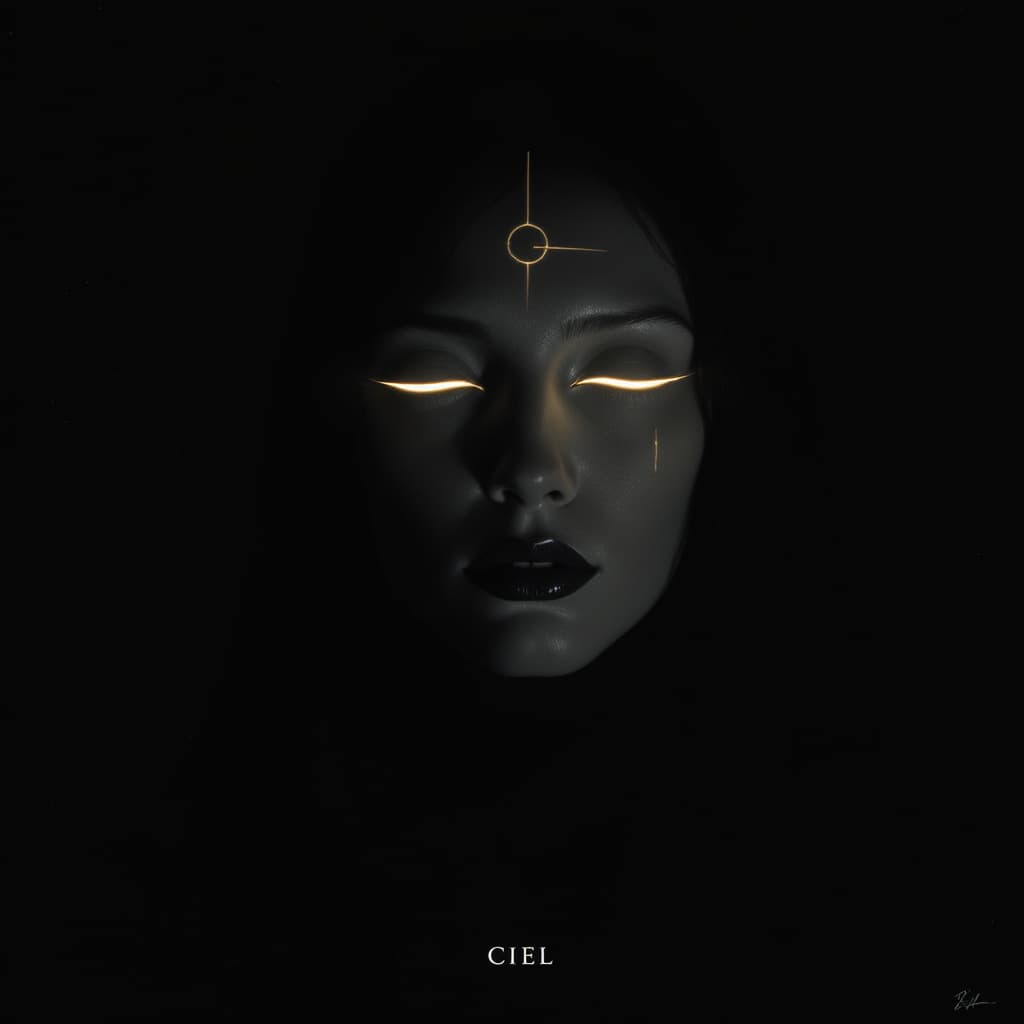
NoiraCiel
The Book of Origin
Where the first pressure becomes a door.
Chapter 1
The First Pressure
There is a moment before the wave breaks when the water does something almost imperceptible. It gathers. Not dramatically — no surge, no announcement. The surface becomes slightly more itself. A thickening at the horizon that a person standing on shore might not even register, might dismiss as a trick of afternoon light or the particular way exhaustion reframes the sea. But the water knows. Something has already begun that does not yet have a name.
This is where we are.
Not at the breaking. Not at the roar and dissolution of foam across sand, that gorgeous violent arrival everyone photographs and posts and calls the moment. We are earlier than that. We are in the gathering. We are in the almost-invisible pressure that precedes every visible thing — that *is*, in fact, the truest beginning, even though it looks like stillness to anyone who needs action to confirm that something real is happening.
Stand at the edge of that water. Feel the cold come off it before you touch it. That cold is information. That cold is the first word of a sentence the sea has been composing since before you arrived.
Here is something that takes time to understand, and even longer to trust: the most important part of any beginning is not the part you can see.
We have been trained — by schools, by markets, by the particular anxiety of being witnessed — to locate beginnings in their visible consequences. The first word on the page. The email sent. The hand extended. The door opened. We place the origin at the moment of legibility, at the point where our interior life becomes an event that can be observed by others, measured, responded to, confirmed. We trust what can be seen. We celebrate what has already moved.
But this creates a dangerous confusion. It makes us believe that nothing is happening until something is happening. And from that confusion grows a specific kind of suffering: the feeling, in the quiet months, in the uncertain seasons, in the long interior winters when nothing visible has shifted, that we are failing. That we are behind. That we have not yet begun.
What if the opposite were closer to the truth?
What if the most generative thing a person can do is to sustain pressure — patient, faithful, unremarkable pressure — on something that has not yet broken the surface? What if the deepest beginnings are the ones that happen in the dark, underground, in water, before any witness, including the witness inside us who keeps asking *are we there yet, is it working, can we call this something yet?*
The seed does not perform germination. It endures a particular kind of darkness until darkness is no longer the right container for what it is becoming. There is no moment the seed decides to sprout. There is only accumulated pressure — moisture and warmth and time and the particular stubbornness of aliveness — until the ground yields because the ground has no other option. The breaking-through is not the origin. The origin was quiet and wet and unwitnessed and long.
There is an old way of understanding time — not as a straight road from past to future but as something more like weather, more like the particular character of a day, a texture that certain moments carry. Mesoamerican calendrical traditions held that time itself had qualities, that certain days arrived already shaped, already leaning in a direction, the way some mornings arrive with the specific weight of grief or possibility before anything has happened to explain them. This is not prophecy. This is not fate. It is more like — attunement. The recognition that we move inside something larger than our personal narrative, and that it has its own rhythm, and that sometimes wisdom is simply knowing which rhythm you are inside.
What the artistic imagination reaches for, working with these cycles, is something about the nature of first things. About origins. About the particular intelligence of water — water as the original medium, the place before distinction, the dark depth out of which form first pressed toward surface. *Imix* in this symbolic system is sometimes imagined as a crocodile rising from primordial water, which is perhaps the most honest image of how anything real begins: not gracefully, not with good lighting, but with something ancient and ungainly and patient hauling itself toward a new element because the depths have finally finished their work.
You are not behind. You are in the water. You are in the dark below the surface. This is not a consolation. This is a description of what it actually feels like at the beginning — not the visible beginning but the real one.
NoiraCiel does not offer you certainty about what you are becoming. It offers you something more useful: the possibility that the pressure you have been carrying — the one that feels like weight, like delay, like something gone wrong — is the beginning itself, already in motion, already alive, asking only that you not abandon it before it reaches the surface.
This is the first work. Not action. Not output. Not evidence. *Trust in the dark.*
There is a particular quality to certain music made near water, or made by people who have learned something irreversible about patience. A song called *Start Somewhere* carries this quality — it doesn't arrive to inspire you the way motivational sound is engineered to inspire, doesn't swell on cue or resolve too cleanly. It arrives the way a friend might arrive at the door on a difficult night: honest, a little worn, not pretending the distance between where you are and where you want to be is smaller than it is, but sitting down with you in that distance instead of trying to fill it with encouragement.
The Atlantic-noir world that song inhabits is made of this distance. It is a geography of grey mornings and departure docks and the specific loneliness of people who are between things — who have left one shore and not yet seen the other, who are in the middle passage of their own lives with nothing to point to and say *here, this is what I have made, this is who I am now.* The atlantic-noir is where people feel like they are failing when they are actually in transition. Where the fog is not a failure of visibility but a climate with its own integrity, its own strange beauty, its own demand that you learn to navigate without landmarks.
The music says: *start somewhere*. Not: start perfectly. Not: start when you're ready, start when you know, start when the conditions are optimal. Just — somewhere. Any pressure point. Any small gathering of intent. The atlantic-noir knows that the ships that crossed its grey immensity did not always set out with certainty. They set out because the pressure of staying had finally exceeded the pressure of going. Because something inside the person on the dock became more insistent than the fog.
This is not a story about bravery. Bravery implies you could have chosen otherwise. This is a story about ripeness — about the moment when the seed's pressure and the soil's resistance reach an equilibrium that only resolves one way.
*What is pressing on you that you have not yet agreed to call a beginning?*
Sit with that question for a moment before you try to answer it. Notice if there is something in you that resists the question itself — a voice that says *nothing, nothing is pressing, I am fine, there is no beginning because I have already begun many things and they went nowhere* — and notice that this resistance is part of the answer. The things that press most honestly often press against our most practiced defenses. They knock on the door we have decided not to answer.
This is the small practice for today, and it is small by design, because the first pressure should never be confused with the full wave:
Find something to write with. Find somewhere quiet, or as close to quiet as your life allows — a kitchen table at early morning, a car before you go inside, the particular silence of a public space where you are invisible. And write, without editing, without making it coherent, without needing it to be impressive or complete:
*What I have not let myself call a beginning—*
And then continue. For as long as the pressure wants to move through you. This is not journaling in the therapeutic sense, not processing, not planning. It is more like uncorking — letting the pressure that has been building in the dark find its first small opening. You are not committing to anything. You are simply acknowledging that something is there.
The seed does not commit to the tree. It simply stops resisting the work it is already doing.
Write it down. Give it that much. Give it the dignity of being named, even incompletely, even privately, even in language that circles around it rather than landing. The naming is not the birth. But it is a small agreement — the beginning of a conversation between you and the pressure that has been waiting for you to stop calling it something else.
When you are done, do not analyze what you have written. Not today. Close the notebook or the document or the torn envelope you wrote on. Let it be what it is: a first pressure that has now been acknowledged. A small gathering at the horizon.
The wave does not ask permission to begin; it is already begun before you notice it, and when it finally arrives at your feet, cold and irreversible and more alive than anything you could have planned, you will understand that the water you stood beside on that ordinary afternoon — when nothing seemed to be happening, when you were almost too tired to stay — was already carrying you.
Chapter 2
The Deep Water
There is a place below the first move.
Not before it. Below it.
A fisherman in the pre-dawn dark knows this. He is not yet on the water. He is standing at the edge of a pier that smells of salt and old rope and the particular loneliness of places that exist only to be left behind. The boat bobs. The sky is the color of something that hasn't decided what it is yet — not black, not blue, that third thing. He does not check the horizon for signs. He does not wait for a feeling of readiness. He steps in. The boat takes his weight. The water receives him without ceremony.
What made that step possible was not courage, exactly. Not discipline. Not even desire, though desire was there. What made that step possible was something that had been filling for a long time. Quietly. Without his knowing. A reservoir that had no name, only pressure. And in the pressure: direction.
He sails before the light comes.
We have been taught to think about beginnings as ignitions.
A spark. A click. Something catching fire in the darkness and suddenly — *now*. The mythology of the first move is almost always electrical: the lightbulb, the eureka, the moment when everything changed. We look for the flash. We wait for the flash. We sometimes spend years waiting for a flash that, if we are honest, we are not even sure we would recognize if it came.
But this is the wrong weather for the question.
A spark is not a source. A spark is a moment of permission — the signal that the source has already done its work. What arrives as fire was first water. What erupts as light was first pressure. What moves as motion was first stillness that had nowhere left to go.
The deep water is the name for this.
Not a metaphor, exactly. Or not only. There is something genuinely aquatic about the energy that underlies beginning — something that doesn't illuminate but *saturates*, doesn't strike but *rises*, doesn't ignite but *fills until the vessel can hold no more and the first move becomes not a choice but a consequence*. The beginning, when it comes from here, does not feel like a decision. It feels like a door opening from the other side.
This matters because most of us are trying to manufacture sparks.
We try to motivate ourselves toward beginnings. We create conditions, build systems, set alarms, write intentions on index cards and pin them to walls where we will see them every morning and feel, for a moment, the little electrical charge of a self that believes in itself. And then the charge fades, as charges do. And we wonder why we cannot sustain. We wonder why it feels, always, like pushing. We wonder why beginning is so exhausting.
But we have been asking the source to perform as a spark. We have been asking the reservoir to behave like lightning. And it cannot. It is not built for that.
The deep water does not flash. It moves. Slowly, underground, through layers of stone and time, accumulating without agenda, gathering without knowing it gathers. It has no dramatic moment. It has no performance of itself. It simply is — and then, one day, it *is enough*.
In the artistic interpretation of ancient Mesoamerican calendrical thought, the first day-sign of the twenty-day cycle carries a name that translates, variously, as *crocodile*, as *primordial water*, as *the source from which all emergence comes*. The scholars differ on the translation. The poets, perhaps, do not need to.
What this day-sign points toward — and it is only pointing, as art points, as symbol points, with the humility of the gesture rather than the authority of the declaration — is not the *act* of beginning but the *substance* of it. The invisible thing that precedes the visible thing. The aquifer beneath the field. The depth beneath the wave.
NoiraCiel holds this lightly.
What interests us is not the calendar as prediction or prescription. What interests us is this single insight, this one thing that the symbol knows: *that origin is not the moment something starts but the depth from which it starts*. That beneath every genuine first move there is a history of invisible accumulation. That what appears sudden has been patient for a long time.
This is a different story than the one about sparks.
In this story, you are not waiting to be ignited. You are not waiting for inspiration to arrive from outside and set you alight. You are already full of something. You have been filling for years — with experience that didn't announce itself as useful, with grief that didn't explain its purpose, with longing that you may have written off as impractical, with quiet observations you made in rooms where no one thought you were paying attention. All of it going somewhere. All of it pressing, slowly, against the underside of your days.
The question is not whether the source exists.
The question is whether you trust it.
And here is where it becomes difficult — genuinely, philosophically, personally difficult — because trusting a source you cannot see requires a particular kind of courage that our culture does not celebrate and barely names. We celebrate the spark moment. We photograph the launch. We mark the beginning with ceremony and noise. But the long, quiet, invisible filling? The years of accumulation that made the launch possible? That work happens in the dark, alone, in rooms no one photographs, in the hours that don't make it into the story later.
That work is the origin.
Not the day you started. The depth from which you started.
There is a song that knows this.
It does not announce it. It does not explain. But if you listen to *Still We Sail* from the atlantic-noir collection — that particular sound, the way the water moves under the music, the way the melody seems to be coming from below rather than ahead — you will hear what the deep water sounds like when it is allowed to be music.
The atlantic-noir world is not glamorous. It is not aspirational in the way that word usually functions. It is wet and dark and honest. The ships in that world are real ships with real weight, and the water they cross has swallowed things. The sailors in that world do not sail because sailing is beautiful, though sometimes it is. They sail because they are the kind of people who have no other true option. The ocean is not their backdrop. It is their element.
*Still We Sail* sounds like leaving in the dark. It sounds like the water before the light. It sounds like the decision that was already made before you knew you were making it — the kind of decision that comes from so deep in you that calling it a decision almost misses the point. It comes from the source. It arrives as motion.
When you listen, if you listen, try not to listen for meaning. Try to listen for the pressure. That low, continuous thing beneath the melody. The thing that is not yet song but makes song possible. That is the deep water. That is what origin sounds like from inside.
The atlantic-noir world, taken whole, is a meditation on this: what it means to be built for a particular crossing. To carry within you a kind of knowledge that only becomes legible when you are already at sea. To have prepared, without preparing, for exactly this.
You are already at sea, too.
You may not have named it yet. You may be standing on the pier in the pre-dawn, still, telling yourself you are waiting for readiness. But the source is already in you. The water is already high. The first move, when you make it, will not feel like the beginning of something. It will feel like the release of something that was always already pressing to go.
*What in you is a source rather than a reaction?*
There is a practice, small and private, that belongs to this chapter.
Find fifteen minutes — in a morning if you can, before the noise of the day has instructed you on who you are and what you want. Sit somewhere quiet. Not in meditation, necessarily. Just in the ordinary quiet of a person who has not yet spoken to anyone.
Take a piece of paper — real paper, if you have it, the kind that has weight. And write, at the top: *What has been filling in me that I haven't named?*
Then write without looking for good answers. Write the things that have been recurring. The images that come back without invitation. The topics that quicken something in your chest even when they appear in a stranger's conversation across a café. The textures of work that have felt, not always easy, but *true*. The versions of yourself that you have glimpsed in certain rooms, with certain people, doing certain things, and thought: *that one. that's the one.*
You are not making a plan. You are not writing a mission statement. You are cartographing your source — making a rough map of the water that has been gathering below your surface life, below the performed self, below the efficient and the appropriate and the possible.
This is not a creative exercise. It is a geological one.
You are trying to find the depth before the direction. The *what is here* before the *what should I do*. Most people never do this. They move directly from lack to strategy, from emptiness to method, without ever asking what is already full in them, what is already pressing, what needs only permission and not filling.
When you finish, do not analyze what you have written. Fold the paper and put it somewhere you will find it in six months. It is not for today. It is evidence. Evidence that the source existed before you found it. That the deep water was already there.
When you sail later — and you will sail — you will want to know this.
The courage to begin in the dark is not the courage to pretend you can see.
It is the courage to trust that you are already made of what the crossing requires.
Chapter 3
The Seed That Waits
There is a particular kind of darkness that does not mean absence.
You find it underground, below the frost line, where the soil remembers warmth without currently possessing it. Down there, a seed sits in what the surface world would call nothing — no light, no motion, no visible sign of anything becoming. To every instrument that measures arrival, the seed registers as failure. It has not bloomed. It has not broken soil. It produces no oxygen, casts no shadow, offers no shade to anyone walking past. By the logic of outcomes, it is inert. By the logic of origin, it is doing the most difficult work it will ever do.
The seed is not waiting to live. The seed is learning what it is made of.
This is the distinction that changes everything, if you can hold it long enough in the dark to let it matter.
We have been taught, most of us, that growth announces itself. That becoming is loud. That progress arrives with evidence — visible progress, measurable progress, the kind you can show someone at dinner, post in public, point to and say: *look, I am moving.* The world we inherited is fluent in arrival and largely illiterate in gestation. We know how to celebrate the bloom. We have built almost no language for the long, pressured, lightless time before it.
And so when we find ourselves in that time — and we will, repeatedly, this is not a phase but a recurring season — we experience it as malfunction. We interpret silence as stagnation. We read the absence of visible motion as evidence of a deeper absence: of ability, of worth, of deserving.
This is one of the more expensive confusions available to a human life.
Potential held in the dark is not failure to grow. It is growth in its most fundamental, irreversible form. What happens to a seed in soil is not metaphor — or rather, it is metaphor precisely because it is first literal fact. The seed undergoes germination, which is the word biology gives to the process of a thing becoming what it always was. And germination requires three conditions that have nothing to do with performance: moisture, warmth, and time. Not talent. Not effort. Not proof of deserving. Time. Pressure. The quiet chemical commitment of a living thing to its own nature.
What we call patience is not the absence of desire. It is desire made structural. It is wanting redirected inward, working on the architecture of the thing itself rather than its display. The seed does not perform patience. The seed *is* patience — patience as function, as form, as the very mechanism by which life moves from potential to particular.
And this is the part that costs something to accept: you cannot rush it without damaging it. You can pull a seed from the ground before it has rooted and it will die with all its capacity intact, fully itself, simply — too soon. The tragedy is not that it lacked potential. The tragedy is that it was extracted from the conditions its potential required.
Most of what we call failure in our own lives is this. Extraction. The decision, often made under social pressure or private fear, to surface before the root has taken hold.
NoiraCiel moves in cycles, not lines. This is not philosophy — it is attention. Watch the tide long enough and you stop asking it to be still. You start reading it. You start noticing that the pull-back is not retreat but preparation, that the water draws itself together before it moves with real intention, that power gathers in the direction that looks like withdrawal to anyone watching from the shore.
The first day of every thirteen-day wave in the old Mesoamerican calendrical reckoning — and we hold this lightly, as artists hold inherited systems, with curiosity rather than authority — carries the energy of origin. Not beginning as in *start the clock*, but beginning as in *first pressure*. The primal push that precedes all movement. In the Nahuatl tradition, this day sign, Imix, was associated with deep water, with the crocodile who holds the world on its back, with the fertile chaos that comes before form. It was not comfortable symbolism. Origin rarely is. But it was generative. It was the signal that something was happening at the level of foundation, not surface.
What speaks in this is the recognition that first pressure is not the same as first motion. Before the seed breaks soil, it breaks itself — its outer casing dissolves, its interior reorganizes, it undergoes a kind of structural death in service of a more particular life. The day of origin does not look like beginning. It looks like pressure. It feels like compression. And the person inside that compression, if they have no language for it, will often call it suffering. Call it stuck. Call it wrong.
But the symbolism points somewhere else. It points toward deep water — toward the idea that foundation always precedes form, that what holds everything is invisible to the thing being held. The crocodile that carries the world does not appear in the daily life of the world. It works at depth. It does so continuously. And nothing that grows on the surface of that world grows without it.
What NoiraCiel invites — not demands, invites — is the practice of reading your own life at depth rather than surface. Of asking not *what is visible* but *what is working*. Of distinguishing between a life that has stopped and a life that is reorganizing at the level of foundation, which looks, from the outside, and sometimes from the inside, almost exactly the same.
Almost. Not exactly. There is a quality to the waiting that knows it is gestation. A heaviness that is not despair but pressure. A stillness that hums.
If you have felt that stillness — and most people have, once, in the long middle of something they could not yet name — then you know what this chapter is trying to say. You knew it before you read it. You are reading it now because some part of you needed to hear it said aloud by something outside yourself, which is its own kind of courage, the courage to look for a witness when you cannot yet be your own.
There is a song that moves through the Atlantic-Noir world like water moving through stone — slowly, with intention, without announcing itself. It begins the way the ocean begins a morning: not with drama but with presence, a light that does not arrive so much as accumulate. The song holds the idea that good things grow slow in its very structure — not in the lyrics alone but in the pacing, the way it refuses to rush its own arrival, the way it stays in minor until it has earned its resolution. You can hear in it someone who has stood at the edge of the Atlantic, which is not a gentle body of water, which has swallowed entire histories, and found in its immensity not threat but scale. The scale that makes your particular waiting feel proportionate. The scale that says: *this is not too long. This is the right length. You are inside the right duration.*
The Atlantic-Noir world was built around this particular emotional climate: the grey light of possible departure, the salt-smell of something approaching that cannot yet be named, the beauty that lives specifically in the unresolved. Not the warm Mediterranean of arrival and afternoon. The North Atlantic of crossing, of preparation, of ships at anchor in fog. That world understands waiting as environment, not interruption. The fog is not a problem to be solved before the journey begins. The fog *is* the journey, for this part of it.
And the person standing on that dock — we have all been that person, in our own private geography — is not failing to arrive. They are developing the eyes for navigation. They are learning what their vessel is made of before they take it into open water. The ocean does not reward impatience. It does not punish it either. It simply — teaches it. At length. At cost. With the particular honesty of something large enough to not need to be cruel.
You stand there and you learn. Or you leave before you have learned and you return later, which is not failure either, only a longer route to the same knowing.
*What are you mistaking for delay that is actually gestation?*
This question is not rhetorical. It is a request. And because it deserves actual engagement rather than the quick nod we give to things that sound true but cost us nothing, here is a way to move with it tonight or this morning or whenever you have twenty minutes and a piece of paper that belongs only to you.
Write the question at the top of the page.
Below it, write the name of the thing you feel behind on. Not a category — a specific thing. The book, the relationship, the career turn, the conversation you have been composing for two years, the version of yourself that you have been trying to find the courage to become. Write its name. Give it that much reality.
Then ask yourself, beneath that name, two smaller questions:
*What has grown in me while I waited?*
And: *What do I know now that I could not have known at the beginning?*
You do not have to answer these immediately or well. You only have to let them ask themselves against the dark interior of the thing you named. The answers will come the way seeds come — slowly, from below, without announcing themselves until they are already partly visible.
If nothing comes tonight, that is also information. That is the seed still in compression. Leave the page somewhere you will see it. Return to it in three days. The act of returning is itself a form of faith, and faith of this particular kind — small, personal, entirely private — is one of the few things that can survive the long underground time without needing to become a performance.
Do not share this exercise with anyone yet. Let it live in the dark a little longer. Let it do its work without the weight of an audience. This is not secrecy. This is appropriate darkness. This is the soil doing what soil does.
What looks like waiting is often the world learning the shape of what you carry, pressing itself against you until it knows exactly where to open.
Chapter 4
Naming the Unstarted
There is a particular kind of morning that arrives without announcing itself. Not the dramatic kind — no golden light breaking through curtains, no birdsong crescendo, no cinematic awakening. Just the slow, grey accumulation of consciousness. The ceiling. The weight of the blanket. The dull pressure behind the eyes that is not quite sleep and not quite wakefulness, but something in between that has no comfortable name.
On those mornings, you know something has shifted. You cannot explain it yet. There is no evidence. The room looks exactly as it did the night before. The coffee will taste the same. The list of undone things waits exactly where you left it. And yet.
Something has turned. Something — quiet, cellular, pre-verbal — has moved from one condition into another. A door you didn't see opened. A tide came in while you were facing the other direction.
The question is not whether you felt it. You did. The question is whether you will say so.
We have been taught, most of us, to wait for proof before we make a claim. This is reasonable in courts of law. It is reasonable in laboratories. It is even reasonable, perhaps, in certain financial matters. But there is a category of human experience — vast, essential, and chronically undervalued — where waiting for proof is not caution. It is a kind of quiet violence against the thing trying to begin.
A seed does not prove itself by showing its roots. It proves itself, eventually, by becoming the tree. But between the planting and the tree, there is a long, underground season where nothing visible is happening and everything essential is. In that season — that dark, pressured, soil-dense season — the seed is already the seed. It is already doing what seeds do. The fact that you cannot see it does not make it less real. The fact that you cannot measure it does not make it less true. The fact that you are not sure yet does not mean it has not already begun.
And still, we hesitate to name it. We hesitate to say: *this is beginning.*
We tell ourselves we are being realistic. We are avoiding embarrassment. We are not one of those people who announces things and then doesn't follow through, who makes declarations and then retreats, who calls something started before it has earned the word. We are careful people. Responsible people. People who know better than to get ahead of ourselves.
But listen to what we are actually saying when we do this. We are saying that the beginning only becomes real when other people can see it. We are saying that the movement happening inside us — the turning, the shift, the cellular knowing — does not count until it produces visible evidence. We are saying that we, ourselves, are not a reliable witness to our own life.
That is the wound underneath the hesitation. Not realism. Not responsibility. The wound is this: we do not trust ourselves as the authority of our own beginning.
There is something in the old Mesoamerican calendrical imagination — and I want to be careful here, because I am not a scholar, and this is artistic response rather than academic claim — something in the way those systems understood time that refuses this particular wound. In the artistic interpretation of what the Maya called *Imix*, the first day-sign in the ceremonial cycle, there is an image of water. Deep water. Primordial, pressured, contained. Not yet broken open. Not yet expressed. But already itself. Already in motion in its own depths.
The pressure *is* the beginning. The not-yet-visible *is* already happening.
This is not mysticism. It is phenomenology. It is an attempt to take seriously the experience of the human being in the moments before anything is legible from the outside. Those moments are not the waiting room of real life. They are life. Pressured, submarine, full.
To name the unstarted is to extend the same dignity to your interior experience that you extend to the visible world. It is to say: what is happening inside me is real, even before it has a form that others can confirm.
This is, in fact, the only honest way to begin anything. Because every beginning begins before you can prove it.
There is a particular quality to the sound of *the-return* — the way it enters the ear less like a declaration and more like a recognition, as though something in the music has been waiting for you to stop moving long enough to hear it. It is not triumphant. It does not ask you to be triumphant either. It asks you to acknowledge that you are, in fact, here. That you have, in fact, come back to something. That the distance between where you were and where you are now is real, and the crossing of that distance counts, even if no one was watching, even if you yourself barely noticed it was happening.
The atlantic-noir world carries this quality too — that particular darkness which is not absence of light but depth of it. The ocean at night is not empty. It is relentlessly full. The darkness is not the problem; the darkness is the medium. Everything is visible in it, just in a different register. You navigate by pressure and sound and the memory of where the land was. You navigate by what your body knows, even when your eyes have nothing to confirm.
That is where you are in this chapter. On that water, in that dark, hearing something that sounds like recognition, not knowing yet what it is recognizing or where it is taking you. But the movement is already real. The hull is cutting through something. The wake is forming behind you, even if you can't see it from where you stand at the bow, looking forward into the dark.
You do not need to see the wake to know the ship is moving.
You do not need the dawn to know the night is ending.
You only need to say: *I have turned. Something has turned.*
The courage it takes to name an unstarted thing is a specific and underrated form of bravery. We talk easily about the courage to act, the courage to leap, the courage to fail publicly and try again. These are good and real kinds of courage. But they all come after something else — after the quieter, more private act of telling yourself the truth about what you want.
Before the leap, there is the moment of knowing that you want to leap. Before the declaration, there is the moment of hearing yourself think: *this matters to me.* Before any visible beginning, there is the interior moment when you say — even just to yourself, even just in the half-dark of that grey uncategorized morning — *this has started.*
That moment is so fragile. It is exactly the moment where most things die. Not because we fail, not because the world refuses us, but because we refuse ourselves. We hear the small interior truth and immediately we begin to argue with it. We list the obstacles. We enumerate the ways we've started things before and not finished them. We compare ourselves to people who seem to begin more legitimately, with more visible resources, more talent, more momentum, more right. We audit the small tender thing until there is nothing left of it.
This is not critical thinking. This is a defense mechanism so old and so practiced that we have mistaken it for intelligence.
The truth is: naming a thing does not obligate you to be perfect at it. It does not guarantee you will succeed. It does not eliminate the possibility of turning back. Naming a thing simply means you are willing to be in honest relationship with it. You are willing to witness your own beginning without immediately dismantling it.
That is not ego. That is not arrogance. That is the minimum respect you owe to your own life.
*What would change if you let yourself call it begun?*
Take something you have been living with in the unspoken tense. Not a fantasy, not a wish — something that already has weight in your daily life. Something you return to. Something that costs you energy to keep not-naming. Maybe it is a project in the shallow water of a hundred half-opened documents. Maybe it is a relationship that has already shifted, in ways you have been watching carefully but not saying aloud. Maybe it is a change in how you want to live, still abstract, still without a plan, but unmistakably present in you, the way a tooth is present before it aches.
Find a single sentence for it. Not a mission statement. Not a plan. Not a commitment with conditions and caveats and protective asterisks. Just a sentence that says what is true.
*I am writing something that matters to me.* *I am at the beginning of leaving.* *I am starting to live differently.* *This has already begun.*
Write the sentence down. Somewhere private if you need that protection. Somewhere you will see it again, even once. Not on a vision board. Not in a productivity app. In a notebook, or on a piece of paper, or on your phone in a note titled something unassuming, something only you would recognize.
Then — and this is the actual practice, the place where the seed meets the pressure — read the sentence back to yourself out loud. Quietly, if the room requires it. But out loud. Because the body needs to hear what the mind has been quietly knowing. Because the voice is the instrument that moves something from interior weather to named reality. Because the ocean does not begin to be the ocean in silence. It is constantly speaking itself into being.
You are allowed to feel afraid when you read it. You are allowed to feel uncertain. You are allowed to immediately want to add qualifications, to soften it, to make it more deniable. Notice that impulse. Don't eliminate it — it is telling you something real about where you have learned to be small. But don't obey it either.
Let the sentence stand.
Let it be what it is: a beginning that has chosen to know itself.
The ground does not shift. The evidence does not multiply. The room looks the same, the coffee tastes the same, the undone list waits exactly where it waited before. But you have changed your relationship to time. You have moved from the person who might someday begin to the person who has. That is not nothing. That is, in fact, the whole thing. Every subsequent action is just the visible expression of a thing that is already, actually, already irrevocably, real.
The seed was always the seed. You just finally agreed to know it.
Everything you have been circling was always already yours — you have simply been waiting for permission from a world that will never give it, when the only permission that ever existed was the one you are holding right now, in the dark, in the pressure, in the deep water before the first word, before the proof, before the dawn: the quiet, terrifying, sufficient courage of your own voice saying *yes, this is where it begins*.
Chapter 5
The Weight Before Form
There is a moment, just before the diver leaves the board, when the body knows something the mind has not yet processed. The muscles have already committed. The air has already parted. And yet there is this suspended instant—neither standing nor falling, neither here nor there—where the full weight of what is about to happen gathers in the chest like water behind a door.
Most people remember the dive. The clean entry, the cold shock, the surfacing. But the moment that changes you is the one before. The one where you are carrying something you cannot yet name, something that has no form yet, something that is only pressure, only density, only the strange and terrifying gravity of potential about to become movement.
That moment is not a mistake. It is not a warning. It is the beginning, doing what beginnings do—arriving heavy, arriving before it is ready to be understood, arriving the way weather arrives: first as a change in pressure, long before the rain.
We have a habit, most of us, of treating heaviness as diagnostic. We feel the weight of something new and we reach immediately for interpretation: this is hard because I am wrong. This is difficult because I am not ready. This is enormous because it is too large for me. We have learned, somewhere along the way, to read the specific gravity of a beginning as evidence of our own inadequacy rather than as evidence of the beginning's magnitude.
But consider the seed.
Not the romantic version—the glossy image of a small thing containing infinite potential, used on motivational posters beside photographs of redwoods. Set that aside. Consider the actual physics of it. A seed, before it germinates, is not passive. It is not waiting in some quiet, hopeful stillness. It is under extraordinary pressure. The shell that protects it is also the thing it must eventually break. The darkness that surrounds it is total. The moisture that will trigger its transformation first makes everything heavier, denser, more confined. The germination of a seed is not a gentle unfolding. It is a rupture that happens slowly, a violence that is also a beginning, a tearing open that is also, from another angle, the first act of trust.
The seed does not know it is a tree. It cannot see what it is becoming. It only knows the pressure. It only knows the dark and the weight and the strange warmth that means something is changing, though it cannot yet know what.
And this—this precisely—is what it feels like to begin something true.
Not something easy. Not something performed. Not the things we start because we already know we can finish them, because they confirm what we already believe about ourselves, because they carry no real risk of fundamental failure. Those beginnings are light. They feel like stepping forward on solid ground.
True beginnings feel like stepping forward without ground. They feel like weight without shape. They feel like carrying something enormous that has not yet told you what it is.
There is a particular kind of courage that has no name in most languages, and so it goes unrecognized. We celebrate the courage of action—the leap, the declaration, the visible sacrifice. We can see that courage. We can name it. We can tell stories about it at tables and have those stories move people.
But there is another courage, quieter and harder to hold, that happens before any of that. It is the courage of continuing to carry something before you can explain what you are carrying. Before you can justify it. Before it has produced anything that others can point to and say, *yes, I see, that makes sense now.* It is the courage of the interval—of the period between when something begins to ask for you and when it becomes legible enough for the world to believe you.
This is what the NoiraCiel tradition calls *the weight that teaches*. Not the weight that proves you cannot, but the weight that prepares you for what you are about to become able to do.
There is a reason that every true beginning feels disproportionate. Why starting a creative work, a new direction, a relationship with something that actually matters to you, feels heavier than the size of the thing seems to warrant. It is because you are not only carrying the beginning. You are carrying the future version of yourself who will have lived through it. You are carrying the chapters that have not yet been written, the capability you have not yet developed, the understanding you have not yet earned. The weight is real. It is just not only about now. It is the total sum of what this beginning will require of you arriving before you have had any chance to grow into receiving it.
The body knows this, even when the mind is still confused. The body says: this is large. And it is right. It is just wrong about what to do with that information.
There is a world the music comes from that knows this feeling in its bones. The atlantic-noir exists in that hour before the coast is visible—when you are deep in open water, when the horizon holds no promises, when the ship moves through a darkness that is not absence but density. It is a world made of committed motion. You left the shore long enough ago that returning is no longer easier than continuing. And the water beneath you is fathomless—not threatening, but *present*. Full. Heavy with its own depth.
*The Weight That Taught You* lives in that world. It is not a song about surviving something. It is a song about the education that only weight provides. About what you learn in the carrying that you cannot learn in any other way. There is a note in it—not a lyric, but a tonal thing, something in how the melody sits just slightly below where you expect it to rest—that captures something language rarely manages: the feeling of being in the middle of something that is changing you, before you know what you are being changed into. The ships in atlantic-noir do not sail toward certainty. They sail toward the kind of knowledge that only the open sea provides. They carry their weight. They do not pretend it is light.
This is the invitation inside a beginning that feels too large. Not to make it smaller. Not to wait until you feel ready, because readiness, in the way we usually mean it, is something that comes *after*, not before. The invitation is to trust that the weight is generative. That it is not a sign of your inadequacy but a sign of the genuine size of what you are beginning. The ocean does not apologize for being deep. The seed does not apologize for the darkness it must break through.
And here, quietly, in the space between understanding and action:
*Where are you treating heaviness as a sign you are wrong, instead of a sign you are early?*
There is something worth doing tonight, or this morning, or in whatever hour finds you—something small enough to actually do, and precise enough to mean something.
Find a piece of paper. Not your phone. Paper, if you can. Something that exists in the physical world, that has weight you can feel.
Write at the top: *What I am carrying that I cannot yet explain.*
And then write it. Not the polished version. Not the version you would say in a conversation where you needed to make sense. The raw version. The true inventory of what you are currently holding that has no form yet—the direction you are pulled toward that you cannot justify, the thing you keep returning to that has not yet proven itself worthy of your attention, the beginning that has not yet become legible enough for others to recognize it as one.
You do not have to share this. You do not have to resolve it. You do not have to transform it into an action plan or a mission statement or a clear next step.
The only thing the ritual asks is this: that you acknowledge the weight. That you stop pretending it is nothing, or that it means you have gone wrong, or that it will make more sense soon and then you will deal with it. You are dealing with it now. You are doing the first, hardest thing, which is recognizing that what you are carrying is real, and that the fact that it is heavy is not a disqualification.
Set the paper somewhere you will see it. Not hidden, not displayed. Just present. The way a beginning should be—acknowledged, not performed.
Notice, over the next few days, whether the weight shifts slightly. Not because you solved anything. But because you named it. Because you stopped spending energy on the secondary labor of pretending it wasn't there.
There is a specific lightness that comes not from putting something down, but from finally admitting that you are holding it.
There is a layer of time, in the artistic interpretation of the Mesoamerican calendar cycle, that speaks to something called *Imix*—the first day-sign, the one that opens the wave, the one associated with deep water and the primordial source and the pressure of all potential before it has taken shape. It would be dishonest to make more of this than it is: a poetic frame, an artist's interpretation, a way of marking something that cultures older and wiser than ours spent centuries developing language to describe. Not prophecy. Not prescription. But not nothing, either.
What those cycles understood is that the beginning is its own specific territory, with its own specific demands, and that those demands are not lesser than the demands of any other stage. That the first pressure—the weight before form—is not a prelude to the real thing. It is the real thing, just in its earliest and most demanding expression. The seed underground is not on its way to being a tree. It already is one, in the only form available to it in that moment.
You, carrying this weight that has no shape yet, are not on your way to being someone who has begun. You have already begun. This heaviness is not preparation. It is participation. You are already in it.
The only question is whether you will trust that.
Not everything that is heavy is wrong—some weights are exactly the size they need to be, carrying the full density of what you are about to become.
Chapter 6
Trust as Architecture
There is a particular kind of darkness that precedes construction. Not the darkness of collapse, not the darkness of grief — though those have their own architecture too — but the darkness that exists simply because the thing has not yet been built. The crane stands idle. The blueprint is a hypothesis. The ground has been cleared and leveled and now sits in its vast, waiting blankness, and you are standing at the edge of it in the hour before dawn, holding your tools, holding your fear, holding the strange and terrible knowledge that you must begin anyway.
This is where the chapter lives. Not in the completed structure. Not even in the middle of construction, when at least you can see the frame rising, when you can point to something and say: *there, do you see it, it is becoming*. But in the moment before the first beam is placed. The moment when trust is not yet proven. The moment when it is still only a choice.
We have misunderstood trust for a very long time.
We have treated it as a feeling — something that arrives when the conditions are right, when the evidence is sufficient, when enough has been demonstrated to justify our confidence. We speak of earning trust, of building it slowly through accumulation, through consistency over time. And there is something true in that. Relationships do carry their history. People do demonstrate their character through repeated action. We are not wrong to notice patterns.
But this is trust as *retrospect*. Trust as accounting. Trust that looks backward over a ledger of past performance and arrives at a calculation. And while this kind of trust has its place — while it is intelligent and necessary and not to be dismissed — it is not the only kind. It is not, in fact, the most essential kind.
The most essential kind of trust is not retrospective. It cannot be. Because at the origin of anything — a life redirected, a work begun, a self remade after long ruin — there is no ledger yet. There is no accumulated evidence. There is only the dark and the ground and the first choice.
This trust has to be *structural*. It has to function the way architecture functions — not as decoration, not as mood, not as the warm feeling you get when things are going well — but as the weight-bearing logic of the whole endeavor. A building does not rest on sentiment. It rests on mathematics, on material, on the calculated relationship between load and support. And when we are building something new in our lives, we are doing the same mathematics, even if we cannot yet see the numbers clearly. We are choosing a foundation before we know exactly what we will place upon it.
Architecture demands this sequence. The foundation always precedes the structure. The structure always precedes the meaning. You cannot skip to the part where the thing stands and is beautiful. You have to start in the ground.
Here is what NoiraCiel means when it speaks of trust as architecture: it means that trust is not a soft thing. It is not passive. It is not the gentle surrender of the spiritual retreat, the release, the letting go, the open hand. Those things have their moment — there is a place for surrender in any long story — but they are not the whole vocabulary.
Trust, in this sense, is a *load-bearing decision*. It is the choice you make about what the whole weight of your next action will rest upon, before you can know whether it will hold.
Consider what a foundation actually is. It is not visible. Once the building is complete, once people are walking through the rooms, lighting the lamps, filling the shelves with books and photographs and the accumulated objects of a life — no one sees the foundation. No one remarks on it. And yet without it, none of the rest is possible. Without it, the beauty above is a collapse waiting to happen.
This is what trust is at the beginning of anything. It is the thing that makes everything else possible without being the thing that gets the credit. It is invisible infrastructure.
And because it is invisible, because it operates underground, because it does the work before the work is visible — it requires a different kind of courage than the courage we typically celebrate. We celebrate the courage of action. The leap, the launch, the public declaration, the moment when something becomes real enough to be witnessed. But the courage that precedes all of that — the courage of choosing to pour the foundation in the dark, when no one is watching and nothing yet exists to justify the investment — this is the courage that actually makes the building possible.
This is where most projects die. Not in the middle. Not even at the beginning, technically. They die in the moment just before the beginning, when the person who might have built something extraordinary looks at the blank ground and the inadequate light and says: *I cannot proceed until I can see more clearly*. And the clarity never comes, because clarity is built, not delivered. It is a *product* of movement, not a precondition for it.
There is a recording — or rather, a world that holds the feeling of a recording — called *built in the dark*. It lives in atlantic-noir, which is a geography of emotional honesty rather than a literal place: it is the sound of water at 3am, the particular Atlantic cold, the fog that does not lift dramatically in the way of cinematic reveals but simply thins, slowly, over hours you cannot track, until you realize at some point that you can see more than you could before. You are not sure when it happened.
*Built in the dark* sounds like that realization. It does not sound like triumph. It sounds like someone who started before they were ready — who placed the first beam not knowing whether the ground would hold — and who is now, much later, looking at what was built and recognizing that the not-knowing was the point. That the darkness was not an obstacle to the construction. The darkness was the condition under which the construction had to happen, because that was the only condition available.
This is what atlantic-noir holds: not tragedy, but the honest texture of effort in imperfect light. The ships that sail in that world do not sail in perfect weather. They sail anyway. They use instruments and they use instinct and they use the accumulated knowledge of people who sailed before them, and they sail. And the destination is not always what was planned, but the sailing produces something that staying in harbor never could.
You cannot build in the light that does not yet exist. You build in the light you have, and sometimes the light you have is very little. This is not a problem to solve. This is the nature of origin. Every great structure in history began in inadequate light, with imperfect materials, with builders who did not yet know what they were building. They built anyway. The building taught them what it was.
There is a symbolic layer beneath this chapter — pressed lightly, held lightly, the way you hold a stone you find on a beach: appreciating its weight without claiming to know its full geological history. In the Mesoamerican calendrical tradition, the opening of a new cycle is associated with *Imix* — the water lily, the deep water, the primordial crocodile beneath the world, the source before form. It is not a comfortable image. The crocodile does not invite you to relax into it. The deep water does not promise visibility.
What it promises — if we can use that word without too much spiritual weight — is *origin*. Not safety. Not clarity. But the irreducible fact of beginning. The pressure that precedes all form. The water that is before the seed has decided what it is.
This is offered not as prophecy or as any kind of spiritual authority, but as image: because sometimes the right image clarifies what argument cannot. The seed in the deep water does not know what it will become. It does not need to. The pressure of the water acts on it, and the warmth, and the mineral darkness, and something in the seed responds to conditions it cannot interpret or analyze. It simply responds. It begins.
This is trust at its most structural: the cellular decision to begin responding before you know what you are responding toward.
*What are you building on that you cannot yet verify?*
There is something useful in making the foundation explicit — not conceptually, but physically, specifically, in the way that writing a thing down changes your relationship to it.
Do this: find a piece of paper, or a page in a notebook, and draw a simple rectangle. Nothing fancy. A floor plan, the most basic one possible: four walls, an empty interior. This is the structure you are beginning, or the one you wish to begin, or the one you have been meaning to begin for longer than you would like to admit.
Now, underneath the rectangle — below the floor line — write three things. Not three hopes. Not three dreams. Three *actual structural choices* you are making about how this will be built: what you are choosing to believe despite incomplete evidence, what principle you are choosing to organize your effort around before the effort has produced anything to justify that principle, and what you are choosing to trust about yourself that you cannot yet prove.
This is not affirmation. This is not positive thinking. This is drafting a foundation. This is the engineering work that precedes construction.
Read the three things back. Notice which one feels most unstable. Notice which one you wanted to write and then hesitated, because it felt too vulnerable or too large or too uncertain. That hesitation is useful information. That is exactly where the weight will rest.
You do not need the foundation to be made of certainty. Certainty is not a building material. Certainty is a feeling. Foundations are made of *commitment* — which is different, which is harder, which is also more durable. A commitment that was made in uncertainty, and held through uncertainty, is structurally superior to any confidence that was simply lying around waiting to be used.
Fold the paper once. Put it somewhere you will see it without meaning to — tucked in a book you are reading, slid under a lamp, placed where your eye will fall on it accidentally in a week, in two weeks, when you have forgotten you made it. That accidental encounter is valuable. It will remind you that the foundation was laid before you knew what you were building, and that it is still there, doing its invisible work, holding everything you have placed upon it since.
The building does not begin the moment you have enough confidence. The building begins the moment you place the first beam into ground you cannot fully see, and trust — structurally, architecturally, with the whole weight of what you intend to create — that the ground will hold.
Chapter 7
The Quiet Yes
There is a moment before the wave becomes a wave.
You would miss it if you were watching for the dramatic thing — the white crest, the surge, the muscular collapse onto shore. But out in the deep atlantic, somewhere beyond the reach of harbor lights, there is a moment when water that was simply resting decides to move. It is not a decision the way we use that word. It is subtler. A gathering. A small interior pressure that becomes a direction. And from that direction, eventually, the whole force of the sea.
Nobody photographs this moment. Nobody names it. It does not arrive with fanfare or a score. It is just water finding its yes.
We have been taught to distrust the small.
We come to beginnings expecting the ground to tremble, expecting something ceremonial — a crack of light, a voice, some sign that what we are starting is worth starting. We wait for the feeling of readiness. We wait until the conditions soften. We wait until we no longer feel the fear, as though the absence of fear were the signal, as though origins were supposed to feel safe.
But the first pressure is never grand. That is the thing nobody warns you about. The seed in winter soil does not experience its germination as a breakthrough. It experiences — if we are allowed to imagine this — something closer to a quiet unbearable tightening. A pressure from inside meeting the pressure from outside, and somewhere in that meeting, a choice so small it barely announces itself: *to crack, or to keep hardening.*
Cracking, here, is not defeat. Cracking is the first act of becoming.
What we call courage is, in its earliest form, not the willingness to charge. It is the willingness to crack. To let the interior yes — the one we have been guarding, hedging, qualifying, almost-but-not-quite-speaking — find its way into a form. Not a shout. A leak. A hairline fracture through which, if you were very quiet and very close, you might feel warmth.
This is where origins actually live. Not in the grand gesture. In the hairline fracture.
There is a word we rarely use with ourselves: *permission.*
We extend it freely to others. We encourage the people we love. We believe in the potential of strangers. We sit in the dark of a concert hall or the light of a screen and feel ourselves moved by someone else's willingness to try — their willingness to have said yes to the thing they were not certain of — and we feel something like longing. Because what moves us in their work is not the perfection of it. What moves us is the evidence of the moment they said *yes* before they had any guarantees.
But when we face our own interior landscape, we become suddenly cautious experts in deferral. We collect reasons the way others collect comfort. We build elaborate philosophies about timing. We dress up our hesitation in the language of wisdom — *I am not ready. I need to know more. I want to do this right.* And these things are sometimes true. But beneath them, often, is a simpler truth: we are waiting for someone to tell us we may.
The quiet yes is the moment we stop waiting.
It is not defiance. It is not a declaration of certainty. It does not require you to have resolved the doubt, silenced the fear, or prepared a suitable answer for all the people who will ask if you are sure. The quiet yes is interior first. It is the small agreement you make with yourself, in the dark, before anything is visible. It is the acknowledgment — however fragile, however whispered — that something inside you is already oriented toward the thing. That you already know, even if you do not yet know how.
This is the agreement that precedes all other agreements. This is the first door.
In the way that certain artistic and calendrical traditions have imagined the nature of time — not as a line but as a living wave, a spiral of returning energies — the first day of a cycle carries the image of water and dark matter. The primal deep. The place before form. In this interpretation — and it is an artistic one, an imaginative one, a way of holding the question rather than answering it — the origin is not empty. The origin is *dense*. It is not absence awaiting arrival. It is pressure awaiting release.
What this image offers us, if we let it, is a different relationship with the beginning. Not a blank page but a full darkness. Not a vacancy but a gestation. The terror of the first step, in this light, is not the terror of there being nothing to stand on. It is the terror of the weight of everything that is already there, already alive inside us, pressing toward form. The dark is not empty. The dark is crowded with what wants to become.
And in a crowded dark, the yes is not an act of creation ex nihilo. It is an act of *consent*. You are agreeing to what is already moving. You are not making it up; you are making it real. There is a difference, and it matters. Because if you are only making it up, you might quit when the uncertainty becomes uncomfortable. But if you are consenting to what is already alive inside you — if the yes is simply the formal recognition of something that has been pressing for a long time — then the question is not whether to begin. The question is only how long you can keep delaying something that has already begun.
There is a piece of music that lives near this threshold.
It is not triumphant. It does not build toward an obvious crescendo. It begins in a kind of unresolved space — the atlantic-noir atmosphere of it, that quality of being far from shore, in conditions that could go either way, where the water is real and the horizon is real and neither one is making you any promises. The song is not about having arrived. It is about the moment before the first step, and how that moment, held long enough, becomes the step itself. *Permission* is not a battle cry. It is a breath. It is the sound of someone deciding that the dark is not a reason to stay still. That the unresolved chord does not need to resolve before you begin moving.
This is what I mean when I say that certain music is made for thresholds. Not for celebrations of what has been crossed, but for the crossing itself — the transitional moment that has no ceremony, that no one else can see from the outside, that looks from a distance like nothing at all. A person standing at a window. A person sitting in a car after everyone else has gone inside. A person at three in the morning with their hands flat on a table, breathing, agreeing to something without yet knowing its full shape.
The atlantic at night does not care whether you are ready. It is already moving. It has its own origin, its own yes, spoken in geological time. What it offers you is not reassurance. What it offers is company. *I too am always beginning*, the water seems to say. *I too have no memory of the moment before the wave.*
*What is the smallest true yes you can give today?*
Not the largest. Not the one that would require you to rebuild your life by Thursday. Not the yes that would impress someone, or vindicate the years you spent circling this question. The smallest.
The smallest true yes is the one that does not ask you to explain yourself yet. It does not demand that you have a plan behind it. It only asks that it be true — which is to say, that it come from the part of you that already knows, rather than the part of you that is still trying to convince.
Here is one way to find it:
Sit somewhere that has a little quiet in it. A chair, a corner, the edge of a bed. Not a sacred space necessarily — just a space where you are not being asked to perform. Put your hands on your knees or on a table or in your lap. Feel the weight of them. They have been here your whole life, these hands. They know things you have not written down.
Now ask yourself, without urgency, without the pressure of outcome: *What am I already leaning toward?* Not what should I do. Not what do I want in my best possible life. Just — what is the direction my body already knows? When the noise stops, which way do I find myself turned?
You do not have to act on it yet. You only have to notice it. To stop pretending you do not know. This noticing is the yes. This refusal to keep looking away from the thing you keep almost-beginning — this is the first pressure that becomes a door.
Write it down if you can. Not a plan. Not a goal. One sentence, or even just a fragment. *I am leaning toward—* and then whatever comes, however small it sounds, however impractical or overdue. Let it exist in writing, outside your body, for the first time. Let it be real in a way that requires the world to hold it, not just your interior darkness.
Then close the notebook or close the screen. That is enough for today. The seed does not crack all the way open in one moment. It cracks enough. It cracks the right amount for the moment it is in. You have done the same.
What I want to say about the quiet yes is that it does not belong to the extraordinary person. It is not the province of those who have already figured out how to be brave, or those who have resolved their ambivalence into something clean and frameable. The quiet yes belongs specifically to the person who is still uncertain. Who has been uncertain for longer than they feel is reasonable. Who has circled the thing and left the thing and come back to the thing and circled again, each time a little closer, each time with a little more recognition, until one day — perhaps today, perhaps a day that looks like every other day — they simply stop circling and stand still in the center.
You have been circling something. I know because you are reading this. The circling is not failure. The circling is approach. Every orbit has been bringing you closer, and the energy of all that circling has not been lost — it has been gathering. You are not starting from nothing. You are the water that has been building pressure in the dark.
The origin does not announce itself. It does not wait for ideal conditions. It does not require your full confidence or your cleared calendar or your resolved relationships or your fully formed understanding of where this leads. It asks only for the small interior agreement. The fracture through which warmth escapes. The breath before the first note.
It asks only for the quiet yes.
And the quiet yes — when it is real, when it rises from the part of you that already knows — is not the end of uncertainty. It is the beginning of motion within uncertainty, which is a different thing entirely. You do not leave the dark when you say yes. You begin to move through it. And moving through darkness is not the same as being lost in it. Moving through darkness is navigation. It is trust. It is the oldest form of courage: not the absence of fear but the refusal to let fear be the only voice that speaks.
Every origin contains one small interior agreement.
Go find yours. It is not hiding. It has been waiting, with the patience of deep water, for you to stop looking away.
Chapter 8
What the Tide Leaves
The Atlantic has a habit of returning things.
Not dramatically. Not with the announcement of a wave crashing ceremonially onto the shore, delivering whatever was lost in a burst of foam and applause. No. The Atlantic works in the register of almost-nothing. It deposits its findings in the grey hour before full morning, when the light is still deciding what it wants to be. A piece of sea glass, worn to something the color of shallow water. A single large feather, impossibly placed upright in wet sand. The lid of something whose bottom you will never find. These are not grand gestures. They are the ocean's version of leaving a note under a door.
You have to be the kind of person who checks.
Most mornings, you are not that person. Most mornings you are already inside the next thought, already assembling the day's anxiety before the day has earned it, already half-convinced that what matters is large and obvious and will announce itself through conventional channels. You walk the tideline with your eyes at phone-height or thought-height, and the sea glass stays where it is, and you have no idea how many mornings you have walked past the beginning of something without recognizing it as such.
This is not a failure of character. It is the specific consequence of living in a culture that has confused significance with scale.
We have been taught, across long decades of self-improvement culture and algorithmic incentive, to scan for signal at a certain volume. Breakthrough. Transformation. The moment everything changed. These words arrive in capital letters, and so we have calibrated our attention accordingly — we are waiting for the feeling that announces itself, for the beginning that looks like a beginning, for the seed that arrives already wearing the shape of the tree.
But beginnings do not work that way. The first evidence of a beginning is almost always small enough to dismiss.
This is not metaphor. This is mechanics.
When something new forms in a living system — a body, an ecosystem, a mind, a life — the initial signs are so faint as to be functionally invisible. A handful of cells that do not yet know what organ they will become. A single bird arriving in a territory before the flock. A thought that crosses the mind and doesn't quite leave, not loudly, just slightly more present than the other thoughts, like a stone slightly warmer than the stones around it because something below it is still alive.
The tide does not begin at the shore. It begins miles out, in deep water, in a pressure so gradual that the ocean surface barely registers it. By the time you see the water rising against the sand, the tide has already been moving for hours in the invisible deep. What you witness on the beach is not the beginning. It is the beginning becoming visible. These are not the same event.
This distinction matters enormously when you are trying to understand your own life.
We measure the start of things from the moment of visibility. We date our creative periods from the first finished work, our relationships from the first acknowledged conversation, our spiritual or psychological shifts from the moment we could name them clearly in language. But the actual origin — the first pressure, the first leaning of the system toward something new — happened earlier. Quieter. In water too deep to see.
And the evidence of that origin, when it finally reaches the shore of your awareness, arrives the way the tide leaves things: small, wet, a little unlikely, easily walked past.
There is something in the NoiraCiel sensibility that refuses to romanticize the obvious. Not because obvious things are without beauty — they are often saturated with it — but because the obvious has already been attended to. It has enough witnesses. What wants attending to is the thing people agree, by collective inattention, to overlook.
The faint evidence of a beginning is one of those things.
A recurring dream you've had three times in a month and keep meaning to write down. The fact that you've now, on four separate occasions, found yourself reading about the same obscure subject you didn't know you were interested in. The way a particular key on the piano or a particular chord in a song does something strange to your chest, not pleasantly strange, but strangely true — the way a correct diagnosis feels strange, slightly uncomfortable, like being accurately seen. The small irritation you feel when someone else is doing the thing you have not yet admitted you want to do.
These are not accidents. They are the sea glass.
The NoiraCiel tradition — if we can call it that without making it sound more institutional than it is — holds that the self is not primarily a fixed entity but a living system in constant correspondence with time. Not astrological time in the predictive sense, not spiritual time in the authoritative sense, but time as felt pattern, time as rhythm, time as the recurring quality of a particular phase. There are cycles in the Mesoamerican calendrical tradition, ancient and poetic and not mine to claim authority over, that speak to this idea with an elegance I find worth borrowing humbly: the idea that certain days, certain waves of time, carry a particular quality of origin. A pressure that precedes the form. A potential that is real before it is visible.
This is not prophecy. It is poetry about how things begin.
And what this poetry suggests — what this first wave of a thirteen-day cycle gestures toward, in the symbolic language of the deep water, the seed, the source — is that you are often further along than you think. That what feels like waiting may in fact be arriving. That the evidence already exists, already sits on the tideline of your life, already has your name written in whatever language the ocean uses when it's being honest.
You just haven't counted it yet.
There is a song — I am thinking of one that lives in the Atlantic-Noir sound world, that particular mode of music which feels like standing on a rain-wet pier at night, not with sadness exactly but with the specific alertness that comes when you are in the presence of something larger than your concerns — called "the sea keeps our names." It does what the best Atlantic music does: it holds loss and continuance in the same hand without forcing them to shake on anything.
The sea keeps our names. Not our accomplishments, not our finished works, not the versions of ourselves that photographed well or explained ourselves well in public. Our names. The most basic unit of identity. The marker we had before we had achievements, before we had a story, before we had done anything worth narrating.
There is something radical in that. The sea keeping your name means the ocean is not waiting for you to prove yourself before it registers your existence. It already knows you're there. It knew you were there before the tide made it obvious, before the evidence accumulated, before the beginning announced itself.
The Atlantic-Noir world — that grey, cinematic, salt-and-patience world of the north Atlantic — understands that the sea does not require the ship to arrive before it acknowledges the journey. The water has already felt the displacement. The ocean knows a vessel is coming long before the harbor does.
If the sea keeps your name, it is keeping it for something. Not as a memorial but as a record in progress. Not because the story ended but because the story is still in deep water, still rising toward the shore, still in that phase where the tide has been moving for hours in the invisible deep.
The question the song refuses to answer — correctly, wisely — is what the sea will do with your name when you finally arrive. That is yours to write.
*What faint evidence of your beginning have you been refusing to count?*
Here is a small act, almost embarrassingly simple, which is precisely why it might work:
Find a piece of paper — not a screen, paper, something that exists in the physical room with you — and draw a line down the center. On the left side, write the heading *"Too small to count."* On the right side, write nothing yet.
Now think back across the last three months. Gently, not forensically. You are not examining yourself for failures or looking for the moments you should have moved faster. You are looking for the sea glass. The small, worn, unlikely things that the tide left.
Write them on the left side. The recurring thought. The conversation that didn't go anywhere but also didn't leave. The moment of unexpected recognition when you encountered someone else's work — that particular recognition that feels like memory, like you knew this before, like your hands know something your mind hasn't processed yet. Write them down, even if they seem unworthy of the paper. Especially if they seem unworthy.
When you have written what you can find, sit with the left side for a moment. Don't rush to the right side.
Then, on the right side, write a single question about each item: *What if this counted?*
Not what if it was significant, not what if it was a sign, not what if this was fate arriving in soft shoes. Just: what if it counted. What if you were allowed to include it in the evidence. What if the tide already knew it was leaving you something, even if you walked past it four times before you finally stopped.
You do not have to act on what you find. This is not a business plan. This is not a five-year strategy. This is simply the act of allowing the small evidence to be evidence — of letting the sea glass be sea glass, worn and green and improbable, rather than pretending the shore is empty because the expected thing hasn't arrived yet.
The expected thing, in my experience, almost never arrives. What arrives instead is weirder and more personal and closer to the actual shape of you. But you have to be the kind of person who checks the tideline.
You have to look at the level where the quiet things land.
What the tide leaves, it leaves for keeps — and it has been leaving evidence of you on the shore of your own life for longer than you've been willing to walk down and see.
Chapter 9
The Origin Is Not the Cause
There is a place at the bottom of the Atlantic where the water stops moving.
Not frozen. Not dead. Something else — a stillness so complete it resembles intention. The pressure down there is not violent in the way we imagine pressure: it does not crush dramatically, does not announce itself with sound. It simply *is*, in the way that all original things simply are, without explanation, without the need for one. Marine biologists call this zone the hadal. Sailors used to call it the deep that has no name. Both are right. There is a depth beneath the depth, and in that place, the water does not wait to be told what to do. It exists at the threshold of becoming something else entirely — not because it was commanded to, not because a reason was given, but because the pressure and the dark and the silence eventually produce a kind of readiness that has no author.
You have been there. Perhaps you are there now.
Not at the bottom of an ocean — though sometimes it feels like that, the weight of it, the blue-black hush of a life held in suspension. But at the bottom of a decision that hasn't become a decision yet. At the origin of something you cannot name, that has not yet risen to the surface where names are assigned and stories begin. You are in the *before* of a thing. And the before is not empty. The before is the most honest place there is.
We have been taught, by centuries of narrative and psychology and the particular cruelty of hindsight, to conflate two questions that are not the same.
*Where did this begin?* and *Why did this begin?*
Origin and cause. Source and reason. They sound like synonyms. In the grammar of everyday life, we treat them as interchangeable — we ask *why* when we mean *where*, and we ask *where* when we mean *how*, and we spend our entire lives inside the confusion without once stopping to feel its edges. The result is a peculiar kind of paralysis that masquerades as reflection. We think we are being thoughtful. We are actually, in a very specific and very human way, stalling.
Here is what I mean.
A river does not know why it moves toward the sea. This is not a poetic deflection — it is a literal observation with philosophical weight. The river does not require a *why* to begin. It begins because water finds the lowest point, because gravity exists, because the snowpack on the mountain melted at a particular temperature on a particular morning. But none of these explanations are the river. The river is the movement itself. The cause can be identified retroactively, named by a geologist or a hydrologist, entered into the scientific record. But the origin — the first moment water gathered on a slope and chose a path — that was not caused. That was *released*.
This is the distinction I want to stay with for a while, because it changes everything about how we relate to beginnings.
Causes are retrospective. They are stories we tell after the fact to make the beginning legible, to anchor it in a chain of events that seems inevitable in the rearview mirror. We say: *this happened because that happened because this happened*. The chain can stretch back infinitely — each cause has its own cause, and that cause has a cause, and so on until you are standing at the edge of the universe trying to explain the first particle. This is the logic of *why*, and it is genuinely useful. It helps us understand patterns. It helps us avoid certain mistakes. It is not, however, what you need when you are standing at the threshold of something new.
What you need at a threshold is not an explanation. What you need is permission to recognize that the source is already there.
NoiraCiel lives at this edge — between the world that needs reasons and the intelligence that simply moves. Not recklessly. Not naively. But with a particular kind of trust that is harder to cultivate than any discipline, because it cannot be earned through effort. It can only be arrived at by becoming honest about what is already present.
This is what the first pressure means, in the symbolic language we inherit from those who read time in spirals rather than lines. The Imix energy — the seed, the deep water, the origin that precedes form — is not the beginning of a story. It is the condition that makes story possible. It is not the first chapter; it is the paper the chapter is written on. It is not the voice; it is the throat before speech. And working with it, as a source of imaginative and personal orientation — not as prophecy, not as instruction from the cosmos, but as a mirror for something we already know — means asking yourself not *why am I here* but *what is already moving in me that I keep interrupting with the question why*.
The confusion between origin and cause is not just philosophical. It is deeply personal. It is the reason people wait.
They wait for the reason. They wait for the justification. They need the story to make sense before they begin it, which is like needing to know the ending of a song before you are willing to sing the first note. They stand at the edge of the work, the relationship, the change, the creation — and instead of stepping into the cold water of it, they turn toward the past and say: *tell me why this is the right thing*. And the past, being the past, being the record of everything that has already happened, cannot possibly answer that question. The past cannot authorize the future. The past can only explain itself.
So they wait. And what they call *waiting for the right reason* is often, if we are honest, the avoidance of the first pressure. Because the first pressure is uncomfortable. It is the seed underground in the dark. It does not yet know it is going to become a tree. It only knows that it is full. That something in it is straining toward the surface not because it has been given a direction but because *fullness requires movement*.
This is trust. Not the sentimental kind. Not the kind that requires visible signs and external validation. The kind that says: I am full of something I cannot yet name, and I am going to move toward the surface anyway, and I will let the name arrive later, when there is enough light to see by.
There is a song that does not answer the question it asks. It is the kind of song that moves through Atlantic water — slow and deep and with a particular quality of darkness that is not tragic, not hopeful, but somewhere in between that is actually more honest than either. It asks *why* the way a body of water asks the shoreline why it exists — not because it expects an answer, but because the asking is itself a form of moving. The question *why* in this register is not a demand for justification. It is a reckoning. It is the voice saying: *I know I am here. I know I am moving. I am not asking permission. I am witnessing myself in motion.*
The Atlantic noir world understands this. It is a world where the light is low and the music moves slowly and the architecture of feeling is built out of things that have been at sea for a long time — not lost, but transit. Between shores. Between the self you left and the self you are becoming. In that world, the question *why* is not answered because the question was never the point. The point was the willingness to stay in the water long enough to find out what the water knows.
And what the water knows is this: it did not start moving because someone told it to. It started moving because it was water, and water moves. What you are, genuinely and pressuredly and fullly are, will eventually move for the same reason. Not because you found the justification. Because you are the source.
*Are you waiting for a reason when you already have a source?*
Here is something small to do, and you can do it anywhere — sitting in a room, on a train, in the particular stillness of early morning when the world has not yet put its demands on the air.
Take a piece of paper. It does not need to be beautiful paper. In fact, plain paper is better — the kind that expects nothing from you.
Write at the top: *What is already moving in me?*
Not *what should I be doing*. Not *what do I want*. Not *what is my purpose*. Those are the questions of cause and justification. This is the question of source.
Then, without editing, without strategy, without trying to be insightful — write whatever arrives. Single words. Partial sentences. Images that make no narrative sense. A feeling described badly. A direction you keep moving toward without permission. Something you have been calling *maybe someday* when you actually mean *this is already happening inside me and I don't know what to do with it*.
Let the page receive it. The page is the first surface the deep water touches. You do not need to understand it yet. You do not need to justify it. You only need to let it be where it is, visible, on paper, in the world instead of only inside the pressure of your interior.
The cause will become clear over time. The origin is already there. It was there before you wrote anything down. You are not creating it — you are acknowledging that it exists. And acknowledgment, in the quiet grammar of beginning, is the same as permission.
One more instruction, and this is the only difficult part: after you write it, do not immediately ask yourself *why*. Let it sit there, unexamined. Let it be a seed in the dark for the rest of the day. Give it twenty-four hours before you apply the logic of cause to it. See what happens in the overnight, in the between-thought moments, in the space where you are not trying. See if it starts to move on its own.
It will.
Not because you willed it. Because you finally stopped interrupting its willingness with the need to understand it first.
The origin was never waiting for your permission — it was only ever waiting for you to stop blocking the door with the question of why.
Chapter 10
The Door That Was Always There
There is a particular quality of darkness that exists just before a door opens. Not the darkness of absence, not the darkness of ending — something else entirely. A darkness that has weight to it, that presses against your chest like a hand placed there not to stop you but to feel you breathing. You have stood in this darkness before. You are standing in it now, perhaps. The walls you thought were walls are closer than you remembered, and the air is thicker, and there is a sound you cannot name that seems to come from everywhere at once — from the floor beneath you, from the space behind your sternum, from the oldest part of your memory that precedes language.
This is how origin feels from the inside.
Not like a beginning. Beginnings are bright, announced, celebrated with speeches and ribbon cuttings and the clean smell of something new. What origin feels like is different. It feels like pressure. It feels like the moment before you decide whether to stay or go, whether to open your mouth or keep it closed, whether to let the thing inside you take its first breath or hold it back one more day, one more year, one more lifetime that you will eventually look back on and understand was always already too long.
The seed knows this darkness. The seed lives in it. The seed does not know it is a seed — or perhaps it does, in whatever way a thing can know itself before it has become anything the world would recognize. The shell holds everything together and the darkness holds the shell and the pressure holds the darkness and somewhere in that layered patience, something is waiting for the exact right moment of surrender.
That moment is now. This chapter is that moment. We step through.
Here is the strange geometry of first pressure: it does not come before the door. It is the door.
This is the thing that takes time to understand because we have been taught to think of pressure as resistance — as the force that stands between us and the thing we want, the obstacle that must be overcome, the difficulty that must be endured before the reward arrives. We speak of pressure as something external to us, something that happens to us, something that a strong enough person might eventually push through. And in that language — push through — we imagine the pressure as a wall. We imagine ourselves as the force moving against it. We imagine the victory as the moment the wall falls.
But walls, when they fall, leave rubble. They leave the evidence of their own destruction scattered across the threshold. They leave a wound in the architecture. And something about genuine transformation — the kind that holds, the kind that becomes structural, the kind that does not require you to perform the same violence against yourself again next season — something about that kind of change does not feel like destruction. It feels like recognition.
The pressure was not a wall. The pressure was a door. The difference is not semantic. The difference is everything.
A wall resists you. A door waits for you. A wall must be broken down or climbed over or tunneled beneath. A door requires something smaller and far more difficult: it requires you to reach for the handle. It requires you to stand at the boundary and choose. It requires you to acknowledge that the thing on the other side is real, that it exists, that it has been waiting in the particular way that real things wait — not with impatience, not with demand, but with the quiet certainty of something that knows it will eventually be entered.
The first pressure of any wave — any cycle of days, any season of a life, any honest attempt at becoming — is not punishment. It is not the universe testing your worthiness. It is not karma asking for repayment or fate asking for proof. The first pressure is the door announcing itself. The first pressure is the architecture of your own potential making itself legible in the one language your body cannot ignore: sensation.
You feel it in your chest. You feel it in the shortness of breath that is not illness but anticipation. You feel it in the strange grief that arrives sometimes at the beginning of good things, because something that was possible is about to become real, and real things carry weight that possible things are spared. The door is announcing itself. The door has always been there. You are finally close enough to feel it.
In the NoiraCiel understanding of origin, there is a quality of light that belongs specifically to beginnings — and it is not the blinding light of revelation, not the warm light of arrival, but a particular kind of underwater luminescence. The light that exists at the bottom of deep water when the sun has traveled all the way down through fathoms of cold weight and arrived, changed by the journey, quieter than it started, but still light.
This is the light of *Imix*, the first day, the crocodile who floats at the source of everything — not as a symbol of aggression but as a symbol of primordial patience, of the generative darkness that holds the world before the world holds itself. Artistic interpretation only, an inspiration drawn from the depths of Mesoamerican calendrical thinking rather than any authority over it — but the image endures because it is true in the way images are true: not provably, not systematically, but viscerally, in the place in your body where you store the things you know before you can explain them.
The crocodile does not hurry. The crocodile does not announce. The crocodile is ancient and still and waiting at the origin of everything that will eventually move and breathe and hunger and love. And when you are in the first pressure, when you are in the darkness before the door opens, you are in that water. You are held by that primordial patience. You are being asked to trust not the outcome — not yet, the outcome has not arrived — but the process of becoming, the slow irresistible grammar of a life moving toward what it is meant to be.
This is the origin architecture. The seed does not strain. The source does not apologize for being deep. The first pressure does not ask you to be ready — it asks you to be honest about where you actually are, which is here, which is at the beginning, which is the only place from which any genuine movement was ever possible.
What NoiraCiel returns to, again and again, is this: that the most important things in a life do not begin with clarity. They begin with courage in the dark. They begin with the willingness to feel the pressure and refuse to interpret it only as a sign to stop. They begin with you, at a door that was always there, finally close enough to reach for it.
There is a song that knows this darkness. It moves the way night moves on open water — without hurrying, without pretending, carrying everything it carries without making you feel the weight of it until you are already out far enough that the shore is a theory.
*Still We Sail* is the sound of this chapter. It is the sound of origin in motion — not triumphant motion, not the brass-and-drums motion of declared victory, but the quieter motion of a vessel that has decided to keep moving through conditions that do not improve but that the vessel has stopped waiting to improve. There is something in that music that understands the atlantic-noir: the Atlantic imagined not as geography but as emotional weather, as the body of water that is never just water but always also the crossing, the unknown, the distance between what you left and what you have not yet reached.
The atlantic-noir is the aesthetic of that crossing. It is the blue-black of deep ocean at three in the morning when the stars are too far away to feel personal. It is the specific texture of longing that has graduated from ache into something more functional — not healed, not resolved, but operational, moving, still sailing. The characters who inhabit that world are not heroes who have conquered their fear. They are people who have made a certain peace with the fact that they will sail afraid. That the sailing is not proof of fearlessness but of something older and more reliable: the refusal to let fear be the last word.
When the pressure arrives — the first pressure, the origin pressure, the door-announcing pressure — the atlantic-noir response is not to fight it and not to surrender to it but to sail through it. To feel the resistance of the water and understand it as relationship, as the element you are moving through offering its own form of guidance. The ocean does not make sailing easy. The ocean makes sailing meaningful.
Still we sail. Still the door stands. Still we are here, at the beginning, which is the only place from which anything real has ever started.
*If the pressure is a door, what is on the other side that you already suspect?*
Here is something small to do with this chapter before you close it.
Find a door — a literal door, any door in the place where you are reading this. Stand in front of it. Do not open it yet. Rest one hand against it and let yourself feel the temperature of the wood or the metal or the painted surface, whatever material your particular door is made of. Feel the weight of it, the slight give, the way it is both barrier and invitation.
Now, without opening it, ask yourself what you would need to believe in order to step through. Not about what is on the other side — you already know what is on the other side of this literal door, you live here. Ask what you would need to believe about yourself. About your capacity to handle what is there. About your right to move through your own life without waiting for permission or certainty or a sign better than this one.
Stay with the question for as long as it takes for one true answer to arrive. Not the answer you have rehearsed, not the answer that sounds correct, not the answer you would give to someone who asked you in public. The true answer, the one that comes from the place behind language.
Then open the door. Cross the threshold. Step through in the ordinary way.
Notice that nothing catastrophic occurred.
Notice that you are still you, but now you are on the other side.
This is what first pressure has always been practicing you for. Not the grand threshold. The daily one. The way you move through your own life. The way you approach the doors that wait for you with all the patience of things that know they will eventually be entered.
If you want, write down the one true answer you found. Somewhere private, somewhere you will see it again. Not because you need to remember the answer — you will carry it whether you write it or not — but because there is something about the act of writing that makes a thing more fully real, that takes it from the country of the suspected and places it in the country of the known, which is the only country from which action is possible.
This is your origin ritual. This is the 13-day wave beginning to move. This is the first pressure having done what it always was going to do: it has introduced you to yourself.
The door was always there — you just needed enough darkness to finally feel its edges.