Chapter 17 · 4 min 09 sec
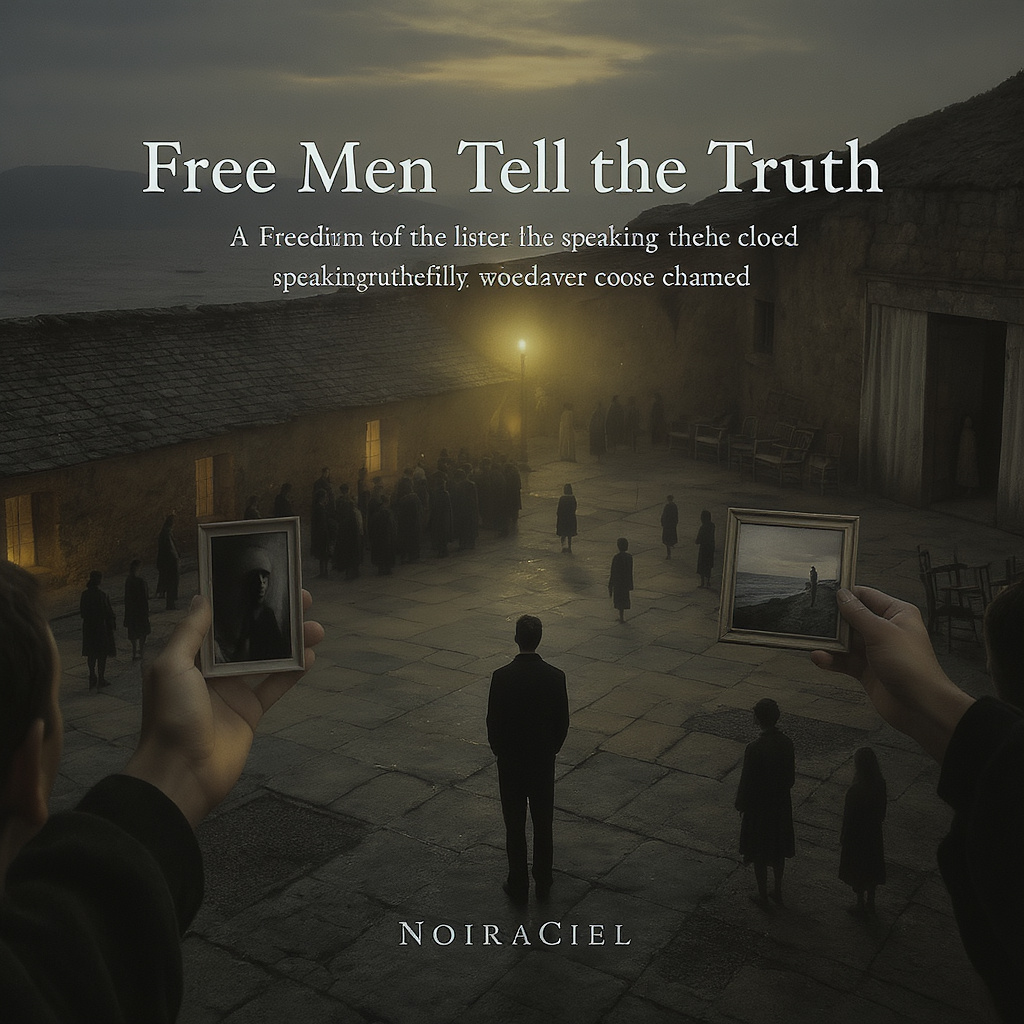
Free Men Tell the Truth
Freedom as clarity — the liberation that comes from speaking truthfully, whatever the cost.
Lyric Video
Lyric Video
Lyrics· 350 words
Oh, there was a boy in a small town who learned to keep his head down He learned some doors stayed open if you never made a sound You watch good people whisper things they wish that they could say But fear has a way of growing when the truth gets pushed away
Every secret gets heavier Every shadow gets longer Three men tell the truth, even when the room turns cold Even when their hands are shaking
Even when they stand alone Because chains aren't always iron Sometimes they're made of fear Three men tell the truth, and suddenly the sky gets clear
There was a woman by the river who carried a burden for years She smiled for every photograph and hid the rest in tears One day she spoke her story, no anger and no blame And the weight she carried quietly never felt the same again
Funny how the hardest words can open locked doors Three men tell the truth, even when the room turns cold Even when their hands are shaking Even when they stand alone
Because chains aren't always iron Sometimes they're made of fear Three men tell the truth, and suddenly the sky gets clear The sky gets clear
Not to win, not to wound, not to prove that they are right But because the truth was never meant to spend its whole life hiding A bird was made to fly A river for the sea
And the truth was made for daylight The way we were made to be free Three men tell the truth, even when it costs them comfort Even when the road gets lonely
Even when the night feels long Because freedom isn't getting everything you want Freedom is having nothing left to hide from anyone Three men tell the truth, and walk a little lighter
Three men tell the truth, and sleep a little better Three men tell the truth, and leave the world a little brighter The truth may cost you comfort, but a lie will cost you peace And peace is too precious to live without
*A story about the cost of silence and the price of speaking*
At the school assembly, the teacher asked who had broken the window in the science corridor.
Thirty-two students looked at the floor.
Leonor knew who had done it. She had been there. It wasn't malicious — a football had gone badly wrong, a window had shattered, and the two boys responsible had looked at each other in the second after it happened and walked away very quickly without saying a word.
She had walked away too.
Now she was sitting in the assembly hall with the others, looking at the same floor, and she could feel the silence like a physical thing pressing on her chest.
The teacher said that no one was in serious trouble — these things happened, windows could be replaced — but that it mattered, for the school to work, for them to trust each other, that when something happened the people who knew about it said so.
Leonor thought about her two friends who had kicked the ball. She thought about how they would feel if she spoke. She thought about how she would feel if she didn't.
She thought about something her father had said once, not to her, but to someone on the phone, not knowing she could hear. He had been talking about a problem at work, about a colleague who had done something wrong and whether to report it. *Free people tell the truth,* her father had said. *That's one of the things freedom means.*
She'd thought about that sentence a lot since. She'd never been sure she fully understood it until now.
She raised her hand.
Thirty-two heads turned. A few of them looked impressed. A few looked worried on her behalf. One of the boys who had broken the window looked at her with an expression she couldn't quite read.
"I know what happened," she said.
It was three seconds of her life. Three seconds and a raised hand. Afterward, when the assembly was over and the teacher had spoken to the boys — who turned out to be fine, who got a lecture and nothing more — Leonor walked out into the corridor feeling lighter than she had in three days.
The boy whose window-breaking had started it all fell into step beside her.
"I was going to say something," he said.
"I know," she said. She thought she probably did know, actually.
"Thanks," he said. Then he went off to class.
Leonor thought about her father's sentence all the way home. *Free people tell the truth.* She thought she understood it better now.
It wasn't that truth was easy. It was that silence, when you knew something, was its own kind of cage.
---
*Speaking the truth is not always comfortable. But it is almost always the thing that lets you sleep.*
More From This Album