Chapter 03 · 2 min 44 sec
The Name I Gave the Customs Officer
The invisible inheritance — what our ancestors planted in us without us knowing.
Lyric Video
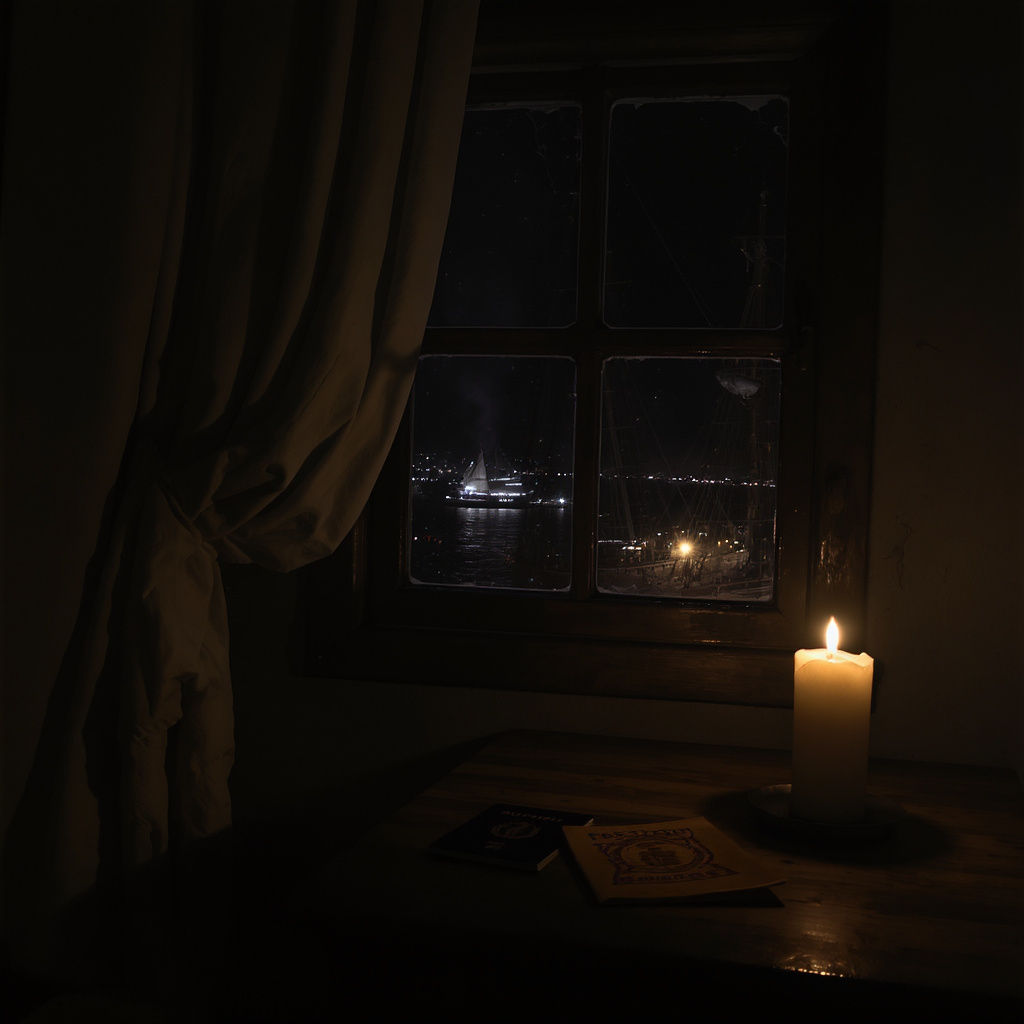
Lyric Video
Lyrics· 278 words
[Verse 1] The officer asked and I answered too fast A name I made up standing in line at the glass It felt like trying on someone else's shoes Walking out the dock with a stranger's name to use
[Verse 2] The room I rented smells like somebody's smoke The key doesn't fit till you lift it and choke I write the false name on the back of my hand So I don't forget who I'm meant to understand
[Chorus] Who am I now that the paper says so Who am I now in a town I don't know I left the old name folded up in my coat And kept the new one like a stone in my throat
[Verse 3] The landlady calls through the door, asks me twice I answer the false name and it sounds about right But something in my chest still turns when she's gone Like a key in a lock that was never quite drawn
[Chorus] Who am I now that the paper says so Who am I now in a town I don't know I left the old name folded up in my coat And kept the new one like a stone in my throat
[Bridge] (half-spoken) If you ever come looking, ask for the woman Who flinches at the name she used to be given That's me. That's still me. I just answer to less now
[Outro] The customs stamp dried on a name that's not mine I'm sleeping tonight on the right side of the line But I keep both names lit like two lamps in the hall In case one of them forgets to answer at all
Short Story
*A story for curious minds*
In a port town where ships unloaded more strangers than cargo, there lived an old locksmith named Bento who believed that everyone arriving by sea carried two names — the one on their papers, and the one that showed up in their face when they thought no one was looking.
He never said this to customers. He only noticed it, the way some people notice weather.
One evening a woman came to his shop needing a key cut for a rented room, and when he asked her name for the ledger, she answered so quickly and so smoothly that he knew at once it wasn't the name her face was wearing.
"That's a fine name," he said, cutting the key anyway. "Mind if I ask what the other one was?"
She went still. "There isn't another one."
"No, there usually isn't," he agreed, "until there is."
She paid for the key and left, and Bento thought no more of it until she returned a week later, agitated, saying the new key didn't fit the lock no matter how she turned it.
He took it from her, turned it once, and it opened clean.
"It fits," he said gently. "I think the trouble isn't the key."
She sat down on his bench without being asked, which surprised them both.
"I keep answering to a name that isn't mine," she said, "and most days it sounds about right. But sometimes someone calls it down the hallway and I don't turn around fast enough, like my own body doesn't believe me yet."
Bento had heard this before, in different words, from other travelers standing in his doorway with new keys that wouldn't quite turn. He told her what he always told them — that a name is just a kind of key too, and sometimes you have to carry the old one in your pocket a while even after you've stopped using it, not because you'll go back to that door, but because a key you've thrown away has a way of making the new lock feel less like a choice and more like a trap.
She didn't throw the old name away. She wrote it on a scrap of paper and tucked it behind the new key on her ring, where it rattled softly whenever she walked, a small and private sound only she could hear.
Months later, when she finally answered to her new name without flinching, she still kept the paper there. Not because she needed it.
Because some locks, once opened honestly, deserve to keep their old key nearby — not to use, just to remember what it cost to need a new one.
More From This Album