Chapter 12 · 3 min 39 sec
The Table Stays Set
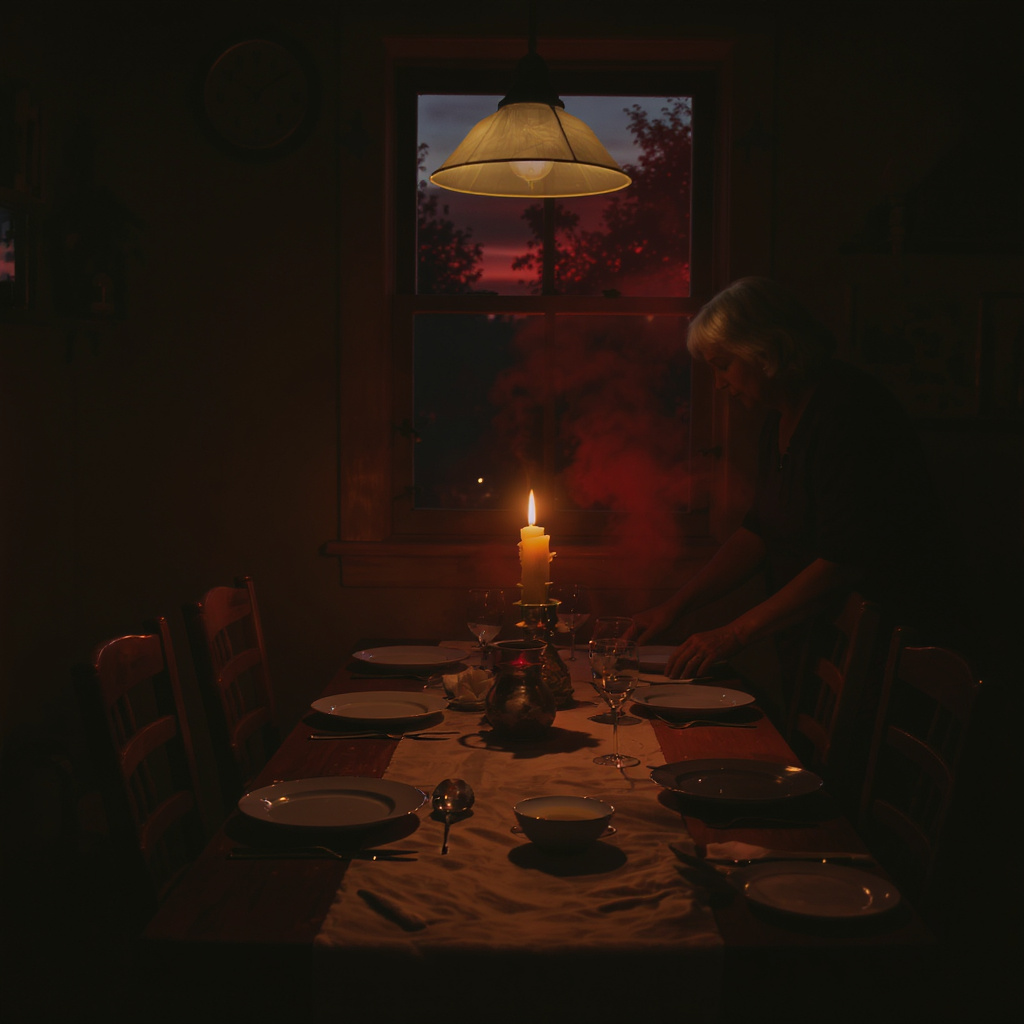
The lit window as love's most silent language — a mother's vigil made visible.
Lyric Video
Lyric Video
Lyrics· 281 words
[Verse 1] Seven plates on a table built for seven souls Three of 'em empty now, but I set 'em anyway, I'm told My daughter says, mama, why don't you just set four I say because this table remembers more than just who walks through the door
[Call/Response] Who's missing today? (My husband, my boy, my friend) Why keep their plates? (Because love don't get to end) Isn't it just habit? (Call it whatever you choose) Isn't it sad to you? (No — it's the only news I refuse to lose)
[Chorus] The table stays set, the table stays set For every chair that the years tried to make me forget I'm not waiting on ghosts, I'm not lost in the past I'm just refusing to let an empty seat be the last word that's cast
[Verse 2] My grandbaby asked whose plate that one is, pointing small I told her that's your grandpa's — he built this whole table, after all She didn't understand, but she touched the empty chair And something in that touching said she felt him there
[Bridge] This ain't no séance, this ain't no candle lit in vain This is just a woman who refuses to let go of the names Every Sunday I cook enough for the ones who left this house Not because I'm haunted — because I'm proud
[Chorus] The table stays set, the table stays set Dignity's not loud, it's just a thing you don't forget No séance, no scripture, just a woman and her spread Making sure that love still gets to break the bread
[Outro] Sit on down — sit on down This table's still the realest church in town
Short Story
*A story for curious minds*
There was a farmer named Imelda who planted an orchard of nine trees the year she married, one for each child she and her husband hoped to raise there, full of the particular optimism of people just beginning a life together.
Only four children ever came. Two more trees were lost to a hard winter years later, and one to a husband who left for a city down south and never wrote again. By the time Imelda was old, only four of the nine trees still stood, and a neighbor, helping her prune one autumn, suggested kindly that she might want to clear the dead stumps and plant something more useful in their place — vegetables, maybe, something that would actually feed her.
"I don't think I will," Imelda said.
"They're just taking up good soil," the neighbor said. "Nothing's coming back from those stumps."
"I know," said Imelda. "I'm not waiting for anything to come back. I just don't see the use in pretending those trees were never planted."
She kept watering the patch of ground around even the dead stumps, out of habit more than hope, and she never once tried to explain this to anyone who asked, because she had found that explaining it made it sound sadder than it actually felt to her. It didn't feel sad. It felt like accounting — like making sure the orchard's whole history stayed visible in its shape, the four living trees and the five gone ones standing together in the same small field, none of them erased to make room for something tidier.
Her granddaughter, visiting one summer, asked about the bare patches between the living trees.
"Those used to be trees too," Imelda told her. "They're gone now. But I like knowing exactly where they stood."
The girl didn't fully understand, being young, but she walked the rows anyway, touching each stump the way you'd touch a name on a stone, and something in the touching seemed to settle in her without needing words for it. The orchard stood that way for the rest of Imelda's life — four trees bearing fruit, five gaps bearing nothing but memory, the whole field telling the truth about exactly what had been lost and exactly what had stayed.
More From This Album