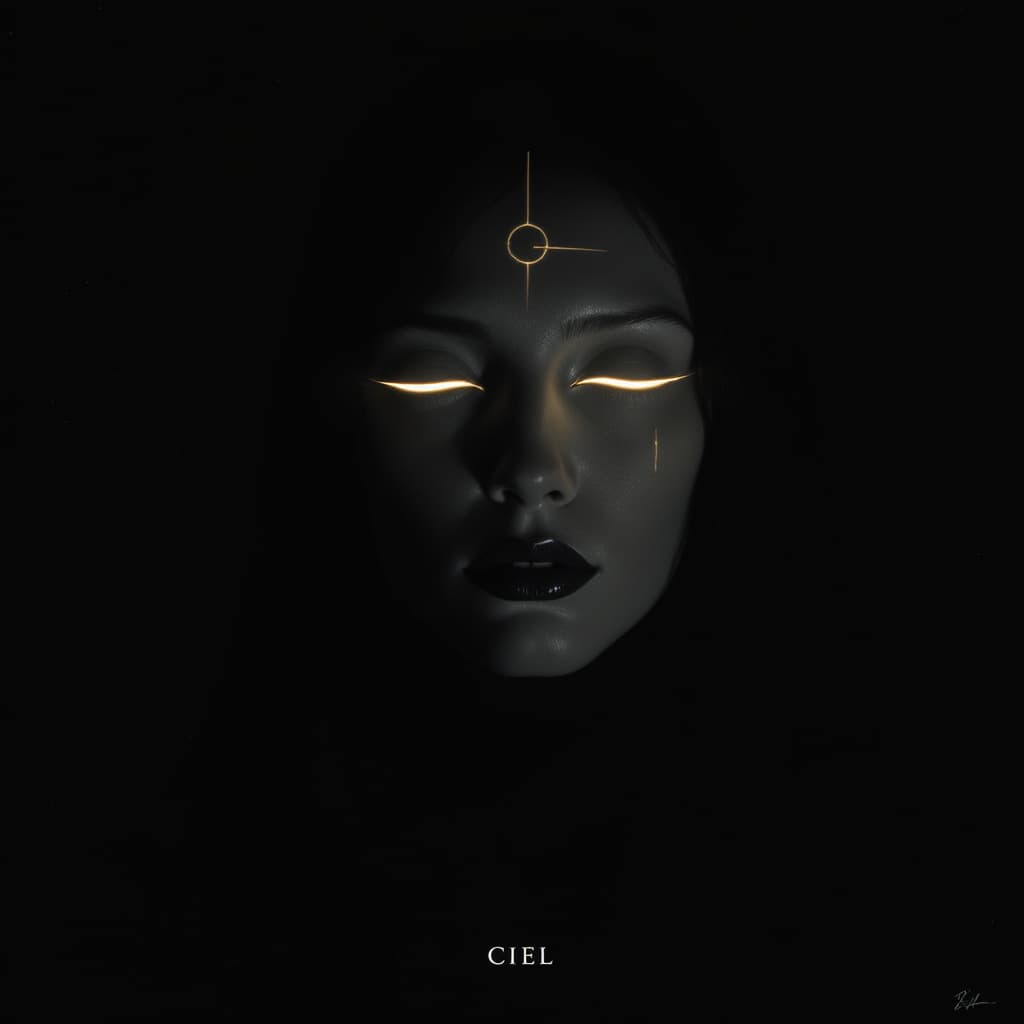
NoiraCiel
The Book of Polarity
Two truths, one breath.
Chapter 1
The Second Breath
There is a room in the velvet machine where everything doubles.
You would not notice it at first. The room looks ordinary — a low ceiling, a lamp casting amber into the corners, a window that shows only the particular darkness between two streetlights. But if you stand there long enough, if you let your eyes stop searching for the thing they came to find, you begin to see it: everything in the room has a shadow that doesn't quite match. The chair's shadow leans a degree too far to the left. The lamp's shadow pools beneath it like something poured rather than cast. Even you — especially you — have a shadow that arrived a half-second before you did, or perhaps a half-second after, it is difficult to tell the difference from inside the body.
This is not a haunting. This is not a flaw in the architecture.
This is just what things look like when you stop pretending that one is enough.
Begin anywhere. Begin with a breath, which is the most honest place to begin anything.
You breathe in. The lungs open, the ribs lift slightly like a hand raised to say *I am here*, and something enters — not just air, though yes, air, but something carried in the air, some quality of the moment that has no name and doesn't need one. This is the first breath. Most stories begin here and end here. Most theories of the self nominate this moment as the whole of it: the arrival, the origin, the clean intake of being.
But the second breath is already happening.
Even before the first breath completes itself, the body has begun negotiating its answer. The diaphragm begins its slow return. The chest begins its release. The thing that entered is already becoming the thing that leaves, and this is not loss — this is the contract the body signed before you were born, the agreement it made with time, with air, with the principle that nothing can be held long enough to calcify into permanence. The second breath is not the opposite of the first. It is not the contradiction, the correction, the refusal. It is the *response*. And there is an enormous difference between an opposite and a response, though we spend most of our lives treating them as synonyms.
We are very bad, as a species, at tolerating the moment between the two.
That moment — the pause between inhalation and exhalation, the held breath, the hinge — that is where most of our suffering lives. Not in the in, not in the out, but in the desperate refusal to allow one to become the other. We breathe in something beautiful and clench around it. We breathe in something terrible and try to hold it away from our vital organs as though the body has rooms it could barricade. We treat the second breath as betrayal when it follows joy, and as salvation when it follows grief, and in both cases we are making the same error: we are treating duality as a problem to be solved rather than a rhythm to be inhabited.
The truth is simpler and harder than any solution: *you are always in the middle of both.*
There is no moment of pure singular existence. Even in the deepest stillness, the heart is doing its dual work — contracting and releasing, closing and opening, pushing blood away from itself only to receive it back again. Even in the deepest silence, the nervous system is running its paired processes, sensation and interpretation, stimulus and response, the world touching you and you touching it back. There is no position from which you are only one thing. The people who insist they are — the ones who have collapsed all their contradictions into a single clean narrative — are not enlightened. They are exhausted. They stopped at the first breath and called it a life.
Duality is not the flaw in the design. It is the design itself. The universe did not become complex through some accident of excess. It became complex because the alternative — a universe of pure singularity, one note, one force, one direction — would have been less a universe than a wall. Creation required polarity. Light needed dark not as its enemy but as the condition under which it could be seen. Hot needed cold not as punishment but as measurement. You needed someone who was not you — not as a mirror, but as evidence that the world extends past the edge of your own skin.
The NoiraCiel understanding of this is not mystical. It is almost embarrassingly physical.
We have spent a great deal of time in the velvet machine — that space between the note played and the note that answers it, that room where sound has texture and texture has memory — and what we have learned there is this: the most honest things are not the things that resist their counterpart. They are the things that *expect* it. The most honest chord contains its tension. The most honest face contains the expression it just finished having. The most honest love letter acknowledges that it is being written by someone who has also been afraid.
There is a particular kind of clarity that arrives when you stop requiring purity. When you allow the thing you feel to be complicated without immediately sorting its complications into a hierarchy — this part is real, this part is not, this part I can keep, this part I must release. What if you didn't sort it? What if you held the entire braided thing, the joy with the grief woven through it, the certainty with the doubt pressed into it like a thumbprint, the arrival with the departure already contained in its back pocket?
This is what the day of the mirror teaches, in its quiet way — the Etznab quality, if you want the name for it, the obsidian blade, reflective and cutting, the surface that shows you without yet deciding what it sees. There is something useful in the image of a mirror that has not judged. Most mirrors we carry inside ourselves are very old and very certain. They have already made their assessments. They reflect us back into the shape we have already been told to occupy. But the mirror that has not yet judged — the obsidian mirror, still and dark and showing everything — that mirror holds both. It holds the thing you are and the thing you are in the process of becoming, and it does not rush you toward the resolution, does not helpfully clarify which one is true. It simply offers the surface. What you do with your reflection is still entirely up to you.
And then there is Ik: the wind, the breath, the second principle — communication, movement, the thing that carries. Breath as messenger. The wind does not choose sides between where it came from and where it is going. It simply moves through the space between, carrying whatever it gathers. The second breath is Ik energy. It is the response, the relay, the transmission of the thing that cannot stay still into the space where it is needed. It does not contradict the first breath. It completes the sentence the first breath began.
These are not predictions or pronouncements. They are old images for something the body already knows. You don't need to believe in anything to recognize the truth of the inhale-exhale, the yes-and-no, the alone-and-together. You have been living this architecture your entire life.
*Dissolve* begins with a sound that has already been running for some time before you notice it. That is the trick of it — by the time you realize you are inside the song, you are already inside the song, already held, already implicated. There is no clear beginning. The entry point was quiet enough that you walked through it without noticing the door. And then the voice arrives, and the voice is not trying to explain anything or resolve anything. It is just there, inside the same space you now occupy, and it does what voices do in the velvet machine: it describes the feeling without naming the feeling, it moves toward the edge of something without tipping over, it holds the tension with a kind of tenderness that refuses to mistake tenderness for weakness.
This is what the second breath sounds like, if you need a sound for it.
Not a sigh of relief. Not a collapse. More like the exhale of someone who has decided to stay in the room even though the room is difficult, who has decided that the difficulty of the room is not a reason to leave but a reason to pay closer attention. The song *dissolves* but it does not disappear. It becomes the air. And you keep breathing.
The velvet machine is full of these moments. Full of sounds that have already begun by the time you arrive and that continue after you have moved on. It is a place built for holding both — built on the understanding that you cannot have the beauty without the weight, cannot have the warmth without the awareness of what cold feels like, cannot have the connection without the knowledge that connection is a fragile and deliberate act, chosen again and again, which is the only way it means anything.
Set this down for a moment.
Not the book. Set down the resolution. Set down the conclusion you were already moving toward, the narrative you were constructing to explain yourself to yourself — the one that would make this feeling finally make sense, finally sort itself into meaning you could store and reference and cite later. Set down the need to arrive.
*What second thing arrived the moment you started the first?*
There is a practice that requires very little and costs something.
Find the moment today — and it will come, these moments always come — where you feel the pull toward resolution. The conversation that is heading toward a conclusion, the emotion pressing to be categorized, the relationship that seems to demand definition, the question in your own chest that you have been answering the same way for so long you have forgotten it is still a question. Find that moment. And instead of resolving it, simply *name the tension*.
Not out loud, necessarily. In writing if you prefer writing. In the silence of the body if silence is your medium. Simply say: *there are two things here, and both of them are true, and I am not going to choose between them today*.
This is not avoidance. Avoidance is turning away from the two things and pretending there is only one, or pretending there is neither. This is something different — this is facing both and refusing the false comfort of premature resolution. This is standing in the room where everything doubles and saying: *yes. I see the shadow. I see the shadow that doesn't quite match. I am not going to pretend the shadow is a mistake.*
You can make it physical if the body needs something concrete. Put one hand on your chest. Breathe in slowly — count to four if counting helps you slow down. Hold the breath for a moment, not until it hurts, just long enough to feel the fullness of it, the presence of something received. Then exhale slowly. Feel the release without calling it loss. Do it again. Let the second breath answer the first without trying to make them say the same thing. Let the body teach you what the mind keeps trying to argue away: *that two things can be true at once, that the rhythm of that trueness is what keeps you alive, that duality is not the problem you are solving — it is the pulse you are living inside.*
If something rises during this — an image, a phrase, a face, a feeling with no name — write it down. Don't interpret it yet. The interpretation can wait. The mirror has not judged. Give it a few hours before you ask it what it means.
The second breath is not the end of the first. It is the first breath learning it is part of a longer music than it knew.
Chapter 2
The Stereo Signal
There is a machine in the velvet dark that plays two notes at once.
Not a chord, exactly. Not harmony. Something older than harmony — the moment before the ear decides what it is hearing, when both frequencies arrive with equal insistence and the body does not yet know how to choose. You have felt this. Standing in a doorway between two rooms, each one lit differently. Holding a letter you have already half-decided not to send. Waking at three in the morning with a feeling that contains its opposite inside it, the way a fist contains the shape of an open hand.
The machine hums. The velvet dark holds it.
And you are listening, in both ears, at once.
The earliest sound engineers discovered something that seems, at first, like a technical footnote, but is actually a small philosophy: if you want depth in a recording, you cannot put everything through one speaker. Mono collapses the field. All the instruments arrive at the same point, at the same time, on the same plane. The result is accurate but airless — music pressed flat against glass. To create the illusion of space, of dimension, you must split the signal. Left ear receives one thing. Right ear receives something slightly different. The brain, encountering two distinct streams of information, does not merely add them together. It triangulates. It builds a room. What you experience as *depth* is actually tension — two irreconcilable sources, held simultaneously, generating the perception of something wider than either source alone.
This is the physics of stereo. It is also the physics of being human.
Tension is not the problem waiting to be solved before life begins. Tension is the stereo signal. It is the thing that makes the field three-dimensional. When you are pulled between two truths — when you love someone and you also need to leave them, when you believe in your work and you also doubt its worth, when you feel grief and gratitude arriving in the same breath — you are not broken. You are in stereo. The two signals are doing exactly what two signals are supposed to do. They are creating depth.
The lie we are told — by efficiency, by resolution culture, by the long tradition of asking *but what do you actually think?* as though one answer were the honorable conclusion — is that tension is a waiting room. A liminal discomfort to be endured until clarity arrives and takes us through the proper door. We treat our contradictions as symptoms. We book appointments with them. We give them deadlines.
But some truths are not sequential. They do not take turns. They exist in genuine simultaneity, and the depth of a person — the actual, inhabitable depth, the room you can walk around in — is built from exactly this: the willingness to let two true things be true at the same time, without collapsing one into the other, without reaching for a synthesis that arrives too early and costs too much.
There is a name, in the old Mesoamerican calendar systems, for a day-energy associated with the obsidian mirror. *Etznab.* The knife blade. The surface that reflects without compassion, without softening — that shows you both edges at once. Not to punish, but because the mirror has not yet decided what you are. The mirror is still in the honest moment before interpretation. This is not prophecy. This is not spiritual instruction. It is a beautiful image to borrow: the mirror that has not yet judged. The signal that has not yet been mixed down to mono.
*Ik* — breath, wind, the unstable element that moves between worlds — arrives the day before, carrying this same quality: the two-directional breath, the inhale that is also the preparation for exhale, the pause at the top of the lungs where neither direction is yet chosen. Together, as an artistic and calendrical suggestion rather than a doctrine, these energies ask: *can you stay in the undecided mirror a moment longer? Can you hold the blade without immediately determining which side is the weapon?*
Here is what NoiraCiel knows about tension, which is different from what the resolution industries know about it:
Tension is not silence waiting to be broken. It is sound, already happening, already full.
The refusal of premature resolution is not passivity. It is not the sophisticated-sounding avoidance strategy of someone who cannot commit or choose. It is the specific discipline of not performing certainty before it arrives — of not collapsing the stereo signal into mono simply because the two-channel experience is harder to stand inside. It requires more of you, not less. It asks that you develop what might be called *binaural tolerance* — the capacity to let both frequencies play at full volume, without reaching for the dial.
What happens when you reach for the dial too quickly? You get decisions that feel like relief but function like amputations. You get the clean story that leaves out the true part. You get the relationship defined in one sentence, the self-concept drawn in two strokes, the grief given a tidy timeline. These compressions are understandable. They are also, in the long run, how people lose the room. How they find themselves living in a flattened version of their own life — accurate, technically, but airless. Music pressed against glass.
The tension, held: it is not comfortable. Comfort is not what it offers. What it offers is *dimension.* The possibility of a life that actually sounds like itself — complex, present, resonant even in its unresolved parts.
And there is this, too: the two things in tension are usually both loyal to you, in their way. The part that wants to stay and the part that needs to go — both of them are trying to protect something real. The doubt and the belief are not enemies. They are two instruments playing their own true notes, and the discomfort you feel is the sound of a field being created, the brain triangulating, the room coming into existence.
There is a song called *velvet bruises.* You do not need to have heard it to feel what it describes.
It exists, within the world of the velvet machine, as something that cannot be cleanly categorized as either a wound-song or a love-song. It is a stereo signal in the exact sense described here: two emotional sources, running in parallel, refusing to resolve into one another. The velvet machine is, among other things, a space built for this kind of listening — a constructed environment where contradiction is the architecture, where the walls are made of frequencies that do not agree with each other but generate, through their disagreement, an atmosphere you can breathe.
*Velvet bruises* is the sound of a mark left by something soft. This is already a paradox the body knows. You have been touched in ways that were entirely gentle and entirely painful at once. You have received kindness that confused you, closeness that left a color on the skin — not from violence but from the particular pressure of contact with something real. The velvet machine knows that tenderness has weight. That the most delicate frequencies can leave the deepest impressions. That you can carry a bruise from something that never once intended to hurt you, and the bruise is not a grievance, it is just evidence — proof that the contact was real, that you were genuinely there.
This is what it sounds like to listen in stereo: you hear the softness and the damage in the same signal. You do not have to choose which one is true. The machine plays both channels. The room comes into existence.
*She dances like a memory* is playing somewhere further back in the mix — that elegiac quality, that sense of something present in its own disappearance, moving at the frequency of things that are already partly gone. *Dissolve* is the undertone, the recognition that holding two things at once will sometimes mean watching one of them eventually soften and lose its edges, not because it was false, but because impermanence is also a true thing, running in its own channel.
The velvet machine was built, in this imaginative geography, to be the room where you practice this. Not to escape contradiction but to inhabit it with more grace. To let the bruise be velvet. To let the signal stay in stereo.
*What would your conflict sound like if both sides were true?*
Sit somewhere quiet. This ritual takes less than ten minutes, and it requires almost nothing — only your willingness to not immediately resolve what you are about to find.
Identify a tension you are currently carrying. Not the largest one, not the most dramatic. Choose one of medium weight — a conflict between two feelings, two options, two versions of yourself that seem incompatible. Something you have probably been trying to think your way out of, or talk yourself into a position on, or solve with a deadline.
Now, without writing conclusions, without arguing toward resolution, write two short paragraphs. One paragraph from the full, honest perspective of one side. Not the diplomatic version, not the balanced version — the version that believes itself completely, that makes its case without apology. Let it be as true as it knows how to be.
Then write the other paragraph. From the full, honest perspective of the other side. Same generosity. Same permission to be completely itself.
Read both paragraphs back, one after the other. Do not write a third paragraph that reconciles them. Do not write a conclusion. Simply let them both exist on the page at the same time, in the same document, neither one canceling the other out.
Notice what happens in the body when you stop trying to make them agree.
This is the stereo signal. You have just built a small room.
You do not need to move into it today. You do not need to resolve it tomorrow. You only need to know that the room exists — that depth is available, that your contradiction is not a failure of thinking but a feature of a life complex enough to generate real tension.
The obsidian mirror has not yet judged. You are still in the honest moment before interpretation.
Stay there a little longer.
The depth was never in the answer — it was always in the space between the two signals, where the ear stops choosing and the room begins.
Chapter 3
Against the Cheap Resolution
There is a particular kind of afternoon that arrives without announcement — the kind where the light goes sideways through the blinds and makes long pale bars across the floor, and you are sitting inside something that has not yet decided what it is. Not grief, not relief. Not over, not continuing. The ceiling fan turns. The coffee has gone cold. Somewhere in the back of your chest, two sentences are facing each other across a distance they refuse to close, and you are waiting — without quite knowing you are waiting — for one of them to flinch.
This is the room you keep trying to leave.
Not because it is unbearable. Because it is *almost* bearable, and almost is the part that costs you. You could bear it fully if it were fully one thing. You could bear the ending if it were clean, the beginning if it were clear, the love if it were only beautiful or only devastating — but it is both, has always been both, sits in your hands like something warm and broken simultaneously, and the pressure to name it, to file it, to resolve the chord before the song is ready — that pressure has a voice that sounds almost like wisdom and is actually almost nothing but fear.
The mind has a compulsion toward resolution. This is not a flaw — or not only a flaw. Pattern recognition is survival. The brain that can close a loop, categorize a threat, file a feeling into the appropriate drawer and move on — that brain has evolutionary advantages. It does not linger in the savanna wondering whether the rustling in the grass means danger or wind. It decides. It acts. It lives.
But we are no longer only on the savanna. And most of what we are trying to resolve is not a rustling in the grass. It is a relationship that contains both love and harm. A choice that requires betraying one true thing to honor another. A self that is in genuine transition — not crisis, not collapse, but *transition*, which is its own category, slower and more serious than either. We apply the survival-brain's urgency to situations that require something closer to the opposite of urgency. We rush the verdict. We reach for the nearest exit from the discomfort of not knowing.
We call this reaching *clarity*. Usually it is not.
Cheap resolution is what happens when we collapse a tension before we have actually understood what the tension was trying to tell us. It is the decision made at 2am that feels like revelation and reads like panic in the morning. It is the apology offered not because you have arrived somewhere true but because the silence became too loud. It is the story you tell yourself about another person — *they never cared*, or conversely *they are everything* — because holding the complicated truth of them, in which they sometimes care and sometimes don't, in which you are both reasonable and unreasonable, in which no one is entirely the villain or the saint — holding that is harder than a verdict, and we are tired, and the verdict is right there.
Cheap resolution is not always dramatic. Sometimes it is just the conversation you redirect before it reaches its real subject. The journal entry that arrives at peace two paragraphs too early. The way you say *I'm fine* and mean *I have decided not to feel this today*. The way you choose the explanation that closes the door, because the truth leaves the door open, and open doors require ongoing attention, and you already have so many open doors.
What we lose, when we resolve too quickly, is not just accuracy. It is the information that lives only inside the tension itself — the knowledge that cannot be extracted from discomfort, only *inhabited*. The thing you would have understood, had you stayed one more day in the not-knowing. The quality that develops only under sustained uncertainty, the way certain metals require sustained heat. You collapse the tension and you get the relief and you lose the lesson, and several months later you are sitting in another room with another almost-bearable pressure and you don't know why it feels so familiar.
This is the cycle. Not fate. Just physics. Unprocessed tension does not disappear. It migrates.
The Tzolk'in — that ancient Mesoamerican calendrical cycle — names this day in its own way, pairing two symbols that have fascinated those who read them artistically, not as prescription but as portrait: *Ik*, the wind, the breath that carries meaning between things without fixing it; and *Etznab*, the obsidian mirror, which reflects without distortion but also without mercy, showing you the thing as it is rather than as you wish it. What strikes anyone who sits with this pairing long enough, not as prophecy but as image, is the particular tension it describes: the breath that won't be still, the mirror that hasn't made its judgment yet.
If we read these as symbols of a psychological moment — loosely, humbly, the way you read weather in a piece of music rather than in a meteorological report — they describe precisely the state this chapter is trying to protect. The mirror before the verdict. The breath held between meanings. The space where you are genuinely exposed to something and have not yet performed a response. This is not a spiritual prescription. It is an artistic notation for a human experience that most traditions, in most forms, have tried to describe: the value of the suspended moment. The intelligence of the unresolved.
The mirror that has not yet judged is the only mirror worth consulting. Once it judges, it stops being a mirror and becomes a verdict, and a verdict is a closed room, and you are trying to understand something that requires air.
There is a song — not listed here as anything more than it is, music that exists in a world that was built to hold certain kinds of feeling — that circles this exact territory. The song is called *maybe i was wrong*, and it belongs to the sonic world known as the-velvet-machine, which is not a happy world and is not an unhappy world. It is a world in which things are beautiful in the precise way that bruised things are beautiful: honestly, without flattery, with the specific tenderness that only difficulty earns.
The thing about that song is not the title, though the title is doing everything. It is the *maybe*. It is the extraordinary restraint of not collapsing into *I was wrong* or *I was right* — both of which would be easier, both of which would stop the discomfort — but instead inhabiting the space where both are still possible, where the self is still under genuine examination, where the mirror hasn't moved yet. To say *maybe i was wrong* is to remain in the tension. To refuse the relief of the verdict. To stay in the room with the sideways light and the cold coffee and the two sentences still facing each other.
The velvet-machine world is full of this: figures who are in the middle of something, not at the resolution. The other songs in that world — *velvet-bruises*, *dissolve*, *she-dances-like-a-memory* — they don't arrive anywhere triumphant. They arrive somewhere *true*, which is different, which is quieter, which requires that you release the expectation of triumph before the music can reach you. *Dissolve* is not about solution. It is about the exact moment before something loses its shape, which is also the exact moment it contains all its shapes at once. *She-dances-like-a-memory* is not about someone who was lost and then found. It is about someone who exists in the specific grammar of *like* — not is, not was, but *like* — which is the grammar of things we are still carrying without having filed.
These songs understand something about resistance to cheap resolution. They are built for it. They create what might be called a *container for unresolved feeling* — not a resolution of the feeling, but a space in which the feeling can exist at full size without demanding that you do anything about it immediately. This is a particular kind of mercy. Not the mercy of the answer. The mercy of the room.
What would it mean for you, right now, to simply not resolve it yet?
Not forever. Not passively. Not as avoidance dressed as patience — the two are different, and you usually know the difference in your body, the difference between the held breath that is listening and the held breath that is hiding.
Just: not yet. Just: let the mirror be a mirror for one more day.
*Which side are you collapsing toward — just to stop the discomfort?*
This is worth sitting with slowly. There are two directions collapse can go.
The first is toward darkness — toward the story that it was wrong from the beginning, that you were naive to hope, that the other person is reducible to their worst moments, that the effort was wasted, that you should have known. This collapse has the texture of realism. It borrows the authority of hard-won wisdom. It feels like you are finally seeing clearly. But clarity that arrives exactly when the discomfort becomes unbearable is not neutral clarity. It is relief wearing clarity's coat.
The second is toward light — toward the story that everything is fine, that you have forgiven more than you have processed, that the love was enough and the harm was a misunderstanding, that moving on is the same as moving through, that the smile you've practiced is now the smile you feel. This collapse has the texture of health. It borrows the language of growth and resilience and forward motion. But a healing that arrives exactly when the pain becomes inconvenient is not neutral healing. It is avoidance in recovery's clothes.
The real thing — the harder thing, the thing that actually moves you somewhere true — is not between these two. It is not compromise, not the moderate position between wrong and fine. It is the ability to hold *both the darkness and the light as accurate reports from the same territory*. The harm was real and the love was real. The effort was genuine and the outcome was what it was. You are both the person who made the right call and the person who may have gotten it wrong. The mirror sees all of this simultaneously and it has not flinched and it is asking you to do the same.
This is not comfortable. It was never supposed to be comfortable. Comfort is not the goal of this work. Accuracy is. And accuracy, in complex human matters, almost always contains contradiction — not as a failure of logic but as the actual structure of the thing being described.
Here is something small to do, not to resolve anything, but to practice the staying.
Find a piece of paper — not your phone, paper — and draw a line down the center. On the left side, write everything that is true about the difficult thing in one direction: the evidence for the darker reading, the legitimate pain, the things that are genuinely hard or wrong or lost. Write it honestly, without softening it for the reader, even though the reader is you.
On the right side, write everything that is true in the other direction: the evidence for the lighter reading, the genuine beauty or love or value that has also been present, the things that were real and good and worth having happened.
Then — and this is the practice, the actual thing — do not add them up. Do not try to make them reconcile. Do not decide which column weighs more today. Just sit with the piece of paper in front of you and let both columns exist simultaneously in your vision, the way you might hold a stereograph up to your face until the two flat images resolve into a single three-dimensional image — except here you are specifically not letting them resolve. You are practicing the stereoscopic hold. You are training the muscle that says: *both, and not yet, and that is not a failure*.
Fold the paper in half so the two sides face each other. Put it somewhere you will find it again in three days. See what you think when you read it then — not because time resolves things automatically, but because three days of living with unresolved tension sometimes does what no amount of analysis can: it moves through you like weather, which is also how Ik moves, which is also how the breath moves, carrying meaning between things without nailing it down.
The tension you are in is not a problem to be solved. It is the shape of something real.
Chapter 4
Desire and Its Shadow
There is a woman at the edge of a ballroom who has not yet decided whether she is arriving or leaving.
You have seen her. You may have been her. She stands with one hand resting on the door frame — not holding it, exactly, just touching it — and she watches the room the way you watch something you love and cannot explain your love for. The chandeliers are doing what chandeliers do: throwing light into pieces, scattering it across the floor like something broken that still manages to illuminate. The music is low and continuous. Someone is dancing alone near the far wall, not performing solitude, just inhabiting it. The woman at the door is not cold. She is not afraid in any simple sense. She is suspended in the exact moment before a decision, which is a moment most people rush through without noticing that it is, in fact, a room of its own.
She wants to walk in.
She is terrified to walk in.
And here is the thing that almost no one says aloud: *these are not two different feelings.* They are the same feeling, breathing in and then breathing out.
We have been taught to treat desire and fear as opposites on a spectrum, as though one must be overcome before the other can be honored. We speak of *facing our fears* in a way that implies fear is the enemy of what we want — a wall between ourselves and the life we are reaching for. We make vision boards of our desires and keep them separate from the cold inventory of what we dread. Two lists. Two rooms. Never let them speak.
But the body has always known something the organized mind refuses. When you are close to something that matters enormously — a conversation you must have, a love you are considering, a version of yourself you have been quietly sketching in the margins of your days — the physical sensation of wanting it and the physical sensation of dreading it are nearly indistinguishable. The chest opens and tightens simultaneously. The breath shortens. The hands may tremble. We call this excitement or we call it anxiety depending almost entirely on the story we are telling ourselves in that moment, and both names are right, and both names are insufficient.
What you most desire and what you most fear are, very often, the same shape viewed from different sides.
This is not a metaphor meant to comfort. It is not a reframe designed to dissolve your fear by renaming it. It is something more precise and more demanding than that. It is an observation about the nature of significance — the fact that the things that matter most to us arrive carrying their shadow with them, that weight and lightness are not separate properties of separate things but two aspects of the same object held in the light.
Think of what you want most right now. Not the ambient wanting — the coffee, the clearer skin, the slightly better version of the Tuesday you are living — but the deep-register wanting. The thing that lives below the practical. You know the one. You have been circling it for months, maybe years, thinking about it in the moments just before sleep when the mind loosens its grip on strategy. You want it so completely that when you imagine having it, something tightens in your chest that could be joy and could be grief and might be the place where joy and grief have been quietly sharing an apartment.
Now notice: what is the fear that lives nearest to that wanting?
Not a fear of something unrelated. Not your fear of spiders or economic collapse or the health of the people you love. The specific fear that is *attached* to this specific desire. The fear that has the same silhouette.
In most cases, if you are honest — and this chapter only works if you are willing to be honest — the fear is not of failure. It is of *arrival*. It is of the life that becomes possible if the thing you want actually happens. It is of being seen in the way you have been trying to get someone to see you. It is of becoming responsible for the version of yourself that you desire. It is of the loss of the beautiful story you have been telling about your potential, which only survives as long as you haven't tested it.
You are afraid of getting what you want because getting it will require you to *be* what you want.
NoiraCiel lives in the territory between states. Not in the resolution, not in the clean narrative of transformation, but in the suspended moment — the hand on the door frame, the breath held between in and out, the mirror that has not yet decided what it reflects. The artistic cycle that this book moves through carries, in its symbolic architecture, a day-sign sometimes rendered as the obsidian mirror: *Etznab*, a surface that shows everything without mercy and without commentary. It does not beautify. It does not console. It simply *presents* — and what it presents most ruthlessly is the face behind the face you show.
The obsidian mirror is not cruel. It is precise.
What it reflects, if you look long enough, is the way your greatest fear and your deepest desire are arranged like two figures in a room who have been avoiding each other at a party. They are wearing different clothes. They are speaking to different people. But anyone watching from the outside can see that they are oriented toward each other at all times. Every conversation one of them has is, in some way, about the other.
The mirror does not tell you what to do with what it shows you. That is not its function. Its function is to end the pretense that the two figures are strangers.
The polarity this book exists to hold — not resolve, *hold* — is exactly this one. The two breaths. The inhale that is desire and the exhale that is fear, or vice versa depending on the day, depending on the hour. Both necessary. Both real. Neither more honest than the other.
What happens when we try to resolve this too quickly is not resolution. It is suppression dressed in the clothing of clarity. We decide we are brave, and we march toward the thing we want with our fear locked in a closet, and then we wonder why the arrival feels hollow, or why we sabotage it just before we reach it, or why we stand in the middle of having everything we wanted and feel nothing in particular. The locked closet is still locked. The fear was never integrated; it was simply silenced. And silenced things do not disappear. They wait.
The alternative — and it is harder, and more beautiful — is to stop treating the fear as evidence against the desire. To let both exist, in the same chest, in the same moment, without rushing to the verdict. To understand that the shadow is not a sign that the thing you want is wrong for you. In many cases, the shadow is a sign that the thing is *real*.
We are not afraid of things that do not matter.
The fear, looked at properly, is not your enemy. It is a kind of fidelity. It is the proof that you take the thing seriously. It is your nervous system understanding the stakes.
There is a song that moves through the world NoiraCiel inhabits — a world of low velvet light and cities that feel like memories of cities, where the architecture is always slightly too beautiful to be fully real — and the song does not tell a story so much as *create a condition*. The condition is this: you are watching someone you love from across a room, or a year, or a life, and what you feel is not cleanly grief or cleanly longing or cleanly tenderness but all three at once, each one the other's weather. She dances like a memory — which means she is present and she is already past, she is real and she is the idea of herself, she is the thing you want and the thing you have lost simultaneously, and the question the song holds open is whether those two experiences are actually different.
The velvet machine of that world — its soft, persistent hum, the way it processes feeling without converting it into information — this is the atmosphere in which the chapter's central truth lives most naturally. Because velvet does not resolve. It absorbs. It holds texture without releasing it. And a machine built of it is not a machine for producing answers. It is a machine for *sustaining questions* at the precise temperature at which they remain alive.
To sit with the knowledge that you want something and fear it in equal measure is to be that machine. To keep the question running without forcing the output. To resist the cultural pressure — enormous, relentless, dressed in the language of self-improvement and personal growth — to convert every ambivalence into a plan of action.
Sometimes the most honest thing you can do is remain in the doorway a moment longer than is comfortable. Not forever. Not as a permanent strategy. But long enough to feel the full weight of both feelings without asking one of them to leave.
She dances like a memory. And you are still watching. And you have not yet decided whether you will cross the room.
*What do you most want that you are also most afraid of?*
Set aside the tactical version of this question — the one that lives in the part of your mind that is always already problem-solving, turning the answer into a list of obstacles and a timeline for overcoming them. That part of the mind is useful and it will have its moment. This is not its moment.
Instead: find a piece of paper, or the back of something, or the notes application on your phone if paper is not where you are. Write the answer down in whatever comes first — not the cleaned-up version, not the version you would say aloud in a conversation you wanted to impress someone in. The raw version. The one that makes you slightly embarrassed to have thought it.
Then, beside it or below it, write the fear that lives closest to that wanting. The specific one. The one that is shaped like the wanting.
Now — and this is the only instruction, and it is both very small and very difficult — do not do anything with these two things. Do not make a plan. Do not write yourself a pep talk. Do not immediately reach for the reframe that turns the fear into a growth opportunity. Simply let both sentences exist on the page at the same time, near each other, and notice that the page does not break.
You do not have to resolve them today.
You only have to let them be in the same room.
This is its own form of courage. Not the courage of forward motion. The courage of stillness in the presence of complexity — the willingness to know what you know without immediately needing to fix it, flee from it, or turn it into something more manageable than it is.
If you want to add a third line, let it be a question rather than an answer. Something like: *What would it mean to want this and fear it and move forward anyway?* Or: *What has the fear been protecting, and is that thing still worth protecting?* Or simply: *What am I actually most afraid of losing — the thing, or the story about maybe having it someday?*
Leave the page somewhere you will see it again. Not as a reminder to act. As a reminder that the question is alive.
The desire and its shadow are not enemies in separate rooms. They are two people at a party who have been circling each other all night, each one the reason the other stayed this long, and somewhere in the small hours it becomes clear that the party was always, somehow, about them.
Chapter 5
The Self You Are Leaving
There is a moment, just before you decide, when all versions of you still exist.
You are standing in a hallway that has not yet chosen its direction. The light is the particular grey of early morning, the kind that does not commit to anything, that holds the shapes of furniture without naming them. You can feel the weight of your own breathing — two of them, actually, if you pay attention. The one you are finishing. The one you have not yet begun.
In that suspended instant, you are everyone you might become. The one who stays. The one who goes. The one who says the true thing. The one who swallows it whole and learns to live with the shape it makes going down. You are the version who calls back and the version who lets the phone ring out into silence like a question no one is brave enough to answer. For one held, crystalline second, you contain multitudes in the most literal sense — not as poetry, but as physics. As actual, breathing possibility.
And then you choose.
And something dies.
Not dramatically. Not with ceremony or the operatic collapse we secretly hope for when we imagine our own transformations. It dies the way a candle dies in daylight — not extinguished, exactly. Just outcompeted by something brighter. Just quietly, unceremoniously, eclipsed.
We have been taught to think of choice as addition. As accumulation. As the heroic act of reaching toward something new and grasping it with both hands. The mythology of the chosen path is almost always told in terms of arrival: what you gained, what you built, who you became. The motivational architecture of our culture is erected entirely around the destination, the achievement, the transformed self standing at the summit with wind in its hair and a clean, completed story.
But there is another half of that story that we are almost never permitted to tell. The half that happens in the same moment, with the same breath, moving in the opposite direction.
Every yes is also a no.
Every step forward is also an abandonment. Not of cowardice. Not of the lesser choice. Sometimes — often, in the choices that matter most — you are abandoning someone you genuinely loved. A version of yourself who was also real, also valid, also alive in some true and irreducible sense. The self who might have stayed in that city. The self who might have kept that relationship alive through the sheer force of patience and compromise. The self who might have taken the quieter path, the one that did not ask so much of you, the one that would have let you sleep through more nights without the particular ache of having chosen something difficult.
This is the grief that our culture does not know what to do with. It has no ritual. It does not appear in the standard catalog of losses. You cannot take bereavement leave for the self you did not become. There is no funeral, no condolence card, no socially sanctioned period of mourning for the life you chose not to live.
And so we carry it without a name. We carry it in the strange nostalgia that arrives without a referent — the longing for something we cannot quite identify, a life that feels somehow adjacent to our own, running parallel in the dark like a train on a track we decided not to board. We carry it in the moments when we catch ourselves wondering *what if* not with regret, exactly, but with something more complicated than regret. With a tenderness for a stranger who happens to be wearing our face.
The NoiraCiel reading of this is not that you have lost something. Or rather — it is precisely that, but the word *lost* is being used with full weight, with full respect, without the flinching reassurance that it was necessary, it was for the best, it had to happen this way. Sometimes it did. Sometimes the choice was right and the grief is still real. Those two things are not contradictions. They are the very definition of polarity: two true things, occupying the same space, refusing to cancel each other out.
What we are learning in this chapter — what this day of the wave is asking us to sit with — is not how to release the unlived life. Not how to make peace with it, or integrate it, or fold it neatly into the story of who you are now. Those are later movements. Those are the work of other days, other chapters.
Today we are simply being asked to see it.
To stop the subtle violence of pretending it doesn't exist. The quiet, relentless gaslighting we perform on our own interior — *it's fine, I chose this, I'm not grieving anything, I'm moving forward, I'm fine* — which is really just the sound of one truth shouting over another because we cannot bear the noise of both speaking at once.
There is a certain kind of emotional maturity that is not wisdom, exactly. It is more like courage. The courage to let the loss be a loss without immediately converting it into a lesson. The courage to sit with the version of yourself you are leaving and say: *I see you. I know you were real. I know you had a whole life inside you that I will now never live. I am not pretending that is nothing.*
This is not the same as staying. This is not the same as going back. You can mourn and still move. You can grieve and still choose. The grief is not a signal that you chose wrong — though it might be, and that is worth examining. Often it is simply the honest price of choosing at all.
There is a song — if you have been living inside the velvet machine, you will know the feeling of it before you know the title — called *the version that survived*. It does not tell you what to feel. It does not explain itself. It simply holds a space that is both luminous and bruised, both triumphant and hollowed out in a particular way, the way a room is hollowed out after someone has left it but before anyone has moved the furniture.
The velvet machine as a world understands this. It is not a world of clean transformations. It is a world where things dissolve and harden and dissolve again, where the self is always partially liquid, where *velvet bruises* — that strange pairing of softness and damage — is not a metaphor for resilience but an actual description of what it feels like to be a person who is alive and paying attention.
*She dances like a memory* — not like a person, but like the idea of one. Like something that exists in the space between what happened and what you remember happening. And maybe that is what the unchosen self becomes. Not gone. Not dead in any final sense. But memory-shaped. Present the way music is present, the way a song you loved at nineteen is present when you hear it at thirty-seven and feel the specific gravity of the person you were, the weight of how much they wanted, the particular brightness and terror of being that unfinished.
You survived. That is the sentence the song keeps returning to, the way water returns to the same stone. You survived — which means something was required for surviving. Something was lost in the transaction. The version that survived is never identical to all the versions that came before it. Survival is also a kind of translation, and translation, as any honest translator will tell you, is also a kind of loss.
The velvet machine is the world where that loss is not shameful. Where you are not expected to perform gratitude for your own survival at the expense of acknowledging what the survival cost. Where the grief and the continuation can live in the same room, not comfortably, not resolved, but together. Breathing.
There is an artistic interpretation — offered humbly, held lightly, as one might hold a compass that measures direction but cannot tell you whether the direction is right — drawn from the imagery of Mesoamerican calendrical thinking, the pairing of cycles that move in tension with each other, two breaths that create rhythm precisely because they are not the same breath. The day named Ik, associated with wind, with the breath that moves between things, that carries without possessing. And Etznab, the mirror, the obsidian surface that reflects without softening, without flattery, without mercy or malice — simply the truth of what stands before it.
The mirror that has not yet judged.
That is what this chapter is asking you to become. Not toward yourself, in some general, ambient way. But toward this specific thing: the self you are leaving. To look at them clearly, without the distortion of either guilt or dismissal, and to see them as they actually were. Real. Chosen. Valid. And left.
*Who are you grieving in order to become who you are choosing?*
There is a small thing you can do today. Not a practice in any grand sense. Not a ritual with candles and intention-setting and journaled lists of what you are releasing. Something simpler. Something that asks very little of your time and a great deal of your honesty.
Find a photograph of yourself from a moment before a significant choice. It does not need to be dramatic — the choice can be quiet, professional, relational, geographic, creative. Just a moment you recognize as a before. A moment when the hallway still had all its doors.
Look at the face in that photograph for long enough that you stop reading it as evidence of who you are now and start reading it as a person in their own right. Someone with a whole interior. Someone who did not know yet. Someone who was about to lose something they didn't know they were carrying.
And then — this is the only instruction — say something to them. Not out loud if that feels strange. In the register of internal acknowledgment, which is quieter than speech but often more honest. Say something that is neither apology nor justification. Something that is simply recognition. *I see you. I know what you were carrying. I know what happened next.* And if there is grief in that recognition — real, specific, particular grief for a real, specific, particular version of yourself — let it be there for a moment without converting it immediately into insight or growth or meaning.
Just let it be a loss. Just for a moment. Just long enough to be honest.
Then put the photograph down.
Not away. Just down. You can return to it. You don't have to carry it in your hands every moment. But you don't have to pretend it doesn't exist, either. It can sit there on the table, this small evidence of a self who was also real, while you go about being the self you chose instead.
The two of you can occupy the same room.
That is not failure. That is not lack of resolution.
That is what it means to be a person who is honest about the cost of their own becoming.
The self you are leaving is not a ghost. They are the ground beneath the person you are standing on.
Chapter 6
Holding the Charge
There is a moment, just before lightning arrives, when the air changes its mind about itself.
You have felt it. Everyone who has stood in an open field before a storm has felt it — that particular quality of silence that is not silence at all but a held breath, a suspension, the atmosphere drawing itself taut between what was and what is about to be. The hair on your arms rises. The light goes green and strange. And there is this peculiar sensation, not quite fear, not quite anticipation, but something that contains both and refuses to resolve into either. The clouds do not apologize for the pressure they are holding. The ground does not flinch away from the charge building in the air above it. They simply hold the tension between them — sky and earth, positive and negative — and in that holding, in that refusal to collapse the distance prematurely, they store something enormous. Something that, when it finally moves, rewrites the landscape.
We call that lightning. But before it is lightning, it is patience of a very particular and almost violent kind.
Most of us never let ourselves get to lightning.
Polarity is not a problem to be solved. This is the first thing to understand, and it is also, strangely, one of the hardest — because everything in contemporary life is organized around the premise that tension is temporary, that discomfort is a malfunction, that if two things are pulling against each other, the correct response is to immediately choose one and release the other. We are trained to resolve. We are rewarded for decisiveness. We are quietly punished for sitting too long in the space between positions, as though uncertainty were a character flaw rather than, sometimes, the most honest response to a genuinely complex situation.
But here is what physics already knows, what the body already knows, what any musician who has ever held a note a half-second longer than comfortable already knows: tension stores energy. The bow drawn back holds the arrow's future in its resistance. The held breath holds the voice's power before the song begins. The unresolved chord holds the listener in a state of exquisite, productive suspension — present, leaning forward, alive to the next moment in a way they would not be if the music had simply resolved on schedule.
Polarity is not the obstacle to forward motion. In many cases, polarity *is* the forward motion — stored, concentrated, waiting for the right moment and the right direction rather than simply discharging into whatever is nearest because the pressure became uncomfortable.
The question this chapter asks is not *which side are you on* or even *what do you choose*. The question is: can you learn to hold the charge?
The NoiraCiel understanding of this is intimate in a way that philosophy textbooks rarely manage to be, because it is not speaking about abstract opposing forces. It is speaking about you — the specific way you, in your specific life, at this specific threshold, are being pulled between two real things that both have weight. Between the version of yourself you have been and the version that is forming in the dark. Between the relationship that is familiar and the freedom that frightens you. Between the wound that made you and the healing that would unmake the wound and, in doing so, would unmake something you have quietly built your identity around. Between the love and the anger that sometimes feels, uncomfortably, like the same love with its face turned away from you.
These are not theoretical polarities. They are lived ones. And the dominant cultural script for lived polarity is to collapse it fast — to pick, to decide, to announce, to move. To treat ambivalence as weakness and resolution as virtue regardless of whether the resolution is true.
NoiraCiel asks you to consider a different proposition: that the most courageous thing you can sometimes do is to refuse premature resolution. To stay in the charge. To let the tension between two real things be a real tension rather than immediately flattening it into a narrative that is easier to carry but less accurate.
This is not passivity. Passivity is when you disengage from the tension because it is too uncomfortable to hold. Holding the charge is the opposite of passivity — it requires an active, continuous, almost muscular engagement with the difficulty. You are not avoiding the choice. You are honoring the weight of it. You are refusing to make a decision from exhaustion or fear rather than from understanding. You are insisting that the energy being stored in this moment of opposition is worth holding, because when it moves, you want it to move *toward something*, not simply *away* from the discomfort of sitting between.
There is a cruelty in resolving things before they are ready. There is also, and this is the part we talk about less, a cowardice. Because holding the charge takes more out of you than releasing it carelessly. It demands that you remain present to something unresolved, which means remaining present to not-knowing, which is the thing most of us would do almost anything to avoid.
In the Mesoamerican calendrical tradition — and we hold this lightly, as artistic interpretation rather than doctrine — there are two day-signs that speak to something adjacent to this: *Ik*, the breath, the wind that moves between things and connects them without belonging to either, and *Etznab*, the obsidian mirror, which reflects everything with perfect and unsparing clarity before it has decided what to do with what it sees. Taken together, they suggest a kind of practice: breathe into the reflection. Do not yet judge what you see. Let the image be present and unresolved before you decide what story it belongs to.
The obsidian mirror is significant here because obsidian — volcanic glass — is itself a product of intense polarity: fire and cold, liquidity and hardness, the earth's interior and the earth's surface meeting with violent speed and then stilling into something reflective, sharp, and permanent. The mirror that has not yet judged is a mirror that was made by holding the charge of opposing forces until they became something that could hold and reflect the world.
You are doing something similar. The tension you are carrying — between what you were and what you are becoming, between what you want and what you are afraid of wanting — is not a malfunction in your becoming. It is the material of it.
There is a piece of music in the world of *the-velvet-machine* called *velvet-bruises* — and if you have heard it, you will know that it does not resolve the way you expect it to. It builds in a way that feels like it is heading toward a release that keeps not arriving, and that sustained withholding of the expected catharsis is not frustrating so much as it is *instructive*. Something in you leans in rather than giving up. You find yourself holding your breath alongside the music, as though your body has understood the assignment even before your mind has.
The world of *the-velvet-machine* is interested in exactly this quality — the aesthetics of tension held, of beauty that has been bruised but not broken, of softness that has learned to carry something hard inside it without becoming hard itself. It is not a world of resolution. It is a world of *sustained aliveness*, which is a different and arguably more demanding thing. The velvet is soft but it is also thick, structured, capable of holding a shape. It bruises but the bruise is also the record of impact, the mark of having met something real.
To live in that world, even imaginatively, is to practice a different relationship to discomfort. Not to seek it, not to aestheticize suffering for its own sake, but to recognize that the bruise is also proof of the contact, that the tension is also the sign of genuine engagement, that you are not wrong for hurting where the real things have touched you.
*Velvet-bruises* understands something about polarity that a lot of self-help frameworks refuse to understand: that you can be soft *and* structured, wounded *and* continuing, holding something painful *and* still fundamentally intact. That these are not contradictions to be resolved but truths to be held simultaneously, like the two poles that make the charge possible in the first place.
*Where could the tension you are carrying become fuel instead of damage?*
Hold that question for a moment before you answer it, because the instinct will be to answer it quickly — to name the tension and immediately reframe it into something productive and resolved, which is exactly the habit this chapter is asking you to examine. The question is not asking you to convert the tension right now. It is asking you to look at it — really look at it, the way the obsidian mirror looks, without yet deciding what story it belongs to — and to consider the *possibility* that what you have been treating as a wound to recover from might also be a charge to direct.
The ritual for this chapter is simple, and it asks nothing of you except a few deliberate minutes and a willingness to stay uncomfortable for slightly longer than feels natural.
Find a quiet place — not necessarily silent, just a place where you are not required to perform or respond. Sit, or stand, or lie down. It does not matter. What matters is that you are not moving through something, not completing something, not optimizing something. You are simply present.
Bring to mind the tension you are currently holding — the real one, not the abstract one. The thing between you and something else, or you and someone else, or two versions of yourself. Let it be present without immediately narrating it. Do not explain it. Do not assign fault for it. Do not resolve it. Just let it exist in your awareness the way weather exists — as a condition, not a verdict.
Then place your hand on your chest, lightly, and breathe in slowly to a count of four. Hold the breath for a count of four. Release it slowly to a count of four. Hold the empty breath — the space after the exhale — for a count of four.
Notice that the space after the exhale, the pause before the next inhale, is a kind of polarity too. The body has just released everything, and it holds that emptiness for a moment before returning to fullness. It does not panic in that pause. It knows the breath will come. It has learned to hold the charge of the empty space without collapsing into urgency.
You are practicing the same thing. You are practicing the knowledge that you can hold something unresolved and still breathe. That the tension will not destroy you before you have understood it. That you do not have to discharge the charge carelessly simply because it has become uncomfortable to carry.
Do this three times. Then sit with whatever remains — the question, the tension, the possibility — for as long as you are willing. There is no minimum. There is no correct emotional response. You are simply practicing the practice of not immediately resolving what is not yet ready to be resolved.
If something clarifies, let it clarify. If nothing clarifies, that is also correct. The point is not to arrive. The point is to hold.
When you can stay in the charge without flinching, what you carry becomes the thing you can give — and the lightning, when it finally moves, knows exactly where it is going.
Chapter 7
The Mirror Before Judgement
There is a mirror in the velvet machine that has never made up its mind.
You find it in the back of the room, past the low hum of the circuitry and the soft collapse of the upholstered walls, past the place where the music begins to sound less like sound and more like memory becoming audible. The mirror is taller than you expected. Its frame is dark — not painted dark but dark the way old wood goes dark, through decades of being touched at the edges by people who needed something to hold onto. The glass itself is still. Not the stillness of something that has stopped moving, but the stillness of something that has chosen, with extraordinary discipline, not to lean.
You stand before it.
It shows you both.
Not the version of you that won, not the version of you that lost — both of them, held in the same silver plane, neither pushed to the periphery, neither given the warmth of the center. You try to find the verdict in it. You are practiced at this: you have been reading the expressions of things that look back at you since you were old enough to understand that the world had opinions. But the mirror in the velvet machine has no expression. It is doing something harder than judging you. It is simply seeing you. All of you. Without the courtesy of preference.
This is the most unsettling thing that has ever happened to you, and you have been through a great deal.
We speak often of balance as though it were a destination, a country you could move to if you sorted your finances and repaired the relationship with your father and finally started sleeping at a reasonable hour. Balance, in the popular imagination, is a state achieved — a plateau reached after sufficient effort, a morning routine made permanent, a nervous system finally brought to heel. We hand the word around like it costs nothing.
But what lives before balance — what must exist before you can even understand what balancing something means — is the moment of holding two things without collapsing either of them. This is not equilibrium. Equilibrium is the result. What we are speaking of here is the act of double vision: the willingness to see both shores of a river at the same time, to feel the pull of each bank equally, to resist the instinct to decide which shore deserves to be called home before you have actually waded into the current.
The ancient mirror in this chapter has a name drawn from a symbolic language old enough that its original speakers are now mostly known through stone. In the poetic system of the Mesoamerican calendar — interpreted here as art, as metaphor, never as decree — there is a day-sign called Etznab: the flint knife, the mirror made of obsidian, the surface that cuts and reflects simultaneously. What the obsidian shows you is not flattering and not cruel. It is precise. The obsidian does not care what you wish you looked like. It also does not care what you fear you look like. It renders, with the cold loyalty of a material that has no nervous system, what is actually there.
Etznab is sometimes called the day of decision, but this is a mistranslation of emphasis. It is, more honestly, the day of seeing clearly enough that decision becomes possible — which is a different thing entirely. Decision made in blindness is just momentum. Decision made after you have genuinely looked at both sides, held both with the same pressure of attention, refused to soften one in order to make the other look harder — that is something that belongs to you. That is a decision with a backbone.
The tragedy of most decisions is not that we choose wrong. It is that we choose before we have truly seen.
The NoiraCiel way of entering a polarity is this: you do not come to it as a judge. You come to it as a witness. And there is an enormous, often underestimated difference between those two roles.
A judge enters the room already armed. A judge has a procedure, a framework, a conclusion that is structurally available before the evidence has finished speaking. A judge is not wrong to exist — there are moments in a life, in a world, when judgement is exactly what the situation requires, and delay is its own kind of failure. But judgement applied before its time is just anxiety dressed in authority. It is the mind's way of escaping the discomfort of not-knowing by pretending it has already arrived somewhere.
A witness enters the room with open hands.
A witness watches the light change across both faces of a thing. A witness notices that what looked like coldness from the left looks like exhaustion from the right. A witness sits with the evidence until the evidence begins to breathe on its own, until it starts to say something it couldn't say while it was being handled. The witness does not let go of the capacity for judgement — that would be its own kind of lie, the performance of neutrality, which is just another form of avoidance — but the witness holds that capacity lightly, in reserve, like a torch you are carrying for when the path demands it, not one you shine in every face simply because you have it.
What we practice in this chapter is the moment before the torch. The moment of standing in the dark, not with despair, but with genuine curiosity about what is actually there.
This is extraordinarily difficult.
Not because seeing is hard. Seeing is natural. It is the refusal to rank what we see that requires the kind of sustained effort most of us were never taught to associate with wisdom. We are trained, from the beginning, to evaluate. To compare. To determine which thing is better, which version truer, which side more deserving of our loyalty. The educational systems, the social systems, the systems of love and approval we grew up inside — they all rewarded rapid sorting. They gave points for quick categorization. They handed out gold stars not for sitting with complexity but for resolving it fast.
And so the mirror in the velvet machine is, for most of us, one of the most frightening things we will ever encounter.
Because it does not tell us what to feel about what we see.
There is a song that lives in the velvet machine — not a song anyone necessarily plays loudly, more the kind of song that is already playing when you arrive, that seems to have been playing long before you got there and will continue long after you leave. It moves in the way memory moves when memory is being honest: not in a straight line, not with a clear before-and-after, but in slow returns, in the recognition of something you did not know you had already felt.
The song has open eyes.
This is the quality that makes it belong here, in this chapter, beside this mirror. It does not argue for its own sadness. It does not insist on its own beauty. It offers both — the ache and the grace — with the same unpressured breath, and it trusts you to be present enough to feel them without needing one explained away. There is a kind of intelligence in music that refuses to tell you how to feel about it, that simply plays and watches what surfaces in you, that holds the tension of its own emotional weather without resolving it into something easier to carry.
This is the velvet machine in its most generous mode. Not the machine as spectacle, not the hum of it as something seductive or performative, but the machine as a space of suspended time, where the upholstered walls absorb everything you bring in — the judgment you arrived with, the verdict you were already writing in your head — and what remains is you, and the mirror, and the extraordinary silence of genuine looking.
The songs that live here — the ones folded into the walls of this book, the ones that hum beneath the chapters like a second nervous system — they do not ask you to feel something specific. They ask you to remain present while feeling arrives. Velvet bruises. The way something dissolves when you stop pressing it. The way she dances like a memory, not like a person — and how that distinction changes everything about what the watching means, what the ache means, what the love that follows or precedes it means.
This is the same invitation the mirror makes. Stay. Don't decide yet. Look at both sides until both sides are real.
The day-sign Ik — paired here with Etznab in the symbolic calendar interpretation, offered as poetry, not prophecy — carries the quality of wind, of breath, of the invisible thing that has direction and force and yet cannot be held in the hand. Ik is the two-breath day: the inhale and the exhale understood not as opposites but as a single movement, each one the condition for the other, each one meaningless without the presence of its counterpart. You cannot inhale without the exhale that preceded it having created the space. You cannot exhale without the inhale that gave you something to release.
The polarity of Ik is not tension. It is rhythm.
And this, perhaps, is the deeper truth the mirror is trying to offer. The two sides you are looking at — the choice, the contradiction, the self divided across some impossible line — they are not actually enemies. They are inhale and exhale. They are both required by the same body. The judgement you have been postponing — the ranking, the elimination of one — may not be the wisdom the moment requires. The moment may require something far stranger and more advanced: the recognition that both are true, that both belong to you, that what you call the problem may actually be the rhythm of something trying to breathe.
*Can you describe both sides so fairly that neither knows which you prefer?*
Sit somewhere you can actually look at yourself — a mirror, a window with darkness behind the glass, a camera screen held still. Not to appraise. Not to begin the familiar audit of face and posture and the thousand small negotiations with appearance that occupy so much invisible bandwidth. Just to look.
Hold a question in your mind — one you have been trying to resolve, one that has two sides pressing against each other, one that you have probably already begun to rank without admitting it. Do not speak it aloud yet. Just carry it.
Now describe the first side. Write it down if you can, or speak it quietly if writing feels too formal. Describe it with the generosity you would offer a friend making a case — let it have its full dignity, its real weight, its genuine argument. Do not hedge it. Do not soften it with the implication that you already know you will choose against it. Let it stand.
Then describe the second side. The same way. The same generosity. The same fullness. Let it make its case without your body language undermining it, without the slight condescension of someone who has already decided and is only going through the motions of fairness.
When you have done both, pause.
Notice where you feel the lean. Not to follow it immediately. Just to notice it. The lean will tell you something about what you have already decided unconsciously, about the verdict that was being written in the dark while you thought you were still deliberating. This is not a moment for self-recrimination. It is a moment for the kind of awareness that gives you back the choice — the real choice, made in the light of seeing, rather than the automatic resolution of pressure.
You may still lean the same way when you are finished. You may not. Either is allowed. What matters is that you saw both sides standing, that neither was reduced to a straw man, that you did the thing that costs something: you held the mirror steady.
Set the writing down. Put the question in a drawer, literally or figuratively, for the rest of today. Let it breathe without you.
The velvet machine runs best when you are not gripping the controls.
The mirror that has not yet judged is not a mirror waiting to — it is a mirror that has understood that some things are most accurately seen in the moment before they are named.
Chapter 8
When Both Are True
There is a moment, in the seconds before a song resolves its final chord, when the music is genuinely two things at once. It is ending. It is still here. The tension in that interval is not a problem to be solved — it is, in fact, the most alive the song will ever be. You are holding your breath not because you are afraid, but because something true is happening that words would only interrupt. The chord hangs. The room waits. And in that suspension, in that refusal to land, you understand something about beauty that you could not have understood from either side of its resolution.
This is where we begin.
Not with an answer. Not with a choice already made and dressed in retrospect as wisdom. We begin in the hanging chord, in the breath held between two equal and opposing truths, in the strange grace of the interval that has not yet collapsed into one thing.
There is a principle in physics — one that has been borrowed, misused, over-romanticized, and yet remains, underneath all that noise, genuinely startling — that describes how a particle can exist in multiple states simultaneously until the moment of observation forces it into one. The particle does not choose between possibilities while unobserved. It *is* both possibilities, held in superposition, neither one nor the other, until the act of measurement makes the question unavoidable.
What physics means by this is technical and disputed and far more nuanced than any metaphor can capture. But what the image means — what it points toward when you bring it close to your own interior life — is something most of us have felt and never had a name for.
You have stood in a doorway — literal or otherwise — and known that you loved something and also knew it was destroying you. And both of those things were true. Not in the complicated, diplomatic sense where we say *well, truth is relative* and mean nothing by it. In the hard, factual sense, where the love was real and the destruction was also real, and no amount of weighing them against each other produced a stable reading. The scale kept tipping. The reading kept changing. And the pressure from the world — from the people who needed you to have already decided, from the voice inside you that equated uncertainty with failure — was enormous.
We are not trained to tolerate superposition. We are trained to resolve it, quickly, and to call that resolution clarity. We are given the word *confusion* as though it were a malfunction, a temporary state to be corrected, a symptom of not having thought hard enough yet. And so we force the collapse. We pick a side. We build a story around it that makes the other side sound like something we were wise to leave behind. We call this growing up. We call it moving on. We call it knowing what we want.
Sometimes it is. But sometimes the forced collapse is a kind of violence we do to ourselves — a silencing of the second truth before it has finished speaking.
Here is what NoiraCiel means when it speaks of polarity: not opposition. Not the cliché of light and dark as enemies requiring your allegiance to one side. Not the motivational poster version where you choose love over fear and then everything softens into place. NoiraCiel means something older and stranger than that. It means the duality that cannot be resolved without cost, and the knowledge that the cost is real, and the choice to stay — for a while, for the right while — in the space where both are still breathing.
There are two glyphs that move through the symbolic architecture behind this collection, drawn loosely — humbly — from the pattern of the Mesoamerican calendar, interpreted here as image, as artistic resonance, never as prophecy. Ik, the wind, the two-breath, the principle that life is not one sustained inhale but a rhythm of opposites — in and out, yes and no, presence and release. And Etznab, the obsidian mirror, which reflects without yet deciding what it sees. Not a mirror of judgment. A mirror of suspension. One that shows you both faces and makes no recommendation.
The day in the cycle that these glyphs represent — again, humbly, artistically — carries the texture of tension. Not conflict. Tension. The tension of a bow before the arrow leaves. The tension of a conversation where the important thing has almost been said. The tension of knowing that what you are holding is real, and that releasing it will change its nature, and that you are not yet ready to change it, and that this is not cowardice. This is a kind of faithfulness to complexity.
The velvet machine — that interior space, that aesthetic atmosphere that runs beneath this entire world like a low frequency — is built on exactly this. It is not a warm room. It is not a cold one. It is a room where the temperature cannot be determined because something in the air is always just arriving and also always just leaving. The velvet is sensory and immediate and close. The machine is structural, rhythmic, relentless. Together they describe a state that is both held and driven, both intimate and inexorable. Both true.
There is a song that lives at the edge of this chapter — it does not arrive loudly, it arrives the way a certain quality of late-night light arrives, without announcement. It is called *between-the-worlds*, and it does what very few songs have the restraint to do: it refuses to arrive. It circles. It approaches the resolution from multiple directions, making you feel, each time, that you are about to land, and then — not a withdrawal exactly, but a reorientation. A turning of the face to look at the same thing from a different angle. And by the end, you realize you have not been frustrated by its refusal to resolve. You have been living inside something. The song has been a container, not a conclusion.
This is the quality of consciousness that this chapter is asking you to practice. Not passive. Not avoidant. Not the resigned shrug of someone who says *I don't know* and means *I've stopped looking.* The active, intentional suspension of a person who says: *I don't know yet, and I am staying here until I do, and I will not be rushed into a false clarity that serves someone else's comfort more than it serves the truth of what I'm holding.*
The songs *velvet-bruises* and *dissolve* and *she-dances-like-a-memory* all move through this same architecture — each of them describing something that is simultaneously presence and loss, grief and desire, the thing itself and the ghost of the thing. They do not choose between these. They insist on holding both, the way you have to hold both hands open to receive something that is larger than one hand can contain.
This is not aesthetic preference. This is a structural claim about how certain truths work. Some things are only visible when you are looking at them from two directions at once. Collapse the observation too soon, and you see the particle, but you lose the wave. And sometimes the wave is the more important truth.
There is a question that belongs here, and it does not need the company of any answer you might have ready:
*What can stay in two states a little longer than you have been allowing?*
The ritual is simple. It requires almost nothing. It requires you to find something in your life that you have been trying to resolve — some question, some relationship, some story you have been telling yourself about who you are or what you want or what something meant — and to deliberately, for a specific and bounded amount of time, *refuse to resolve it.*
Not forever. That is not what this is asking. Superposition is not a permanent state. The chord must eventually land. The particle will be observed. The arrow will leave the bow. But you get to decide when. And the decision of *when* is itself a form of agency that we have largely forgotten we possess.
So: take a piece of paper. Write the two truths at opposite ends. Do not write them as contradictions, as though one must be wrong. Write them as two separate true things that have not yet negotiated their coexistence. *I love this.* *This costs me something I cannot sustain.* Or: *I was wrong about this.* *And also I was not wrong.* Or: *I want to stay.* *I want to go.* Write them plainly. Do not soften them for each other's benefit.
Then fold the paper in half — not so that one side covers the other, but so that they face each other in the dark, held together, pressed close, in contact but not collapsed.
Leave it somewhere you will encounter it once a day. A pocket. A desk corner. The inside cover of the book you're reading. Not to look at it. Just to know it is there. To let the holding of that folded paper remind you that you are practicing something rare and necessary: the patience to let both truths be real until the moment arrives — organically, undeniably — when you must choose.
That moment will come. It always does. But it will come as a genuine arrival, not as a surrender to pressure. And when you act from that place, the action carries a different quality. It carries the weight of something fully considered. It carries the dignity of a person who did not abandon the second truth too early, who honored it by holding it until they understood it well enough to let it go.
This is not indecision. This is a more sophisticated form of decision-making — one that treats the complexity of experience as data rather than inconvenience.
There is a kind of loneliness specific to people who live in superposition. Who hold two truths and will not release either one prematurely. The world around them moves with what looks like confidence — making calls, taking sides, revising history to suit the side they chose — and the person in the doorway, the person with the folded paper, the person who has not yet let the chord land, can feel profoundly out of step with the tempo of things.
This loneliness is real. It would be dishonest to romanticize it away. Holding complexity is exhausting in a way that certainty — even false certainty — is not. The obsidian mirror that does not judge is also the mirror that offers no comfort. It simply reflects. It simply shows. And sometimes you want the mirror to just *tell you* what it sees. To make the face its final face. To give you the verdict so you can stop performing for it.
But the mirror that judges prematurely is not a mirror. It is a door that has already closed. And you cannot go back through a closed door to retrieve the truth you left behind on the other side.
So the loneliness is worth something. The suspension is worth something. Not everything — not your sanity, not your ability to function, not indefinitely. But for long enough. Longer than the culture around you is comfortable with. Longer than you have probably been allowing.
The two-breath — in and out, Ik — is not a single intake held until the lungs give out. It is a rhythm. A willingness to keep breathing through the uncertainty rather than holding the breath until the resolution arrives. Because sometimes the resolution is a long time coming. And the only way to survive the wait is to keep moving air through yourself. To stay alive inside the question.
There is a thing that happens when you allow both truths their full existence, their full weight, their full reality alongside each other. Something shifts in how you understand yourself. You stop being the person who chose, and start being the person who understood. You stop narrating your life as a series of correct and incorrect moves, and start narrating it as something more like a piece of music — where the value is not in arriving at the final note but in what happens between the first sound and the last.
The velvet machine hums at this frequency. Not the frequency of answers. The frequency of sustained, lucid, open-eyed uncertainty — held not with despair but with something closer to reverence. Because the moment before the chord resolves is the moment the music is most fully itself. And you, in the interval, suspended between your two truths, eyes open, folded paper in your pocket, breath moving — you are also, precisely then, most fully yourself.
Not despite the tension. Because of it.
*The mirror will judge when it must; until then, it is enough to stand before it and be seen by both of your faces at once.*
Chapter 9
Choosing Without Killing
There is a door in the house you grew up in that you never opened.
Not because it was locked. Not because anyone forbade it. But because you always meant to, and then the afternoon moved on, and then the years did, and now that house belongs to someone else's childhood entirely. You pass it sometimes in memory — the particular quality of light in that hallway, the way the floorboards narrowed just before the door — and what you feel is not quite regret. It is something quieter and more precise than regret. It is the knowledge that the unopened door is still there, somewhere in the architecture of who you almost were. It did not disappear when you chose the other room. It is simply waiting with the patience of things that have never been needed to prove themselves.
This is where we begin today. Not with the choice you made. With the choice you didn't make, and the fact that it is still alive.
We have been taught to choose as though choosing were a small annihilation.
The logic goes like this: there are two paths; you can only walk one; therefore, the moment your foot commits to the left, the right ceases to exist in any meaningful sense. It becomes the ghost-path, the phantom road, the haunting. And because we do not want to be haunted, we learn to kill what we leave behind. We talk ourselves into believing the other option was lesser. We build a mild contempt for it. We say *I never really wanted that anyway*, and we say it often enough that it starts to feel true, and then we wonder why our chosen path sometimes feels smaller than we expected — why the victory feels like it has a strange hollow in it, shaped precisely like the thing we convinced ourselves we didn't need.
This is the cost of killing your alternatives. Not that you walk the wrong road. But that you walk the right one with one hand always occupied — holding the shovel, ready to bury the next doubt before it surfaces. You spend your energy not moving forward but defending the decision you already made, because you turned the other path into an enemy, and enemies, unlike friends, require constant vigilance.
The question this chapter is interested in is not *which road*. The question is: what do you do with the one you don't take?
Can you lay it down gently? Can you let it remain whole and undiminished, a genuine alternative that you simply did not choose this time, in this body, in this particular unrepeatable season of your life? Can you honor it precisely because it was real — because the difficulty of choosing proves that both options had genuine worth — without letting that honor become paralysis, without letting the tenderness toward what you left become a slow betrayal of where you're going?
This is what it means to choose without killing. And it is harder than it sounds. Because it requires you to hold two true things simultaneously, and to refuse the comfort of collapsing them into one.
There is a quality of light that appears in the moment just before a decision resolves.
It is the quality of the mirror that has not yet judged. In certain traditions of Mesoamerican thought — and here we are speaking artistically, interpretively, the way a musician might be inspired by a scale — the concept embedded in the day-sign Etznab carries something like this: the obsidian mirror, the surface that reflects everything and judges nothing, that holds contradiction in suspension. And paired with it, in the breath of a day like this one, is Ik — wind, the glyph of breath and passage and the invisible force that moves through things rather than around them. Not fire, not water, but the thing between them that lets both exist.
Breath is the original polarity, after all. Every inhale is a small accumulation. Every exhale is a small release. You do not choose between them. You do not look at the exhale and say *that one was the lesser breath, I wish I had kept it, I should have held on*. You understand, without philosophy, without effort, that each one requires the other. That the breath only works as a cycle. That the fullness only means something because of the emptiness that precedes it.
The NoiraCiel reading of this is not that all choices are equal and therefore you should relax. That would be the kind of reassurance that costs nothing and therefore offers nothing. The reading is more demanding than that. It is this: the other road has a kind of oxygen in it. The alternatives you didn't take, when they are honored rather than buried, become part of the atmosphere you breathe as you walk your chosen path. They inform your decisions. They keep you humble. They remind you that you are not a person who had no other options — you are a person who had genuine options and made a real choice, which is an entirely different kind of person, moving through the world with an entirely different kind of groundedness.
The person who killed their alternatives must perform certainty. They have no choice. The person who kept their alternatives as friends can afford to be uncertain, curious, occasionally wistful, without that uncertainty collapsing into crisis. Because they never built their identity on the annihilation of what they left behind.
In the velvet machine — that imagined place, that particular texture of music and memory and half-lit rooms — there is a song called *i-chose-the-open*.
Not *i-chose-correctly*. Not *i-chose-and-now-I-am-certain*. Simply: open. As though the choice itself were not a destination but a quality of orientation. As though what mattered was not the specific door but the willingness to remain porous to what the door opens onto.
The velvet machine, as a world, has always understood that tenderness and devastation are not opposites. That you can miss something deeply and still have been right to leave it. That the bruises in *velvet-bruises* are not evidence of a wrong turn — they are evidence that something was real enough to leave a mark, and being marked is not the same as being harmed. What harms you is the story you tell about the mark afterward. Whether you turn it into proof that you chose wrong, or whether you let it be what it actually is: the residue of genuine contact with a genuine alternative.
*She dances like a memory* — not like something gone, but like something that lives in a specific register, that occupies the frequency just below waking, that appears in the peripheral vision of your present life and does not accuse you, does not demand you return, only moves the way it always moved, beautiful and unhurried and entirely itself.
The dissolve in *dissolve* is not destruction. It is what happens when two things stop fighting for the same space and begin instead to exist in solution with each other. The choice you made and the choice you didn't — they can exist in solution. They do not have to be adversaries. One becomes the path under your feet. The other becomes something closer to music: present in the room, shaping the atmosphere, giving the silence its particular texture, never demanding to be the main event.
This is the velvet machine's deepest gift, I think. It refuses the brutality of clean breaks. It insists on the tenderness of incompleteness. It says: you can carry what you left without being weighted down by it, if only you stop treating it as a wound and start treating it as a companion.
*How could you choose one thing without making the other your enemy?*
Here is a small thing to do, and it requires only a pen, a few minutes, and a willingness to be honest with yourself in the way that feels uncomfortable but not destructive.
Think of a choice you made — not the largest one you can find, not the one still raw and unresolved, but a medium-sized one, a choice whose consequences have already largely settled. A relationship you ended or didn't pursue. A city you left. A career path you stepped away from. A version of yourself you decided not to continue becoming.
Write down what you chose. One sentence.
Then write down what you didn't choose. One sentence.
Now — and this is the part that asks something of you — write three things that were genuinely good about the option you didn't take. Not to second-guess yourself. Not to destabilize the choice you made. But to honor it honestly, the way you might honor a person you loved briefly and well and then moved on from: not by pretending the love wasn't real, but by naming what was real about it, clearly, without drama, without needing it to be more or less than it was.
When you've done that, read both sentences again — what you chose, what you didn't — and notice whether they feel like enemies now, or whether they feel more like two separate truths that happened to occupy the same moment in your life, that required you to prioritize one, that are both still intact somewhere in the structure of who you are.
You don't have to resolve anything. You don't have to feel certain. You only have to practice, for a few minutes, the discipline of not needing the unchosen path to be lesser in order for the chosen one to be right.
That discipline — practiced small, practiced often — is how you eventually become someone who can stand at a crossroads without flinching. Not because you have learned to be unfeeling about the roads you don't take. But because you have learned that the feeling is not a problem to be solved. It is a sign that you were paying attention. It is proof that the choices were real.
And real choices, made by real people who are fully present to their own lives, are the only choices that actually count as living.
The road not taken does not ask you to return — it only asks that you remember it was real, so that you can be real too.
Chapter 10
The One Breath
There is a moment, late in any night that has lasted too long, when the argument between yourself and yourself goes quiet. Not because one side has won. Not because you have found the answer you were looking for, or reached the shore you thought you were swimming toward. But because exhaustion has dissolved the boundary between the swimmer and the water, and what remains is something simpler and stranger than either position you were holding.
You are still breathing.
You had forgotten, in the heat of the conflict, that you were always breathing. That the inhale and the exhale were not opponents. That the chest rising was not canceling out the chest falling. That the whole architecture of your life — the loves you held and the loves you released, the certainties you built and the doubts that wore them down, the version of yourself you protected and the version you feared — was being held in rhythm, not in resolution. The body knew something the mind had been arguing against for years.
The two of you were always one breathing.
We tend to think of resolution as arrival. As the moment when the tension breaks and one truth claims the field — when the scales tip, when the decision is made, when the long negotiation between who you were and who you are becoming finally produces a winner. We are trained toward this. Every narrative structure we inherit — the story arc, the moral lesson, the therapeutic breakthrough — suggests that the point of holding two opposing truths is to eventually choose one. That ambivalence is a waiting room. That the door you've been standing between will, if you are patient or brave enough, finally swing open on one side.
But consider the breath for a moment. Not as metaphor — though it is that, richly — but as a literal fact of your body. The inhale is not trying to defeat the exhale. The exhale is not waiting to be replaced. What makes breathing *breathing*, what makes it the sustaining rhythm that it is, is precisely the refusal to resolve into either state permanently. A body locked in inhale is not more alive than a body locked in exhale. Both are finished. What is alive is the movement between them, the threshold that keeps being crossed in both directions, the oscillation that we call, when it is working, *being here*.
Polarity, at its depth, is not a problem to be solved. It is the mechanism by which anything remains in motion. Opposites do not cancel each other out; they call each other into being. The tension between them is not a flaw in the system. It is the system. The two breaths were never competitors. They were always one breathing, taking turns being the heavier side of themselves.
This is not a comfortable idea. It asks us to relinquish something we have been holding very tightly: the promise that clarity is coming, that the contradiction will resolve, that we will one day stand on the firm ground of having chosen correctly and completely. It asks us to consider that the firm ground is not a destination the breath is moving toward. The firm ground *is* the rhythm. The rhythm is where we live.
The NoiraCiel way of reading this is not mystical, exactly. It is more like learning to see in the dark — not by adding light, but by allowing your eyes to adjust to what was always there. What was always there is polarity. What was always there is the pulse.
The machine hums at a frequency that contains its own opposite. There is a reason so much of what moves us — music, poetry, the face of someone we love — carries within it a quality of ache. Not because beauty is sad, or because joy is secretly grief, but because the thing that moves us most is the thing that is *in motion*. We respond to the oscillation. We feel the breath inside the note, the space inside the word, the exhale inside the embrace. What we call resonance is the moment when the rhythm inside the art finds the rhythm inside our chest and they begin to match.
The velvet machine — that quietly running intelligence of sensation and sound that has been threading through these pages — is not a metaphor for technology or coldness. It is a metaphor for the body's own strange, soft precision. The way the nervous system holds both grief and hunger in the same afternoon. The way the skin can be simultaneously the boundary of the self and the place where the self most desperately reaches out. The velvet machine is the architecture of your interior life: elegant, a little worn, capable of producing both damage and tenderness with the same mechanism.
And what this machine teaches, if you listen to it rather than trying to repair it, is that the two settings — expansion and contraction, holding and releasing, the version of you that wants and the version that withdraws — are not malfunctions taking turns. They are the operational rhythm. The machine runs on its own polarity. It always has.
The mirror in this — the one that has not yet judged, the still surface of Etznab before the reflection becomes verdict — asks only that you look without deciding what you see. Not that you refuse to see. Not that you pretend the contradictions aren't there. But that you let the image sit a moment before you name it enemy or ally, flaw or gift. The 13-day wave that carries this particular day carries something about that suspension: the artistic interpretation of Ik, the wind, the breath that moves without a destination, and Etznab, the mirror, the obsidian surface that reflects everything without softening it. Together, they suggest a quality of attention — clear and moving, both — that is not the same as resolution. It is the capacity to witness the two truths and feel them breathe together, without forcing them to shake hands or throw a punch.
There is a song — it has been playing, in some sense, through the whole of this chapter, through the whole of this collection — where the layers of sound arrive at a place where the distinction between melody and dissonance stops mattering, because what you hear is the breath inside both. All is one: not as a declaration, not as a comfort, but as an acoustic fact you discover by listening long enough. The song doesn't tell you everything will be fine. It tells you something more precise and harder to dismiss — that the thing you thought was breaking you in half and the thing you thought was holding you together are, at the frequency beneath both, the same vibration.
This is what velvet bruises feel like. This is what it means to dissolve, not into nothing, but into the rhythm that was always larger than the position you were holding. This is what she dances like when she dances like a memory — not performing wholeness, but moving *through* the split, letting the two halves of the step be one movement in the air. The music knows what the mind forgets. The body knows what the mind refuses. Art knows it first, because art does not have to wait for the argument to end before it can begin.
If you have listened to these songs — really listened, in the particular way that requires you to stop doing everything else — you will have felt something that was not quite sadness and not quite relief and not quite recognition, but contained elements of all three. That feeling is the one breath. That feeling is what it is to hold two truths and let them breathe together, without requiring one to win.
*What if the two of you were never enemies, only lungs?*
This is the question to carry. Not to answer — not immediately, maybe not ever in a way that satisfies the part of you that wants resolution. But to carry, the way you carry breath without thinking about it: constantly, with the whole body, in a rhythm you did not choose and cannot stop without consequence.
The two of you: whichever two have been in conflict. The version that wants to stay and the version that needs to leave. The tenderness and the defense. The faith and the doubt. The person you have been performing and the person who watches the performance from somewhere quieter and older inside you. The love you are holding and the wound beneath it. The yes and the no that keep arriving at the same crossroads and looking at each other without speaking.
What if none of them were the enemy? What if enemy was simply the name you gave the other lung when you forgot that both of them were keeping you alive?
Here is a small thing you can do. It is not a practice, exactly. It is more like a reminder disguised as a gesture.
Find a quiet moment — not a perfectly quiet moment, those are rare and waiting for them is its own form of avoidance. A quiet-enough moment. Sit, or lie down if sitting feels too deliberate. Place one hand on your chest and one hand on your belly, the way people do when they are trying to locate themselves after something has shaken them.
Breathe in for four counts.
Hold for two.
Breathe out for six.
Do this three times. Not to calm down — that may happen, or it may not. But to feel, physically and without abstraction, the thing this chapter has been trying to say. Feel the inhale arrive. Feel the hold — that suspended middle place, neither coming nor going, the brief stillness that is not emptiness but fullness, the moment between. Feel the exhale release. And notice, when the exhale is done, that the inhale is already beginning. That there is no pause at the bottom that the body does not eventually fill. That the two are not waiting for each other's permission. They are already, and always, one breathing.
Then ask yourself, without pressure: what in my life has been needing to be seen this way? Not solved, not collapsed into one side. Just breathed.
You don't have to answer. The body already knows. That is why you can feel it in your chest right now, the particular weight of the thing that has been asking for this kind of attention — not the attention that resolves, but the attention that simply breathes alongside.
Let it be there. Let it breathe.
Polarity does not end with a winner. It ends with rhythm — and rhythm does not end at all, which is, when you stop being afraid of it, the closest thing to grace that a body in motion can find.