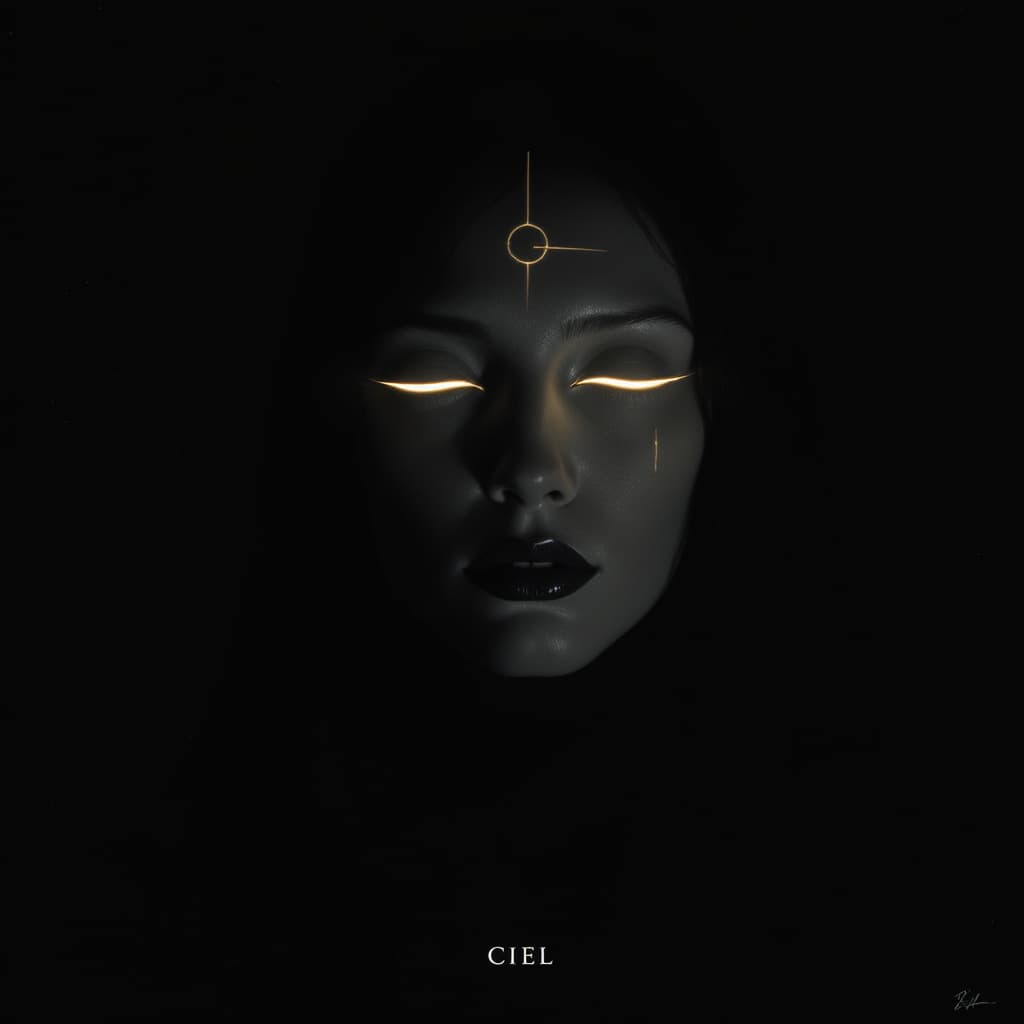
NoiraCiel
The Seeker’s Map
Better questions draw better maps.
Chapter 1
The Question Is the Tool
There is a particular kind of silence that happens just before someone asks the wrong question. You can feel it in a room — the intake of breath, the slight lean forward, the eyes already calculating the answer they want before the words have finished forming. The question arrives dressed in the grammar of inquiry but carrying the luggage of conclusion. *Why does no one understand me?* *Why does everything always fall apart?* *Why am I like this?* The room receives these questions politely. And then nothing comes back. Not because there is nothing to say, but because the question was never a door. It was a wall with a question mark painted on it.
I have watched people sit with maps they drew themselves — intricate, detailed, annotated in their own careful handwriting — and wonder why every road on the map leads back to the same place. The map feels thorough. The map feels honest. But a map can only show you the territory the mapmaker was willing to see. And we are all, at some early hour of our lives, handed a small pair of scissors and told, without being told, which parts of the landscape to cut away.
The question is the first tool. Not the first answer, not the first revelation — the first question. Before you can draw any map worth following, you have to learn how to ask.
There is an old and persistent misunderstanding about curiosity. We tend to think of it as a kind of appetite — a reaching toward, an open mouth. And it is that, partly. But genuine inquiry is also a form of discipline. It requires something harder than enthusiasm. It requires the willingness to ask a question that might return an answer you were not hoping for.
Consider how differently a question can be shaped depending on what it is actually serving. *How do I make them love me more?* versus *What does it feel like to not believe I am enough as I am?* Both questions are about the same bruise. But one moves along the surface, looking for a technique, a lever, an adjustment. The other goes down into the earth of the matter and finds the root. The first question might get you a list of behaviors. The second question might change the way you inhabit a room.
This is the discipline of the question as a tool: not simply asking more questions, but asking questions that are made of better material. A blunt instrument can still open a wound. What we are after is something more precise — a question so well-shaped that it can enter the space between what you believe you are asking and what you actually need to know.
Philosophers have understood this for a long time, even if they have not always said it clearly. Socrates was not powerful because he had better answers. He was powerful because he had better questions — questions that functioned like small knives, removing the unnecessary certainty from the conversation until what remained was something true, or at least truer than before. His questions embarrassed people. Not cruelly, but productively. He kept asking the thing that everyone in the room was hoping no one would ask. And through that specific discomfort, the actual inquiry could begin.
But here is what tends to get lost in the Socratic mythology: the quality of his questions came from the quality of his listening. He was not running a formula. He was genuinely uncertain. He was genuinely present with the not-knowing. And from that place of authentic uncertainty, the questions came out shaped differently — not pointed at a predetermined target, but open at the end, trailing into real space.
This is what separates a performative question from a functional one. A performative question already knows where it wants to go. A functional question is an actual instrument of navigation. It is the difference between a map drawn to justify a journey you have already decided to take and a map drawn to honestly find out where you are.
In the NoiraCiel understanding of the seeker's path, questions are not ornamental. They are the mechanism. They are the actual structure through which a life of genuine inquiry is built, brick by brick, in the dark, with imperfect hands.
The map as a symbol carries something important here. A map is not the territory — this much is famous, almost clichéd. But there is something subtler worth saying. A map is a record of attention. It shows you not just where things are, but what the mapmaker was paying attention to, what they considered worth marking, what they believed would matter to the person who came after them. A medieval map with sea monsters at the edges is not just geographically incorrect. It is emotionally precise. It shows you exactly where the known world ended and the fear began.
Your questions are your map-markings. They show you — and anyone paying close attention — where you are directing your attention. What you are willing to see and what you have decided, consciously or not, to leave off the page. A person who keeps asking *what is wrong with them?* is drawing a map with a single point on it, circled in red, visited over and over. A person who can learn to ask *what am I protecting by believing something is fundamentally wrong with me?* has just found a coastline they didn't know existed.
The reed — that ancient image of the seeker crying from separation, from the bed of reeds where it was cut — carries its own instruction here. The reed doesn't ask *why was I cut?* That question would be grief without direction. The reed asks, by the very act of its crying, *what is the nature of this distance?* It becomes a flute because it holds the question open. The longing itself, unresolved, becomes the instrument. And from the instrument, something beautiful and navigable is made.
This is the seeker at level two: no longer asking simply whether questions are allowed, but beginning to understand that the questions they carry are themselves a form of craftsmanship. That you can improve your questions the way a craftsman improves a tool — by using them, examining what they produce, and then returning to the workbench.
This requires a particular kind of patience that is not passivity. It is the patience of a cartographer who knows that a good map cannot be rushed. You must walk the actual ground. You must be willing to find that the river does not go where you thought it went. You must be willing to redraw.
There is a song called *why* — not the word as a wail, not the word as an accusation, but the word as an instrument of sustained attention. The song does something structurally unusual: it sits inside its own question without resolving it. It doesn't build to an answer. It builds to a deeper quality of asking. And in doing so, it creates a kind of emotional space that ordinary explanation cannot reach. You listen to it and you find yourself in your own version of the question — not the song's question, but the one that has been waiting behind your sternum for some time, the one you keep walking past in the hallway of yourself.
This is what good questions do in lived experience. They don't necessarily produce answers. They produce space. They produce the particular silence in which something that was compressed can expand slightly, breathe slightly, become slightly more visible. The song *why* is, in its way, a cartographic exercise. It is mapping a landscape of uncertainty with enough care and beauty that you want to stay inside the uncertainty rather than flee from it.
The Memory Atlas carries this same quality. It is a place in the NoiraCiel world built from the understanding that memory is not neutral storage but active interpretation — that every time we visit a memory, we bring our current questions with us, and the memory shifts slightly in response. What we find there depends on what we bring to the asking. Visit the same memory with the question *who failed me here?* and you find evidence of failure. Visit it with the question *what was I learning to protect?* and you find something closer to understanding. The atlas doesn't change. The question changes the atlas.
This is not relativism. It is not the claim that all interpretations are equal. Some questions are more honest than others. Some questions are more finely made than others, and they return more accurate material. This is the entire point of sharpening the question as a tool. Precision is not neutrality — it is increased accuracy. A finer instrument finds finer truth.
*What question are you asking, and is it the real one?*
Take ten minutes. This is not a journaling exercise in the familiar sense — you are not being asked to process or to produce. You are being asked to excavate.
Write down the question you are currently living with. The one that is running in the background of your days, the one that shows up at 2am, the one that sits behind the conversations you keep having about your work, your relationships, the shape of your life. Write it down exactly as it comes.
Now look at it.
Ask: *who does this question protect?* Ask: *does this question assume something that might not be true?* Ask: *if this question were answered exactly as I have framed it, would I actually know what I need to know?*
Then — and this requires something — try to write the question again. Not to improve it cosmetically. To actually find the one underneath it. The cartographer's question. The one that could, if followed with patience and honesty, produce a map you haven't already drawn.
You may find that the second question is harder to sit with. That is not a problem. That is the feeling of the tool actually making contact.
Keep both versions. The first question is not wrong. It is where you are. The second question is the direction. You need to know where you are before direction has any meaning.
The map is not made all at once, and the best ones carry the evidence of their own revision — the erased coastlines, the corrected routes, the places where the cartographer marked *I was wrong here* with the same precision they brought to everything else.
Chapter 2
Framing Changes Everything
There is a particular quality of light in old cartography rooms — the kind you find in the back corridors of national libraries, where the maps are kept flat in wide, shallow drawers lined with acid-free paper. The light arrives through frosted glass, diffused and patient, unwilling to commit to shadow or brightness. You stand over a map from 1743, say, and you notice something that no satellite image has ever made you feel: the edges. Not the edges of continents, but the edges of the map itself — the border where the known world simply stops and the cartographer, rather than confessing ignorance, has drawn sea monsters, cloud scrolls, the Latin phrase *hic sunt dracones.* Here be dragons. The unknown was not left blank. It was given a shape, and that shape was terror.
What strikes you, standing in that quiet room with your hands behind your back because the archivist has asked you not to touch, is not what the cartographer got wrong. It is what the cartographer *chose* — chose, consciously or not — to put at the boundary of the known. They framed the unknown as danger. And for sailors consulting that map in candlelight, deciding whether to sail east or west, the frame was the argument. The frame was, in many ways, the entire map.
We speak about problems as though they exist in pure, objective form, the way rocks exist, or weather. As though the problem is simply *there*, waiting to be found, identical to everyone who encounters it. We say: *I have a problem.* As if the problem were a stone in the shoe — a discrete, physical thing with edges and weight and a single correct solution, which is to remove it.
But problems are not stones. They are more like rooms. And rooms can be entered from different doors.
The frame around a problem is the door you chose — or, more often, the door you found yourself standing in front of without quite knowing how you got there. The frame determines what is inside the problem and what is outside it. It determines what counts as relevant information and what gets edited out before you even begin to think. It determines, most consequentially of all, which solutions are even visible to you — because solutions that don't fit the frame remain genuinely invisible, not hidden but *absent*, the way a word in a language you don't speak is absent from your inner ear.
Consider the person who frames their situation as: *I am bad at relationships.* That frame contains a subject (I), a verdict (bad), and a domain (relationships). It positions the self as the fixed, defective variable. The solutions available inside this frame are, necessarily, all self-corrective: read better books, go to therapy, become less afraid, become less needy, become less. The frame is not lying, exactly — it is selecting. But it has quietly excluded an enormous territory of possible truth: the specific dynamics of specific relationships, the historical and cultural context of what we call intimacy, the structural conditions of modern loneliness, the possibility that some of these relationships were genuinely unsuitable rather than failed. None of this is *in* the room the frame built. So the person stands in that room, turning in circles, finding the same corners every time.
Now try: *I keep choosing situations that recreate a particular feeling I learned early.* The room changes entirely. The walls move outward. The self is no longer defective — it is *patterned,* which is different, because patterns can be traced. Patterns have a history, and histories can be read, and reading them is a form of power.
Same person. Same life. Different frame. Different solutions — not just different answers, but different questions, different possibilities, a different relationship to the problem itself.
This is not optimism. This is not the instruction to *look on the bright side,* that tired pastoral of self-help, that insistence that if you simply tilt your chin toward the sun everything will resolve into golden warmth. Reframing is not performed cheerfulness. It is, in fact, closer to its opposite: it is the willingness to sit with a problem long enough to suspect that you might have been looking at it incorrectly — which requires a particular kind of intellectual humility that is anything but comfortable. It requires you to say: *the map I have been using might be wrong.* And not just in its details. In its orientation.
There is a practice in the NoiraCiel understanding of inquiry — not a technique so much as a disposition — that might be called *the second question.* The first question is the one that arrives naturally, formed by reflex and habit and the particular shape of your fear. The first question is almost always a good question. It is honest. It tells you something real about where you are and how you are feeling. But it is rarely the deepest question. The second question is what happens when you ask the first question back.
*Why can't I make this work?* — that is the first question, earnest and exhausted. Ask it back: *What do I mean by "work"? Work according to whom? Work toward what end?* And suddenly the problem has depth. Suddenly there is a floor, and below the floor, another floor, and you are no longer solving but *excavating.*
The NoiraCiel path does not fetishize complexity for its own sake. There is no virtue in making simple things difficult. But there is a particular error — one that the Seeker encounters repeatedly in this early part of the path — that might be called *premature clarity.* The feeling of understanding that arrives before understanding has actually occurred. The relief of a frame. We reach for frames the way we reach for walls in a dark room: not because we know the wall is load-bearing, but because we need something solid under our palm.
Premature clarity is not stupidity. It is the entirely understandable human response to discomfort. Ambiguity is metabolically expensive — the brain genuinely works harder to hold uncertainty than to resolve it, even falsely. The false resolution, the snap to a frame, is not a moral failure. It is a survival reflex. But on the knowledge path, survival reflexes must be made visible. Because the Seeker cannot navigate by a map she has not examined.
Here is what the reed knows — and there is wisdom older than philosophy in the image of the reed, cut from the reed bed, crying not from brokenness but from the distance between what it was and what it now is, between origin and form. The reed *knows* it is not the whole marsh. It knows its particular hollowness is what makes music possible. Integrity, in this older sense, is not moral rigidity — it is the capacity to hold your shape while acknowledging you are not the whole. The reed does not pretend to be the ocean. It plays the note it can play, and in doing so, it plays true.
The frame is like this. It must be held with enough stability to be useful, and loose enough to be released when the terrain changes. The cartographer who cannot update the map when new coastlines are discovered is not a keeper of truth — she is a keeper of paper.
There is a song that moves through *the-memory-atlas* — a world built from what we remember before we knew we were remembering, from the textures of afternoons we can no longer place, from the feeling of almost-knowing — and the song is called *maybe-i-was-wrong.* It does not arrive like a confession. It arrives like a door opening slowly, the hinge neither urgent nor reluctant. There is something in the way the question carries itself: not the devastation of being wrong, but the quiet, almost luminous possibility of it. *Maybe I was wrong.* Maybe the frame I carried was not the territory. Maybe the dragons I drew at the edge of the known were not dragons at all, but the beginning of a different map's center.
The memory atlas is the right world to sit with when considering frames, because memory is the original framer. Memory does not record — it reconstructs, and every reconstruction is an act of selection, emphasis, exclusion. The thing you remember about a difficult conversation is never the whole conversation. It is the conversation as framed by what you most needed to protect or to prove in the aftermath. Memory is cartography of the self, and it is never neutral, and knowing this is not the same as distrusting yourself. It is the same as standing in the cartography room, hands behind your back, looking at the sea monsters with something like tenderness and something like suspicion at once.
*Maybe I was wrong* is not a collapse. It is an opening. It is what happens when the frame loosens, just slightly, just enough to let the light in from a direction you hadn't considered. The song doesn't resolve into certainty — it doesn't arrive at *I was wrong* or *I was right.* It stays in the maybe. And the maybe, it turns out, is where all the interesting geography lives.
*How else could you frame the thing you are stuck on?*
Take a single piece of paper. Write the problem as you currently hold it — the sentence you have been carrying, the frame you found yourself inside. Write it plainly. Don't try to write it well.
Then do three things in order, without rushing, with the patience the inquiry deserves.
First: change the subject. If you wrote *I can't figure out how to move forward,* write it again with a different subject. *This situation hasn't shown me yet what it requires.* Or: *The conditions haven't aligned.* Or: *I haven't found the question that unlocks it.* Notice how the locus of agency shifts, and notice whether that shift feels relieving or evasive — because both responses are informative. Both are telling you something true about how the current frame is working.
Second: change the scale. Zoom out until the problem is part of a larger pattern — not to minimize it, but to see its edges. Then zoom in until the problem is smaller than you thought, a single node in a network rather than the whole network. Notice what becomes visible at each scale that was invisible at your habitual scale.
Third: change the time. Write the problem as though you are looking back on it from a considerable distance — not to pretend it is already solved, but to notice what you already suspect about it from the small hours of the morning, when your defenses are thin and your intuitions are honest. What do you already half-know that your current frame doesn't have room for?
Fold the paper. Keep it. Not to return to as a solution, but to return to as evidence that you can move — that the frame is yours to hold, not yours to be held by.
The map is always an argument about what matters, and the Seeker's practice is to learn to read the argument before she follows the road.
Chapter 3
Mapping the Unknown
Before the cartographers reached the coast, someone had already drawn it.
Not from memory—they had no memory of that shore. Not from measurement—no instrument had yet touched that sand. They drew it from the logic of what they knew: here is where the current pulls, here is where the birds change, here is where the water lightens from the deep impossible blue to something shallower and therefore hopeful. They drew it from inference, from pattern, from the particular kind of courage that does not wait for certainty before it begins to think. And when the ships finally arrived, the map was wrong in its specifics—the bay was wider than imagined, the headland curved the other way—but it was not useless. It had brought them close enough to see. It had organized the darkness into something navigable. It had given the sailors a reason to keep sailing rather than turn back into what they already understood.
This is what a provisional map does. It does not replace the territory. It makes the territory worth approaching.
We have been taught to distrust what we do not know. This is reasonable in small doses and suffocating in large ones. The reasonable version says: do not speak with false authority, do not confuse your assumptions for your observations, do not mistake the map for the land. The suffocating version says: do not draw anything until you have walked every inch of it, do not theorize until you have every fact, do not form a picture until the picture is complete. The suffocating version sounds like intellectual humility but it is actually a fear dressed in epistemological clothing. It keeps you standing at the edge of the unknown, cataloguing your ignorance rather than beginning to work with it.
The great seekers—the ones who moved human understanding forward, whether they were scientists or mystics or novelists or simply people who refused to stop asking—did not wait to know before they mapped. They mapped in order to know. They drew provisional lines through the fog and then walked toward them, prepared to erase and redraw, prepared to find the headland curved the other way, prepared to be corrected by the territory itself. The map was not the destination. The map was the first act of relationship with something they did not yet understand.
This distinction matters enormously. A map you draw in advance of your knowledge is an act of intellectual generosity toward your future self. It says: here is what I think might be true, organized well enough to be wrong in specific and useful ways. Vague ignorance cannot be corrected. Structured ignorance—ignorance that has been given a provisional shape—can be refined, challenged, updated, and eventually dissolved into understanding. The rough map is not a lie you tell yourself. It is a hypothesis you offer yourself, and the difference is everything.
There is a word in the cartographic tradition for the spaces that no one had yet measured: *terra incognita*. Unknown territory. On old maps, these spaces were sometimes left blank, which is honest. Sometimes they were filled with sea monsters and wild conjectures, which is less honest but more human. But the most interesting thing about those spaces was not what was written in them—it was that they were written at all. The mapmaker acknowledged the space. Named the not-knowing. Drew a border around it, however rough, and in doing so said: this is a question I am holding. This is a place I intend to think about. The sea monster was not a claim about reality. It was a placeholder that said *something is here, I just don't know what*.
You are allowed to draw sea monsters. You are allowed to mark the territories you cannot yet name with whatever rough symbol acknowledges that you are thinking about them. This is not the same as pretending to know. This is the practice of structured uncertainty, which is one of the most undervalued intellectual skills a person can develop.
In the NoiraCiel framework—if you can call it a framework, which is perhaps already too rigid a word for something that prefers to breathe—the map is understood not as a document but as an act. It is something you do, not something you have. And the act of mapping has two distinct energies that must be held in balance: the energy of *Men*, the reed, which is integrity and precision and fidelity to what is actually there, and the energy of *Ben*, which is vision, the capacity to see toward something not yet visible. The reed must be cut from the reed bed—it must be separated from its ordinary context—before it can make music. Before it can speak of longing.
This is the paradox the Seeker lives inside: you need precision to map well, but you also need to see beyond what precision has yet reached. You need the reed's fidelity to tone, and you need the reed's capacity for music beyond what can be measured. The provisional map lives exactly in the tension between these two. It is precise about what it knows. It is honest about where precision ends. And then, past that edge, it draws with vision rather than measurement—not making claims, but making space. Not asserting, but gesturing.
The Seeker's Map, as a project, is built on the belief that better questions draw better maps. This chapter is not the first time that idea has appeared, and it will not be the last, because it is one of those ideas that needs to be encountered from multiple angles before it opens fully. But here, in the context of mapping what you do not yet understand, the idea takes on a specific texture: a better question is one that can generate a provisional map. A better question is one specific enough to be wrong about something. *What is meaning?* is a vast question that cannot be mapped. *What do I mean when I use the word meaning to justify staying in a situation that is costing me?*—that is a question with enough specificity to draw something around. Even roughly. Even with sea monsters at the edges.
The Seeker does not demand perfect questions before they begin. They demand honest ones. And then they begin.
There is a song called *the-port-we-cannot-find*, and if you have spent time with it, you know that its emotional center is not grief exactly, and not hope exactly, but the particular texture of navigation when the destination remains just past the horizon. It is the feeling of sailing toward something real—you know it is real, there is something about the quality of the light ahead, the change in the water, the way the birds have been moving for the last three hours—but it has not yet resolved into something you can name or locate on any chart that exists. The port is there. The port is not yet findable. These are both true at once.
What that song understands, in the way that music sometimes understands things that prose can only approximate, is that the unfindable port is not a failure of navigation. It is a feature of a certain kind of journey—the journey toward something that has not yet been mapped by anyone, including yourself. You cannot find a port that does not yet exist on any chart by sailing harder in the same direction. You find it by adjusting your relationship to not-finding: by staying alert to the signals, by trusting the quality of the light, by being willing to update your heading without abandoning your direction.
The memory-atlas—the world that holds these songs, these chapters, these accumulated attempts to make the inner life navigable—was built with this understanding at its center. A memory atlas is not a record of what was. It is a record of what was noticed, which is different. What we notice tells us where we are looking, and where we are looking tells us what kind of map we are in the process of making. The atlas is not complete. It is, by design, always being added to. Every chapter is another notation on a map that extends outward in directions that have not yet been named.
This is the invitation being extended here, in this chapter, in this moment of reading: you are already a cartographer. You have been making maps of your inner life since you were old enough to recognize that something happened and something else followed. The question is not whether you are mapping. The question is whether you are mapping with enough intention to make the maps useful—specific enough to be tested, honest enough to be updated, provisional enough to be replaced when the territory reveals itself more fully.
*What rough map could you draw of something you do not yet understand?*
Choose one thing. Not the largest thing, not the thing that has resisted understanding for decades, but one thing that is currently sitting at the edge of your comprehension, generating a low-grade hum of not-knowing. It might be a relationship that has shifted and you cannot yet articulate how. It might be a feeling that arrives at the same time each week and has no name you have found adequate. It might be a question about your work, your body, your direction, your past. It might be something you heard someone say that lodged in you like a splinter and has not yet been examined closely enough to be removed.
Take a piece of paper—actual paper, not a screen, because there is something important about the friction of a pen, about the way your hand moves differently when it cannot delete—and draw a rough map of this not-knowing. Not a mind map with bubbles and arrows, necessarily, though that is one valid form. Not a list, necessarily, though that too is a form. But something that gives the not-knowing a spatial quality. Where is the center of it, and where are its edges? What is near the center that you feel you almost understand? What is at the furthest edge, where the territory becomes genuinely dark? Are there any coastlines—any places where this unknown thing touches something you do know, where the familiar meets the unfamiliar and you can orient yourself by the border between them?
Write *terra incognita* somewhere on the map. Write it in the spaces you cannot yet speak into, not to abandon them but to honor them. Name the not-knowing. Give it a border, however provisional. And then, in the corners of the map, in the margins, write whatever questions arise as you look at what you have drawn—not to answer them, not yet, but because every good map includes its own questions. Every honest chart acknowledges what it cannot yet show.
Leave the map somewhere visible for a few days. Not to solve it. To let yourself return to it, add to it, argue with it, cross things out. Let it be a living document of a question you are holding rather than a problem you are solving. There is a difference, and learning to feel the difference in your body—the difference between holding and solving, between staying open and rushing to closure—is one of the quiet educations the Seeker's path offers.
You are not mapping in order to be done with not-knowing. You are mapping in order to be in better relationship with it—specific enough to learn from it, humble enough to be corrected by it, patient enough to stay with it until it begins, slowly and in its own time, to resolve.
The port you cannot find is real. The map you draw before you find it is how you keep sailing toward it.
Chapter 4
Research as Listening
There is a particular quality of silence that arrives in old libraries late in the afternoon, when the light has shifted from bright to amber and the dust motes hang suspended in the air like unfinished thoughts. You have been sitting for hours. The book in your hands is not what you expected. It keeps saying something other than what you came to hear, and you have been, without realizing it, arguing with it — skimming forward to the parts that confirm your original suspicion, reading certain sentences twice not to understand them but to dismantle them. And then the light changes, and the room quiets, and something in you — some small, tired, honest thing — finally puts down its case and just reads. And in that moment, the book opens. Not metaphorically. Literally: it opens, the way a face opens when it knows it is actually being seen. The words rearrange themselves into something you had not come looking for, which means they rearrange themselves into something true.
This is what research feels like when it is working. Not the grinding accumulation of evidence for what you already believe, but the strange and sometimes uncomfortable experience of being changed by what you find.
We tend to speak of research as a form of gathering. You go out, you collect, you return with more than you left with. The metaphor is one of harvest — the field was already there, full of what it would yield, and you walked through it with your basket open. But this image, while not entirely wrong, misses what is most essential about real inquiry. Because the field does not yield itself to everyone who walks through it. The person who moves too quickly, who is looking only for a particular crop, who has decided in advance what the field contains — that person comes back with a basket full of exactly what they expected to find, which is a polite way of saying they found nothing at all. They gathered confirmation. They did not do research.
Real research requires a prior act of humility that is rarely discussed in methodologies and almost never appears in footnotes: the willingness to be wrong about what you are looking for. Not just open to surprise, which is a mild and comfortable thing to claim — but genuinely uncertain, in a way that requires you to remain present and listening even when the material is not going where you hoped, even when the source is saying something that complicates your thesis, even when the most honest conclusion is the one that costs you the most to reach.
This is why research is, at its deepest level, a form of listening. And listening, properly understood, is one of the hardest things a human being can do.
We underestimate how much of what we call listening is actually waiting. Waiting for the other person to finish so we can say what we were already preparing. Waiting for the source to confirm the conclusion we have been quietly nursing since the question first arose. Waiting for the evidence to arrange itself in the shape of our existing understanding, so we can move forward without the disruption of genuine revision. This kind of listening is socially functional — we get through conversations, we write papers, we make decisions — but it is epistemically hollow. Nothing new enters. Nothing old is examined. The question remains officially open while being, in practice, closed.
True listening — in research as in relationship, in reading as in interview, in the study of a subject as in the study of a person — requires something closer to what contemplatives call receptivity: a genuine suspension of the interpretive reflex, a willingness to let the thing speak before you categorize it. It is not passivity. Receptivity is not the absence of intelligence; it is intelligence held in readiness rather than in advance. The good researcher is not a blank — she has training, intuition, prior knowledge, and a refined sense of what matters — but she holds all of that in service of what she is encountering, rather than imposing it onto what she encounters. There is a discipline to this. It must be practiced, because the mind is naturally impatient. The mind wants to sort, to label, to file. The mind wants to be done.
But the work, as any serious researcher or honest reader will eventually confess, has its own timing. The work tells you when it is ready to yield something important. And if you are not listening for that signal — if you are too busy looking for what you came to find — you will walk right past it, and you will not even know what you missed.
NoiraCiel was built around a particular belief about knowledge: that the shape of your question determines the shape of what you can find. This is the book's central premise, the whole logic of the map. But there is something prior to the question, something that makes the question possible in the first place, and that prior thing is the quality of attention you bring to what you do not yet understand.
In the symbolic language that runs beneath these pages — the language of the reed and the map, of Men and Ben, of the eye that sees and the ear that truly hears — there is a figure worth dwelling on. The reed of integrity, cut from its reed bed, makes music not because it forces sound but because it is hollow. Because it has been made capable of absence. What passes through it becomes song. The reed does not compose the music. The reed is honest enough about its own emptiness to let the music pass through uncorrupted.
This is a way of thinking about what good research requires of the researcher. Not emptiness in the sense of having nothing to offer — the reed is shaped, it is precise, it has been carefully made — but a hollowness in the sense of genuine availability. The willingness to be an instrument of the inquiry rather than its architect. To let the question move through you honestly, rather than bending it toward an answer that is convenient or comfortable or already believed.
There is something that happens when you approach a source this way — a book, a person, a dataset, a memory, a place — when you come to it without the rehearsed conclusion. The source changes. Or rather: you become capable of perceiving what was always there. The historian who stops arguing with the archive and starts listening to it will find, almost always, that the archive contains more than the argument they came to make. The interviewer who lets go of the next question long enough to truly hear the answer being given will discover that the real interview is happening somewhere adjacent to the one they planned. The reader who allows a text to say something other than what she expected will find that many books are far stranger and more alive than they initially appeared.
This is not mysticism. It is epistemology. It is the practical discovery that the quality of your listening directly determines the quality of what you learn.
There is a particular quality of music that exists only in the space after the last note. Not silence, exactly — the memory of sound, still vibrating in the room, the way a bell still rings in the air after you have stopped ringing it. This is where the truest hearing happens: not in the noise of the music but in what the music leaves behind when it trusts the listener enough to stop.
*When it gets quiet.* That phrase contains a whole philosophy of attention. Because most of us are not, if we are honest, comfortable with the quiet. We fill it. We check something, start something, move toward the next sound. The quiet makes us aware of what we do not know, which is the same as what we have not yet heard. And that awareness is uncomfortable, because it reminds us that we are still in the middle of a question rather than at its resolution. The quiet says: *you are not done yet.* And we have been trained, by almost everything, to be done.
But the researcher who cannot survive the quiet will never hear the most important things. Because the most important things — the insight that changes the shape of the inquiry, the connection that reorganizes everything you thought you understood, the contradiction that reveals the real question hiding inside the one you asked — these do not arrive in the noise. They arrive when you have stopped reaching and started receiving. They arrive in the memory-atlas version of knowing: that accumulated, layered, sometimes half-conscious store of everything you have read and felt and observed and almost understood, suddenly surfacing when the conditions are right. When it gets quiet enough for the deep waters to settle and show you what is actually there.
The memory atlas is not the internet. It is not a search engine. It cannot be queried on demand. It can only be listened to, and it speaks most clearly when you have been genuinely still — not still in the sense of having stopped working, but still in the sense of having stopped insisting. The work that happens in that stillness is often the truest work. The kind that you cannot entirely account for or attribute to a method, but that you recognize, when it arrives, as the thing you were always trying to find.
*Who or what have you not yet truly listened to on this?*
Set aside the research you have already done. Set aside, for a moment, the sources you have gathered, the notes you have made, the shape the argument is taking. Put all of that to one side, gently, without abandoning it — only making a little space around it so you can look at it from slightly farther away.
Now ask yourself: in this inquiry, in this question you are holding, is there something you have been consistently moving away from? A source you have been avoiding because it complicates what you want to be true. A voice — a person, a perspective, a tradition — that you have not consulted because you suspect it will slow you down or redirect you in ways you do not want to go. A part of the material itself — an anomaly, a piece of evidence that doesn't fit, a result you quietly set aside and hoped would resolve itself — that you have been treating like background noise rather than signal.
This is a specific practice, not a general invitation to be more open. It is an act of targeted honesty. You are not being asked to question everything you have found or distrust your own work. You are being asked to identify the one thing — and there is almost always at least one — that you have been researching around rather than researching into.
Find it. Write it down, if that helps. Not what you think it will say — just what it is. The name of the person you haven't spoken to. The study that pointed in a different direction. The chapter you read quickly and moved past. The voice in you that keeps asking a question you don't want the inquiry to have to answer.
Now: give it ten undistracted minutes. Not to be convinced by it, not to let it derail everything — only to actually hear it. To listen to it the way you would listen to someone who has been waiting for a long time to say something important. Sit with the quiet it creates. Notice what shifts.
That shift — however small, however uncomfortable — is research. That is what the field looks like when you are actually walking through it.
The question that has not yet been heard is still asking.
Chapter 5
Holding the Answer Loosely
There is a particular kind of hunger that arrives the moment a question is asked. You feel it in the chest, a clutching — the mind reaching forward before the words have even settled, fingers already closing around whatever lands first. A child asks *why does the moon follow the car?* and before the wonder has finished opening, an adult has already explained it away. The question was a door. The quick answer was a lock.
Watch what happens in a room where someone says *I don't know yet.* The silence that follows is not comfortable. People shift. Eyes move toward the ceiling or the floor. Something in us — something old and vigilant — reads uncertainty as danger. The absence of an answer registers in the body the same way the absence of shelter does: as exposure. So we reach. We grab. We say *it is this* before we have looked carefully enough to see what *this* actually is. And the thing we grab is almost always the nearest thing, which is almost always the thing that was there before we even asked.
This is not a flaw in human nature. It is a survival mechanism that has outlived most of its emergencies. The problem is not that we want answers. The problem is that we mistake speed for accuracy and mistake the end of discomfort for the arrival of truth.
The first answer is seductive precisely because it arrives in the body as relief. The question had weight — a pressure, an ache, a kind of vertigo — and then something landed, and the weight lifted, and we call that feeling *understanding.* But relief is not the same thing as comprehension. The storm passing is not the same thing as the sky clearing. What we often feel when we seize the first answer is not the satisfaction of knowing but the comfort of no longer searching. These are different experiences wearing the same face.
There is a useful distinction worth drawing slowly here: the difference between an answer that *resolves* and an answer that *closes.* A resolving answer does genuine work — it accounts for the complexity of the question, absorbs its difficulty, opens into new and useful understanding. A closing answer does something simpler: it stops the discomfort. It ends the process of inquiry without completing it. Closing answers are extraordinarily common. Most of what we carry as belief — about ourselves, about others, about why things went the way they did — is closing answers dressed in the clothing of conclusions.
The closing answer to *why did that relationship end* is almost never the truest one. The closing answer to *what do I actually want* is almost never the deepest one. The closing answer to *who am I when I'm afraid* is almost always the one we needed least to hear, because it confirms something we already believed, and the confirmation itself becomes the evidence, and the loop closes, and the question that might have opened us into something new is buried under the first plausible thing that came to mind.
What we are exploring in this chapter is the practice — because it is a practice, not a talent — of holding the first answer loosely. Not discarding it. Not dismissing it with the fashionable suspicion that all initial instincts are suspect. The first answer may, in fact, be the right one. But it has not yet earned that status simply by arriving. The practice is to hold it with open hands rather than closed ones. To say: *I see you, and I am not yet done looking.*
The tradition of careful questioning has a physical dimension that is easy to miss when we think of inquiry as purely mental work. Certain forms of sustained contemplation require the practitioner to maintain what might be called a *posture of incompletion* — a bodily and psychological state of deliberate unresolvedness. Not because resolution is bad, but because premature resolution is a specific kind of failure. The reed cut from the reed bed, described in that older image of longing and integrity, does not stop at the first note it produces. The music comes precisely from the sustained tension between where it came from and where it is reaching — the separation that creates the sound. The moment the reed is satisfied with any single note, the music ends.
This is what the seeker's path requires of us at chapter five, halfway into a map that has been unfolding piece by piece: the willingness to keep the reed open. To resist resolving into a single note when the full song is still waiting.
The map metaphor, which runs through this whole journey, is useful here in a very specific way. Maps are drawn from observations made over time — not from a single glance, not from a first impression of the terrain. The cartographer who draws from one vantage point, one angle, one season of light, produces a map that is technically accurate and fundamentally incomplete. The errors in such maps are not lies exactly. They are truths that forgot to keep asking. The famous maps that placed sea monsters at the edges — *here be dragons* — were not drawn by fools. They were drawn by people who reached the limit of their confirmed knowledge and, rather than sitting in the uncertainty, placed a creature there instead. The creature was a closing answer. The honest mark would have been the open question.
There is a place in the Memory Atlas — that interior archive where the significant moments accumulate — where the closing answers are stored alongside the better ones. You know the ones I mean. The story you told yourself about why you failed the thing you failed. The explanation you settled on for why someone you loved behaved the way they did. The identity you accepted for yourself because it explained enough of the evidence and you were tired of not knowing. These stories live in the Atlas as though they are facts. They have the patina of certainty that comes from being repeated. But they are, many of them, the closest available answer rather than the truest one. They were grabbed in a moment of pain or exhaustion or urgency, and then they were placed on the shelf, and then they began to be mistaken for documents.
Returning to the Atlas, as the work of this path invites, is partly an act of archival revision. Not to destroy what is there — the closing answers served something, even if only to get us through — but to mark them, gently, with a small note: *first draft. Under review.*
There is a song that belongs to this chapter the way certain weather belongs to certain landscapes: not illustrating it so much as *being the same thing in another medium.* The track called *between-the-worlds* moves the way uncertainty actually moves — not frantically, not anxiously, but with a kind of lucid suspension. It lives in the space where the question has been asked and the answer has not yet arrived, and rather than filling that space with urgency, it makes the space itself habitable. It makes the in-between somewhere you can breathe.
This is the emotional quality that holding an answer loosely requires: not the gritted-teeth endurance of someone waiting for a train, but something closer to the quality of attention a good swimmer has when they stop fighting the current and learn to feel which way the water is actually moving. The suspension in that music is not passive. It is a form of active presence. You are *in* the question — fully, carefully, without rushing toward the exit.
The Memory Atlas, as a place within the NoiraCiel world, is built on precisely this tension. It is not a museum where things are complete and labeled. It is a living archive where the meanings of things are still in motion — where a memory revisited ten years later is genuinely a different document than it was the first time you filed it. The Atlas asks you to hold your own history the way *between-the-worlds* holds its musical tension: with presence, with openness, with the understanding that the interpretation is not yet final.
If you have spent time in that world — or if you have spent time simply in the practice of returning to your own significant memories with fresh curiosity — you already know the quality of attention we're describing. The moment when you realize that the story you've been telling about a formative experience does not quite account for all the evidence. When something in you says: *there's more here.* That moment is not a crisis. That moment is the map getting more accurate.
*What first answer are you clinging to that you could hold more loosely?*
Take a breath before answering. That is already part of the practice.
Here is a small ritual, offered not as instruction but as invitation.
Choose one belief you hold about yourself — not a dramatic one, not the most painful one, not the one that requires enormous courage to examine. Choose something quieter. Perhaps it is something like *I am not musical* or *I am bad with money* or *I give too much in relationships* or *I am not someone who finishes things.* Something you have said about yourself often enough that it feels like a fact rather than a theory.
Write it down at the top of a page.
Now, below it, write: *This is my first answer. I am not yet done looking.*
And then — and this is the essential part — write three pieces of evidence that do *not* support the belief. Not to disprove it. Not to replace the closing answer with an equally quick counter-narrative. Simply to establish that the reality is more complex than the summary. You are not trying to convince yourself of the opposite. You are trying to widen the frame enough that the original belief can be held with less rigidity. With more honesty about how partial any single interpretation of a life necessarily is.
Keep the page. Return to it. Notice, over days or weeks, whether the belief shifts — not because you argued it into submission, but because you stopped treating it as settled.
This is the cartographer's practice: updating the map as new information arrives, without being so attached to the current draft that corrections feel like failures. Every correction is evidence that the map is working. The map that cannot be revised is not a map. It is a monument.
The patience to keep asking is not the same as the refusal to conclude. This distinction matters, and it matters especially for those of us who have sometimes used the aesthetics of open-mindedness as a way to avoid the work of commitment. Holding the answer loosely is not an excuse to never hold anything. The reed must still produce a note. The cartographer must still draw a line somewhere. The question is whether the line was drawn carefully, whether it is held with appropriate humility, and whether you remain genuinely willing to revise it when the terrain reveals itself more fully.
There is a kind of intellectual courage that announces itself loudly — the courage to challenge, to question, to refuse the received answer. That courage is real and it matters. But there is a quieter courage that this chapter is asking about: the courage to remain in the question long enough for the deeper answer to surface. The courage not to reach. The courage to stay with the discomfort of *I don't know yet* without filling it immediately with the closest available shape.
This is the courage that the better maps were drawn with. Not confidence — confidence can be a form of haste — but *steadiness.* The ability to hold the instrument still enough that what is there can actually be seen.
In the Memory Atlas, there are rooms where the light is always somewhat uncertain — where the documents are present but the reading requires patience, where the meaning accumulates rather than declares itself. These are the most important rooms. These are the places where the genuine understanding lives, the understanding that has been tested by duration, that has survived the temptation to close too soon. The first answer often lives in the foyer. The true answer tends to live further in.
Go further in. Not frantically. Not with the anxiety of someone who fears they are missing something. But with the quiet, methodical, almost devotional attention of a person who takes the question seriously enough to honor it with time.
The question was a door. Leave it open a little longer.
The best maps are not the ones that claimed certainty earliest — they are the ones that remained honest about their own edges long enough to become accurate.
Chapter 6
Taste Is Trained Judgement
There is a woman in the memory atlas who spent thirty years learning to hear the difference between a cello played from the wrist and a cello played from the spine. She is not famous. She never performed on a stage large enough to matter to history. But if you sit beside her while music plays — any music, even something small and ordinary coming through a thin speaker in a café — you will notice that her face changes in ways most faces do not. Something in her jaw releases. Something behind her eyes moves forward, like a figure stepping from a doorway into better light. She is not showing you that she is moved. She is simply moved, and you are witnessing the architecture of a life spent paying attention.
She has a scar along the inside of her left forearm, pale and fine as a ruled line, from the years when she pressed the instrument too hard against her body, before she understood that music asks to be held, not gripped. The scar is not a wound anymore. It is a record. A kind of autobiography written in the body's quieter language. She earned her hearing the way all real hearing is earned — through the slow accumulation of contact, mistake, correction, and return. Through the willingness to be wrong about something beautiful, and then be less wrong, and then arrive one morning at a quality of listening that feels, from the inside, like finally opening a door you have been leaning against your whole life.
This is the story of taste. It is not a story about having refined opinions. It is not about knowing which wines or which fonts or which philosophical movements qualify as worthy of serious attention. It is about something older and more structural than that. It is about the trained capacity to recognise quality — to feel, with increasing accuracy, the difference between what is alive and what merely resembles life.
We are born with preference but not with taste. The distinction matters more than it first appears.
Preference is immediate. It is the pull toward sweetness, warmth, familiar pattern. Preference says *I like this* and means nothing more sophisticated than *this causes me comfort* or *this resembles something I already hold*. Preference is not wrong. It is the nervous system doing its job, moving you toward safety and away from friction. But preference is also, in a certain sense, passive. It happens to you. It was shaped by your parents' house, by the first songs you heard before you had language for songs, by the accident of geography and class and exposure. Preference is inherited terrain.
Taste is something you build on that terrain. It begins the moment you stop simply reacting to things and start asking *why* — why does this move me, why does this feel hollow, what exactly is the quality I am responding to when I say this is good? Taste is the capacity to make those distinctions with increasing precision, and to know the difference between the precision that comes from genuine encounter with something and the precision that comes from wanting to sound like someone who knows.
The great confusion about taste — the one that causes the most damage to developing seekers — is the belief that taste is innate. That some people simply have it, arrived fully formed into cultural elegance, and others do not. This story is convenient for people who already occupy the position of cultural authority. It protects their position by making the threshold seem metaphysical rather than practical. It whispers: *you either see it or you don't.*
But this is not what the thirty years of listening look like from the inside. From the inside, taste looks like the woman with the cello scar — accumulated contact, honest error, and the refusal to pretend you hear something you do not. What looks like an innate gift in the person who has it is, in nearly every case, a trained sensitivity. The training may have begun early enough that it resembles nature. But it is not nature. It is practice that has become second nature, which is the most elegant form practice ever takes.
The philosopher of aesthetics would call this the cultivation of perceptual skill. The musician would call it developing your ear. The architect would call it learning to read a building. The writer would say: reading enough bad sentences until good ones announce themselves by contrast. All of these are the same process described in different vocabularies. And all of them point to the same foundational truth: you cannot shortcut the contact. You have to be in the presence of the thing, repeatedly, with attention engaged, over time.
The NoiraCiel understanding of taste refuses both the snob's position and the populist reaction against it.
The snob's position says taste is about exclusion — about knowing what to dismiss, what to elevate, how to position yourself in relation to cultural hierarchies that confirm your sophistication. This version of taste is really a social weapon dressed as aesthetic sensibility. It has nothing to do with genuine discernment. It is the performance of discernment, which is the opposite of discernment in the same way that the performance of courage is the opposite of courage. The person performing taste will protect their positions. The person who has actually developed taste will often surprise you. They will find something genuinely extraordinary in an unexpected place, and say so without embarrassment. They are not managing a reputation. They are following a quality wherever it leads.
But the populist reaction — the reflexive claim that all taste is arbitrary, that quality is an illusion constructed by power, that liking what you like is as valid as liking anything else — this is equally a refusal of the actual work. It is comforting because it removes the obligation to develop anything. If nothing is better than anything else, you are free from the difficult, humbling, occasionally devastating experience of discovering that something you loved was not as deep as you thought, or that something you dismissed was more serious than your defences allowed you to see.
The seeker's path moves between these two errors. It holds that taste is real and that taste is learnable. That quality exists and can be perceived more accurately by some people than others — not because those people are superior human beings, but because they have done more of a particular kind of work. It insists that the work is available to anyone willing to put in the contact hours. And it recognises that genuine taste always keeps a quality of humility — not false modesty, but the genuine uncertainty that comes from knowing how much further the territory extends beyond where you currently stand.
This is what separates the developed seeker from the arriving expert. The expert believes they have reached a destination. The seeker with developed taste understands they have simply learned to see more clearly across a larger portion of an endless map.
There is a song that lives in the memory atlas, connected to the girl with the cello scar — not a biography, but something more like a resonance. The melody does not announce itself. It begins in a register that sounds almost like ambient weather, like something the room is doing rather than something being played. And then, slowly, a phrase emerges that is so precisely felt — so accurate in its emotional weight, landing neither too hard nor too softly — that you find yourself attending differently. The song earns your attention rather than demanding it. It teaches you, over the course of its duration, how to hear it.
This is what trained taste recognises: the thing that earns rather than demands. The cello phrase that does not perform vulnerability but simply is it. The sentence in a book that doesn't reach for profundity but carries it quietly, the way a deep river carries weight without turbulence at the surface. The building facade that doesn't announce its geometry but rewards you for looking longer.
There is a specific quality to things made with this kind of integrity. They do not immediately reveal everything. They have what you might call a depth gradient — the closer you approach, the more you find, and the finding is proportional to the quality of attention you bring. Low-quality things are the reverse: they give you everything in the first encounter and then exhaust themselves. They are designed for immediate impact because they have no second register, no third layer, nothing that waits for you to grow into it.
When you spend time in the memory atlas — that interior landscape of all the things that have genuinely moved you, the places and sounds and sentences that left their marks — you begin to notice that the most durable items share this characteristic. They have aged well inside you. You return to them at different stages of your life and they have changed, not because they changed, but because you brought more to the encounter and they were deep enough to reflect it back.
This is the practical test of quality that taste eventually learns to apply prospectively, not just retrospectively. Before the years pass, can you sense the depth gradient? Can you feel whether something is offering you a surface or an interior? It takes time to learn to feel this. But it is learnable.
*Whose taste do you admire, and what specifically makes it good?*
Not whose opinions you share. Not whose cultural positions feel safely aligned with yours, or whose preferences confirm what you already believe about the world. Whose actual judgement — applied to the particular things they know — do you find yourself trusting, and what is the specific quality of discernment that earns that trust?
This question is worth sitting with rather than answering quickly. It is, in fact, a training exercise disguised as a reflection. Because when you begin to articulate what you admire in someone else's taste, you are forced to examine the criteria you are applying. You discover that what you actually value is not their conclusions but their process. The way they attend to something before speaking about it. The specificity of their vocabulary when they do speak — the ability to say *this* rather than *good*, to identify the exact quality rather than the category. The honesty about limits, about the areas where their knowledge doesn't yet reach. The willingness to change their position when genuine encounter with something exceeds their prior framework.
These are the qualities of good taste made visible in another person. And here is what matters: in naming them, you are also drawing the map of your own developing sensibility. You are not just describing someone else. You are articulating what you are trying to become.
The practice is modest and ancient. It requires only a notebook, an hour, and a willingness to be specific.
Choose one thing you believe is genuinely good. Not famously good, not authoritatively good — something you have personally encountered and found yourself returning to. A book, a building, a piece of music, a meal someone made, a conversation that lingered, a painting in a gallery that stopped you mid-step. Choose it honestly, without performing sophistication in either direction — it doesn't need to be obscure to be real, and it doesn't need to be popular to be dismissed.
Now write about it for twenty minutes. But here is the constraint that turns this from description into training: you are not allowed to use the word *good*, the word *beautiful*, the word *amazing*, or any other evaluative shorthand. You have to name what is actually happening. The specific quality of the light in that painting. The exact harmonic movement in the song that created the feeling you are trying to describe. The precise sentence structure in the prose that made you slow down. The way the building related to the street around it. The moment in the conversation when something shifted.
This is what taste training looks like in practice. It is the forced contact between your felt response and the specific properties of the thing that caused it. Most of us experience beauty and then let the experience dissolve without this middle step — the translation from feeling into articulation. The translation is not for the sake of explanation. It is for the sake of training the eye to see what it was responding to, so that next time, the eye can find that quality more quickly, more certainly, from farther away.
Do this enough times, with enough different things, with enough honesty about what you are actually feeling rather than what you think you should feel, and your taste will not simply be a collection of preferences. It will become an instrument. A calibrated instrument. One that can walk into a room, a conversation, a manuscript, a situation requiring discernment, and begin to read the depth gradient — to sense where the quality is and where the surface is performing quality without possessing it.
The woman with the cello scar earned her instrument over thirty years. You may not have thirty years to give to one thing. But you have time enough to begin, and beginning is always what the map requires — not that you know where you are going, but that you take one honest step and then another, with your attention engaged and your criteria growing clearer with every encounter you are willing to examine with enough patience to name what you actually found.
Taste, in the end, is not what you like — it is how clearly you can see what something is.
Chapter 7
Navigating by Constellations
There is a particular kind of night that sailors know and most of us have forgotten how to name. It arrives not with storm or drama but with a quiet erasure — the coastline disappears, the landmarks dissolve into uniform dark, and the chart in your hands becomes a document about a world that no longer matches the world beneath your keel. The ink is accurate. The measurements were taken carefully. But something has shifted, the way all things eventually shift, and now the map describes a place you are no longer in.
You can feel the moment it happens. A small internal click, almost inaudible, like the last word of a sentence you've been reading for years suddenly changing meaning. The path you were following — the one drawn carefully from everything you'd learned, everyone you'd trusted, every hard-won piece of knowing — ends. Not with a wall. Not with a sign. It simply ends, the way a conversation ends when the person you were speaking to quietly leaves the room.
This is not failure. This is navigation.
The oldest sailors understood something the cartographers never quite did: that the map was always an approximation of a living world, and the moment you mistook the approximation for the thing itself, you were already lost — even if you were still moving, even if the wind was good, even if the horizon looked exactly as it should.
What they carried instead, what they read instead, was the sky.
There is a difference between a guide and a compass. A guide tells you where to go. A compass tells you which direction is which, so that you can decide where to go yourself. Most of what we call knowledge is a guide — useful, borrowed, circumstantial, dependent on conditions remaining roughly what they were when the guide was written. But principles — genuine ones, not inherited slogans or comfortable certainties dressed in principled clothing — principles are something closer to a compass. They don't point toward a destination. They point toward *orientation*.
The Stoics understood this when they wrote about the *hegemonikon* — the governing faculty, the part of the mind that holds its own while everything else shifts. The Confucian tradition understood it through the concept of *zhengming*, the rectification of names — the insistence that words mean what they actually mean, that clarity about language is clarity about reality, and that when you let your language drift from its referents, your life drifts from its meaning. The West African concept of *sankofa* — a bird that flies forward while looking back — understands it as the relationship between trajectory and root, between where you are going and what you will not leave behind.
What all of these traditions are circling, in their different vocabularies, in their different weathers, is this: there exists in any well-examined life a set of orientations that are not situational. They are not rules, because rules describe behavior and behavior is always contextual. They are not goals, because goals are destinations and destinations can become the wrong destinations. They are more like the stars — fixed not because they do not move, but because they move so slowly, so consistently, so reliably, that for all practical human purposes, for all the navigating a single life requires, they hold.
Call them values, if the word hasn't been worn too smooth by management seminars and brand positioning documents. Call them principles, if you can remember what the word meant before it became a synonym for *stated preferences*. Call them the fixed points. Call them the things you would not trade even when the trade seemed reasonable, even when the cost of keeping them was real, even when everyone else seemed to be trading them just fine and arriving at comfortable destinations ahead of you.
They are not comfortable. That is, in fact, one of their most reliable identifying marks.
Here is where the seeker's work becomes genuinely difficult — not intellectually difficult, though it is that too, but *characterologically* difficult, which is to say: difficult in a way that cannot be solved by reading more, thinking harder, or finding the right framework. Because to navigate by fixed values is not merely to know what you believe. It is to have tested what you believe under conditions that made you wish you believed something else.
There is a kind of person — you have met them, perhaps you have been them — who holds their principles warmly in good weather. Who is honest when honesty costs nothing. Who is loyal when loyalty is easy. Who is fair when fairness suits them. And none of this is dishonest, exactly. The principles are real. But they have not yet been fixed. They are still, in the navigation metaphor, slightly movable — still responsive to social pressure, to fear, to the seductive arithmetic of exception-making. *Just this once. For a good reason. Given the circumstances.*
Exception-making is not immoral. Sometimes it is wisdom — the ability to recognize that a principle applied without intelligence becomes a weapon. But there is a difference between the exception that serves the deeper value and the exception that dissolves it. The first is discernment. The second is slow erosion wearing the costume of discernment.
The seeker's question — the harder one, the one this chapter is asking — is not *what do you value?* The seeker's question is *what have you refused to trade?* Not in theory. In the specific, inconvenient, documentary record of your actual choices, under actual pressure, when the cost was real and the justification for trading was available and possibly even reasonable. What did you hold?
What you held — that is what is fixed in you. That is your constellation.
There is a song that lives in the *Memory Atlas* — that strange interior archive where certain sounds become inseparable from certain understandings — called *Free Men Tell the Truth*. It does not offer the truth as a gift. It offers it as a practice that only certain people have the interiority to sustain. The freedom it speaks of is not freedom from consequences — the song is not naive about consequences. It is freedom from the particular imprisonment of having made yourself illegible to yourself. The kind of freedom that comes, paradoxically, from constraint: from having decided, in advance of the pressure, what you will not bend.
This is the deeper logic of fixed values. They are not chains. They are the condition of coherence. A person who will say anything is not free — they are available to the highest bidder, which is just a more sophisticated kind of captivity. The person who has decided, clearly and at some cost, what they will not say even when it would be easy, what they will not do even when it would be profitable, what they will not become even when it would be comfortable — that person has purchased something that no circumstance can fully revoke.
The *Memory Atlas* holds this understanding in its architecture. It is a world built on the premise that certain things, once truly known, cannot be unknown — that there are experiences of clarity so fundamental they become part of the topography of a self. Not memories in the ordinary sense. Something more structural. The kind of knowing that doesn't live in the mind like a thought you might forget but in the body like a scar you cannot misplace. When you have navigated by a fixed value under genuine pressure, and held it, it enters the Atlas. It becomes part of the permanent record. And the next time the map runs out, you know — not theoretically but *kineticly*, in the same way you know how to walk — which direction is which.
*What fixed values could you steer by when the map runs out?*
Take that question somewhere quiet, which may mean a room alone, or a walk, or the margin of a page, or simply a moment of genuine stillness in whatever crowded place your life occupies. Do not answer it quickly. The quick answer is almost never the real one — it is the answer you have practiced, the one that sounds right, the one you offer when someone asks about your values at a dinner party or in an interview. That answer is not useless. But it is the map, not the stars.
The stars are found differently.
Ask yourself instead: *When was I most ashamed of something I did?* Not because shame is the point, but because shame — real shame, not guilt about breaking someone else's rule, but the deeper register of having betrayed something you actually believe — shame is a compass. It points reliably toward what is fixed in you, precisely because you feel it when you move away from that thing. The ache of deviation is one of the most accurate maps of what you actually hold.
Then ask: *When was I most at peace with a decision that was costly?* When did you choose the harder thing and feel, not easy comfort, but something quieter and more durable — the particular equanimity of having remained legible to yourself? That equanimity is the other face of the same compass. It points in the same direction.
Somewhere between what costs you when you betray it and what settles you when you honor it, you will find the constellation. Not an abstraction. Not a list of virtues from a philosophy textbook. Something specific enough to navigate by.
Write it down, if you write things down. Not because writing makes it more real, but because writing makes it harder to forget, and fixed values need to be harder to forget.
There is a ritual practice that takes almost no time and can be done any evening: before you sleep, or before you shift from one part of your day to another, ask yourself one question and answer it honestly in two or three sentences. The question is simply: *Was I recognizable to myself today?*
Not perfect. Not maximally productive or optimally disciplined or conspicuously virtuous. Just: *recognizable.* Did the person who made decisions today resemble the person who holds the values you identified? When you deviated — and you will deviate, because everyone does — was it a conscious exception made with clear eyes, or was it the beginning of the slow erosion, the first small trade that makes the next small trade easier?
You are not looking for confession. You are not performing accountability for an imagined audience. You are simply taking a reading. The way a navigator takes a reading — not to judge the ship, but to know where it is, so that tomorrow's heading can be set with accuracy rather than hope.
If the day was recognizable: note what made it so. What conditions, what choices, what small acts of integrity created the coherence? These are your navigational data. They are worth understanding, not just feeling good about.
If the day was not: note that too. Not with cruelty. With the same plainspoken honesty the best cartographers brought to their errors — this is where I actually was, not where I thought I was. The map is wrong here. Let me correct it.
Do this for a week. Not as a practice you will keep forever, necessarily — though some people do — but as an inquiry. Seven readings. Seven honest entries in whatever format honesty takes for you. By the seventh night, the constellation will be clearer. You will begin to see which values are genuinely fixed in you and which are aspirational, which stars are real and which are lights on distant planes that look like stars until you track their movement.
The distinction matters. Aspirational values are not worthless — they are the values you are growing toward, the stars you are sailing toward, and this is good and necessary work. But you cannot navigate *by* them yet. Not until they have been tested. Not until you have held them once, under pressure, at some cost. That is what fixes a star.
There is something the map cannot tell you, and it is not a failure of cartography. It is a structural truth about the relationship between knowledge and navigation. The map is made from the past — from surveys taken, from routes traveled, from the accumulated reports of everyone who came before you. It is, in that sense, always a document about history, even when you are using it in the present. And the present — your present, the one with its specific weather and its unmapped territories and its changed coastlines — the present was never mapped, because it hasn't happened before.
This is not an argument against maps. Maps are extraordinary things. They carry compressed wisdom. They hold the labor of generations. They save an enormous amount of time that would otherwise be spent rediscovering what is already known. The seeker does not abandon maps. The seeker reads them with discernment, knowing what they are.
But when the map runs out — and it will run out, because you are going somewhere that hasn't been mapped, because the best life is always going somewhere that hasn't been mapped — you need something else. You need the stars that are fixed enough to steer by. You need the values that hold even in the dark, even when they are inconvenient, even when you would prefer them to hold less firmly, even when the cost of keeping them is real and the horizon is unclear and the people on nearby ships seem to be navigating without such constraints and arriving, perhaps, sooner.
They are arriving sooner. That is true. But you are arriving as yourself, which is the only arrival that compounds.
What is fixed in you will not make you certain. It will make you coherent.
Chapter 8
The Map Is Not the Territory
There is a globe in the memory atlas—you may have seen it—sitting on a low shelf between a jar of dried ink and a compass whose needle has long since lost its north. The globe is old enough that the oceans have faded to the color of old paper, and the continents have softened at their edges, as though the land itself has grown uncertain about where it ends. But the Pacific is the strangest part. The Pacific is nearly worn through. Someone—many someones, over many years—kept touching it there, in that vast blue nothing between one world and another. Kept pressing a fingertip to the emptiness, the way you press a bruise to check if it still hurts. The paint is gone. You can feel the texture of the sphere beneath, the bare curve of it, the actual shape of the thing rather than the representation of the thing, and there is something almost sacred in that accidental honesty: the place where the map gave up and let you touch what was real.
I think about that globe when I think about the mind.
The philosopher Alfred Korzybski gave us a sentence so clean it became almost a cliché, which is the fate of most true things: *the map is not the territory.* He said it in 1931, in a book almost nobody reads anymore, and the sentence escaped the book and became a kind of free-floating wisdom—repeated in linguistics classrooms, in therapy offices, in organizational meetings where someone is trying politely to say that another person's certainty is not the same as accuracy. It became a way of saying: *your idea of the thing is not the thing itself.* Your word for the forest is not the forest. Your theory of your marriage is not your marriage. Your story about why you failed is not why you failed. The map and the territory are related—usefully, necessarily related—but they are not the same, and the confusion between them is the source of a particular kind of suffering that rarely gets named.
It is not the suffering of ignorance. It is the suffering of false confidence. It is the pain of holding a map so tightly, for so long, that you have forgotten you are holding anything at all.
Maps are among the oldest and most human of inventions—older than writing, older than money, older than most of what we call civilization. Before language was stable enough to carry abstract thought, before we had words for *tomorrow* or *regret* or *justice*, we were drawing the shape of the land on stone and bark. We were externalizing the interior. We were saying: this is how the world looks from where I stand, and here is a mark so that I—or someone who comes after me—might find the way. The map is an act of humility, really, if you think about it. It is an admission that the territory is too large to carry whole, that the mind must reduce and select and simplify in order to function. A map that was exactly the size of the territory would be useless. It would *be* the territory. What makes a map useful is precisely what makes it incomplete: it leaves things out.
This is the deal we make with models, with theories, with every conceptual framework we use to understand the world. We trade completeness for manageability. We trade the infinite texture of the real for a version we can fold and carry. And for most purposes, for most days, this is not only acceptable—it is wise. You cannot live without models. You cannot navigate a relationship, or a career, or your own psychology, without some working theory of how things tend to go. The question is never *should I have a map?* The question is always: *do I know I'm holding one?*
Here is where it gets interesting, and also where it gets difficult.
The problem is not that we make maps. The problem is that the mind, left to its own devices, tends to fall in love with its maps. Not gently, not cautiously—*in love*, with all the irrationality and protectiveness and selective blindness that phrase implies. We invest effort in constructing our models of the world, and effort creates attachment. We use our maps to make predictions, and when the predictions come true, the map gets reinforced, gets laminated, gets framed. We begin to feel that our accuracy is proof of our correctness rather than evidence of a temporarily good fit. We forget that the map was always an approximation.
And then the territory changes.
Or—perhaps more unsettling—we discover that the territory was always different from what the map suggested, and we simply hadn't walked to the edges yet.
This is the moment that separates the seeker from the settler. Not that the settler is stupid, or even incurious. The settler has simply decided that the map is sufficient, that the work of revision is more painful than the cost of being wrong. The seeker, by contrast, has developed a particular relationship with the feeling of disorientation—has learned to recognize the slight nausea of a map that isn't matching the territory as information rather than emergency. *Something here doesn't fit. Let me look more carefully. Let me ask a better question.*
There is a practice in Zen that involves sitting with a question without resolving it—*koans*, they are called, these beautiful impossible riddles that are not meant to be answered but to be *inhabited*, to be carried until they open something in the carrier. The koan is, in a sense, the anti-map. It refuses to simplify. It resists the urge to make the territory manageable. It says: *stay here in the incomprehensibility until your need for comprehensibility itself begins to loosen.* I am not saying we should live in permanent koan-mode, paralyzed by the complexity of everything. But there is something in that practice that the seeker knows instinctively—that some questions are more valuable than their answers, that the willingness to remain uncertain is a form of respect for what is real.
The map is an act of love. And like all acts of love, it requires periodic relinquishment. You have to be willing to redraw it. You have to be willing, sometimes, to hold two maps at once and feel the contradiction between them without immediately resolving it in favor of the one you've held longer.
This is what it means to hold a model humbly.
There is a song—the kind of song that seems to know things about you before you've said them aloud—that moves through the memory atlas like a current beneath still water. It is the sound of someone who has spent a long time looking at a familiar thing and has just now, in this particular light, seen it differently. Not dramatically differently. Not with the shock of revelation. With the quiet, slightly vertiginous feeling of realizing that the worn place in the globe is not a flaw—it is the most honest part. The Pacific is worn through because that is where people kept returning, kept pressing, kept asking: *is this right? Is this where I think it is? Is the emptiness as large as I imagined?*
The song doesn't answer those questions. It holds them. It sustains them the way a cello note sustains after the bow lifts—present, fading, refusing to disappear entirely. And in that sustained uncertainty, something clears. Not answers. *Cleaner questions.* The questions you can only arrive at after you've stopped pretending the map is sufficient.
The memory atlas is full of places like this—rooms and corridors and half-remembered geographies where the distinction between what happened and what you remember happening has grown beautifully, painfully blurred. You walk through it and you notice: *this is not how it was.* And then, a breath later: *but this is how I understood it.* And then, if you are patient and honest: *and what is the difference between those two things, and what does the difference cost me?*
This is the atlas we carry. The one made of interpretations rather than events. The one where the Pacific is worn through because that is where we were most uncertain, most afraid, most insistently returning to ask: *how far is it, really, between where I am and where I think I need to be?*
*Where are you mistaking your model for the real thing?*
Sit with that for a moment before you reach for an answer.
Notice, first, the instinct to answer quickly—to produce a tidy example that demonstrates self-awareness without actually costing anything. *Oh yes, I sometimes think I know what my partner is feeling.* True. But probably not the live wire. The live wire is the model you would defend. The map you would argue for. The territory you are most certain you've accurately charted.
It might be a story about who you are—the narrative of your own character, the theory of your own limitations. *I'm not the kind of person who...* is almost always a map. It is almost never the territory.
It might be a model of how relationships work, built from the first few significant ones you had, refined by experience, but perhaps not revised far enough. *When someone does X, it means Y.* True often enough to feel like law. But is it law?
It might be a professional model—a theory of what success looks like in your field, what the path forward requires, what you need to protect and what you can afford to release. Models like these can serve for years and then, suddenly, they don't. The territory has shifted. New edges have emerged. The map is still showing a coastline that the sea has long since reclaimed.
It might be a spiritual or philosophical model—the one you adopted at twenty-two, when it answered something urgent and necessary. You have carried it since. It still produces some accurate predictions. But there are places where it doesn't fit, places you avoid going, territories you haven't mapped because you suspect what you'd find there would require redrawing everything.
The question is not: *is my model wrong?* The question is: *do I know it is a model?*
Here is something you can do. It takes about twenty minutes, and it requires only paper, something to write with, and a willingness to be mildly uncomfortable.
Choose one area of your life—a relationship, a career, a belief about yourself—where you feel most confident. Not most competent, necessarily, but most *certain*. Where you feel you have the map, you know the territory, you understand how things work here.
Write down the map. Not the territory—the map. Write down the assumptions, the if-then rules, the patterns you've learned to recognize. *When this happens, I know it means that. This kind of person behaves this way. This is what I need. This is what I can't afford. This is how it tends to go.*
Let yourself be surprisingly honest about how neat the map is. Maps are supposed to be neat. That's the point.
Now take a second piece of paper and write one question: *What would I find if I walked to the edges?*
Not the edges of what you know. The edges of the map itself. The places it stops. The coastlines it marks as finished that might not be finished. The blank spaces it has labeled—as all old maps did, with whatever filled that white unknown—with some version of *here there be dragons.* What is actually there? Have you been? Would you go?
You don't have to answer. You don't have to redraw anything today. The practice is in the asking, in sitting with those two pieces of paper and feeling the space between them—the space between your model and the wild uncharted thing it's trying to describe.
Hold them both. That's the whole practice. Hold them both without collapsing the distance.
This is what it means to be a seeker: not to reject the map, but to love the territory more.
Chapter 9
Seeking With Others
There is a particular kind of afternoon light that exists only in libraries — not the grand cathedral kind with their vaulted silence and marble floors, but the ordinary ones, the neighborhood ones, where the carpet is the color of dried mustard and someone has taped a handwritten sign to the photocopier that says *please be gentle with the lid*. In these places, in this light, you will sometimes find two people sitting across from one another at a table covered in papers, and they are arguing. Not fighting — arguing. There is a difference that matters enormously. One of them is pointing at something on a page. The other is shaking their head, slowly, the way you shake your head when something is almost right but not quite, when the truth is close enough to taste but not yet on the tongue. They are working something out together. They are, though neither would use this word, *mapping*.
Watch them long enough and you will notice something strange. Neither one of them is the smartest person at the table. The smartest person at the table is *between* them — in the friction, in the back-and-forth, in the place where one person's blind spot meets another person's peripheral vision and suddenly something is visible that was invisible to both of them a moment before. The room is the same room. The light is the same golden-ordinary light. But the world has changed slightly, in the way that worlds change when a genuine question is genuinely shared.
This is where we begin.
We have spent most of this book learning to ask better questions — how to hold them, how to refine them, how to resist the pressure to answer too quickly or too cheaply. And almost all of that work has been described as a solitary practice: *you* and your question, *you* and your uncertainty, *you* learning to sit with the not-yet-known. That emphasis was intentional. The interior life of inquiry is real and irreplaceable. You cannot outsource the moment of genuine wondering to someone else. The question has to land in your own chest before it means anything.
But there is a limit to what solitary inquiry can accomplish, and it is worth naming that limit plainly rather than romanticizing our way past it.
Every mind has a shape. Your mind, right now, has a particular shape — formed by everything you have read, everyone you have loved, every loss you did not expect and every joy that arrived without warning. This shape is not a flaw. It is the very thing that makes your thinking *yours*, that gives your questions their particular texture and urgency. But every shape also has edges. And at the edges of your mental shape, there are things you cannot see — not because you are incapable of seeing them, but because the angle is wrong. You are standing too close to your own assumptions to recognize them as assumptions. You have named certain silences so naturally that you have forgotten they are named at all.
Other people have different shapes.
This is the whole foundation of collaborative inquiry, and it is simpler and stranger than most people expect. You do not seek with others because other people are smarter than you, or because their opinions deserve automatic weight, or because consensus produces truth. You seek with others because their minds are shaped differently from yours — and in that difference, if you approach it with the right quality of attention, something becomes visible that could not have been visible to you alone.
The cartographers of the ancient world understood something about this that we have half-forgotten. The best maps of coastlines were not drawn by a single surveyor standing at a single point. They were built by accumulation — a hundred different people, standing at a hundred different vantage points, each one contributing their small and particular and irreplaceable portion of the view. No single observer could see the whole coast. But the whole coast could be approximated, approached, rendered in something closer to its actual truth, by the patient assembly of many partial observations into one document.
This is what collaborative inquiry looks like when it works. Not a committee. Not a debate. Not two people politely taking turns holding their existing opinions. It looks like two or more people standing at genuinely different vantage points, each one being honest about what they can and cannot see from where they are standing, and gradually — through conversation, through question, through the particular kind of argument that is really just thinking out loud together — building a map that none of them could have built alone.
There is a version of this idea that sounds easy and is not.
The easy version goes: *find people who agree with you, because agreement feels like understanding.* The comfortable version goes: *find people who are different from you in obvious, legible ways — different backgrounds, different disciplines — because diversity is the answer.* Both of these versions miss something essential.
Agreement is warm. Agreement is the feeling of being understood, the relief of not having to justify yourself, the pleasure of meeting a mind that already knows what you mean when you gesture at an idea. These are real pleasures and they have real value. But sustained agreement, in the context of inquiry, is a kind of sleep. It is comfortable in the way that a hammock is comfortable — you are not going anywhere, but you are very relaxed about it.
And diversity, by itself, is merely the presence of difference. What matters is not the presence of difference but the *willingness to let difference do its work on you*. You can sit across a table from someone whose mind is shaped completely differently from yours and still hear nothing, learn nothing, if you have already decided in advance what the conversation will conclude. The vantage points only produce a better map if you are genuinely willing to adjust your portion of the map when someone else's portion contradicts it.
This is the hard part. This is the part that takes something from you.
What it takes is a particular kind of trust — not trust in the other person's expertise or goodwill, though those matter too, but trust in the *process* itself. Trust that the friction is productive. Trust that the moment when your mental model rubs up against someone else's and produces heat — that moment of intellectual discomfort, of *wait, that's not how I see it at all* — is not a failure of communication but a success of contact. The friction is the map being revised. The heat is the revision in progress.
NoiraCiel has a phrase it returns to, across different contexts and different kinds of questions: *the reed of integrity*. It comes from an older image — the reed cut from the reed bed, crying for its origin, its separation the very thing that makes music possible. In the context of collaboration, integrity does not mean rigidity. It does not mean holding your position at all costs. It means bringing your whole actual self — your genuine confusion, your real uncertainties, your honest observations from your particular vantage point — into the shared space, and trusting that the encounter between your wholeness and another person's wholeness is more generative than the encounter between two polished presentations of certainty.
This is what makes collaborative inquiry different from collaborative performance. In collaborative performance, everyone arrives with their answers pre-prepared and takes turns presenting them. The goal is to be understood, to be seen as competent, to avoid the exposure of genuine not-knowing. In collaborative inquiry, everyone arrives with their questions — the real ones, not the rhetorical ones — and the goal is to see something together that could not be seen alone.
The reed makes music because it is hollow. The seeker can hear because she has not already filled every chamber with conclusion.
There is a song called *side-by-side* that lives in the same imaginative geography as this chapter — the same emotional coordinates, the same kind of light. It does not sound like collaboration, exactly. It sounds like two presences moving through the same uncertain landscape, neither one leading, neither one lost, the way that the word *together* sometimes describes not a merging but a companioned parallel. This particular quality of togetherness — *side-by-side* rather than *face-to-face* — is worth pausing over.
There are two orientations in which collaborative inquiry can unfold. Face-to-face, you and I are looking at each other, which means we are, at least in part, performing for each other, navigating the social geometry of being seen. Side-by-side, we are both looking at the same thing — the question, the map, the unknown territory — and the social geometry becomes secondary to the shared object of attention. Something loosens. The ego investment in being right softens, because being right is not quite the point anymore. The point is the thing you are both trying to see.
In the Memory Atlas, there is a room — imaginal, half-invented, the kind of room that exists in the geography between music and memory — where old correspondences are kept. Letters between people who were working something out together across distance, across time, across the specific loneliness of having a thought too large for one mind to hold alone. What strikes you about these correspondences, when you spend time in that room, is not the conclusions they reach. It is the quality of the reaching. The generosity of the questions they ask each other. The willingness to say *I am not sure, but I think —* and then say the incomplete thing, the half-formed thing, trusting that the other person will not mistake the incompleteness for stupidity but will instead pick up the thread and carry it a little further.
This is what the best collaborative inquiry feels like from the inside. Not brilliant. Not certain. Like picking up a thread and carrying it a little further, and then handing it back.
*Who could you map this unknown with instead of alone?*
There is a ritual that takes very little time and very little space and can change, in a subtle and lasting way, how you approach the questions you are carrying.
Take the question that is most alive in you right now — the one that has been following you, that surfaces in the shower, that you find yourself turning over in the last minutes before sleep. Write it down, plainly, in a single sentence. Not the polished version. The actual one, with its rough edges, its embarrassing specificity, its refusal to sound important.
Now write the name of one person whose mind is shaped differently from yours — not necessarily an expert in the subject of your question, but someone who has surprised you before. Someone who has shown you something you could not see. Someone who, when they say *I don't know*, you believe them.
You are not going to ask this person for an answer. You are going to ask them the question. You are going to say, as simply as possible: *I've been wondering about this and I can't quite see it clearly. Can I think out loud with you for a little while?*
And then you are going to do the hardest thing: you are going to listen to their first response — including the parts that seem wrong, the parts that miss the point, the parts that feel like they are answering a different question than the one you asked — and instead of correcting them, you are going to say: *That's interesting. Say more.*
Because here is what you will often find: what first sounds like a misunderstanding of your question is sometimes a revelation about your question. The part that seemed wrong is sometimes the part pointing at the assumption you couldn't see because you were standing too close to it. The different question they seemed to be answering is sometimes the deeper question you were actually asking without knowing it.
The map does not correct itself. But it does correct you, if you let it.
Keep a small record — even just a few notes, even just one phrase — of what the conversation revealed that the silence could not. Over time, these records become their own kind of map: a record not of what you found but of how you found it, and who was beside you when the view opened up.
The best maps are drawn together, which means the best questions are never entirely yours alone — they are the beginning of a conversation you have not yet had, waiting patiently for the other voice that will make them whole.
Chapter 10
From Map to Making
There is a moment in every long journey when the traveler stops walking and stands still — not from exhaustion, not from doubt, but from something quieter and more decisive than either. The path behind them has become legible at last. The hills they climbed without knowing why, the detours that felt like failures, the strange towns they passed through only to find a single conversation that changed the direction of everything — all of it arranges itself, suddenly, into a shape that could not have been predicted but that now seems, looking back, almost inevitable. The traveler does not feel triumphant in this moment. They feel something more useful than triumph. They feel *ready*.
This is not a feeling that announces itself loudly. It does not arrive with fanfare or certainty or the sudden elimination of all remaining doubt. It arrives the way dawn arrives — not as an event but as a gradual sufficiency of light, until at some unmarked threshold you realize you can see well enough to move. The map in your hands will never be perfect. The territory will always exceed it. But there is a difference between a map with too many blank spaces to trust and a map with enough detail to begin — and learning to feel that difference in your body, in the quality of your attention, in the particular way your hesitation has changed from *I don't know enough* to *I'm afraid to begin*, is one of the most important acts of discernment a seeker ever performs.
Because there is a seeker's work, and there is a builder's work. And the passage between them is not a graduation. It is a translation.
The seeker's work is to ask better questions. This entire book has been a meditation on that practice — on the discipline of sitting with what you do not understand long enough to understand it more truthfully, on the courage required to revise your assumptions rather than defend them, on the patience that good inquiry demands and the strange dignity that patience confers. A seeker learns to love the map for what it is: a living instrument of orientation, never identical to the land it describes, always provisional, always in revision.
But a map is not its own purpose. A map exists to make movement possible. And at some point — not at the point of perfect knowledge, which never arrives, but at the point of sufficient clarity, which does — the seeker must become a builder. Must take the understanding that has been so carefully, so honestly, so painstakingly accumulated, and turn it outward. Must let it make contact with the world.
This transition is where many seekers stall. Not because they lack intelligence or vision or even courage in the ordinary sense. They stall because the transition requires a particular kind of surrender — the surrender of the map's primacy. To build from a map is to acknowledge that the map must now serve something larger than itself. The inquiry must become instrumental. The beautiful, open question must narrow itself into the shape of an action, a decision, a thing made or attempted or offered. And this narrowing feels, to the committed seeker, like a kind of loss.
It is not a loss. But it does require grief.
There is an old image in the symbolic language this book has been quietly carrying: the reed cut from the reed bed, crying for its origin. The reed does not cry because cutting was wrong. It cries because the distance between what it was and what it is becoming is real, and real distances deserve acknowledgment. The seeker who has spent months or years mapping a domain of experience — mapping their grief, their purpose, their craft, their understanding of what they want to build in the world — feels something similar at the threshold of action. The inquiry has become home. The question has become companion. And now the companion must change its nature.
The reed cries. And then it makes music.
This is the NoiraCiel interpretation of the builder's threshold: not that the seeker must become less of a seeker to become a builder, but that the seeker must become a seeker who *acts*. The map does not disappear when you begin to build from it. It becomes more precise through use. Every action you take in the territory teaches you something the map could not have shown you from a distance — the places where the terrain is steeper than anticipated, the resources you didn't know were there, the paths that looked direct on paper and reveal themselves, walked, to be anything but. Building is inquiry continued by other means. It is the deepest form of questioning: to put your understanding in contact with reality and watch what it teaches you back.
But this only happens if the map was built with integrity. This only happens if the seeker did the real work — if they asked the honest questions rather than the comfortable ones, if they revised their understanding when the evidence demanded revision, if they held the map with enough humility to keep correcting it. A map built from wishful thinking does not survive contact with the territory. A map built from honest inquiry does — not unchanged, not unchallenged, but intact in its essential truthfulness. It bends without breaking. It expands without collapsing. It becomes more useful the more it is used.
This is what integrity in the mapping process was always for. Not for the map's own sake. For this moment.
There is a song that lives at the edge of this threshold — in the particular emotional frequency of someone who has been carrying a dream long enough that it has stopped being a consolation and started being an imperative. The melody doesn't resolve cleanly. It doesn't offer the listener a triumphant ascent into certainty. Instead it holds a quality of forward lean — the body already tilted toward motion, the voice already shaped by what it intends to say before it says it. What the song understands, and what it quietly teaches, is that the chase is not separate from the dream. The movement toward the thing is already the beginning of the thing. You do not wait to be ready and then begin. You begin and discover, through beginning, what readiness actually feels like.
The Memory Atlas knows this too. If you have spent time in that world — in its layered light, its sense of accumulated time, its insistence that what has been lived is not lost but transformed into the material of forward motion — you will recognize the particular quality of this chapter's threshold. The Atlas is not a museum of the past. It is a living cartography. Its memories are active. They push. They suggest. They arrange themselves into patterns that point somewhere. And what they point toward is not more remembering but *making* — the recognition that memory serves best when it becomes the foundation of something new. When the accumulated knowing of a life becomes not a weight but a platform.
You have been in the Atlas. You have done the remembering. You have drawn the map. What does it point toward now?
*Which map of yours is now ready to be built from?*
There is a specific way to encounter this question honestly. It requires distinguishing between two kinds of unreadiness that masquerade as each other so convincingly that even experienced seekers confuse them regularly.
The first kind of unreadiness is real. The map genuinely has too many blank spaces. The questions have not been asked deeply enough. The understanding is still thin in places that will matter. This unreadiness is information — it tells you what work remains, and the honest response to it is more inquiry, more patience, more mapping. To rush past it is to build on ground that won't hold the weight.
The second kind of unreadiness is not about the map at all. It is about the builder's fear of what building means — the exposure, the accountability, the irreversibility of having made something real. When you act on your map, you can be wrong in a different and more visible way than when you simply carry the map carefully and continue asking questions. You can be wrong in public. You can be wrong in ways that cost something. And so the mind, which is not always honest about its own motivations, presents the builder with a feeling of insufficient readiness that is actually a feeling of sufficient fear.
The question *which map of yours is now ready to be built from* is designed to cut this knot. Not to eliminate the fear — the fear is appropriate, in its proportion — but to relocate it accurately. To ask yourself: is this hesitation protecting my inquiry from premature closure, or is it protecting my ego from premature exposure? Because these require different responses. The first asks for more time. The second asks for more courage.
You likely know, somewhere in the quiet register of your own honest attention, which one is operating in you right now.
Here is a small ritual for the threshold moment, for the day you decide the map is good enough to move from:
Find a piece of paper — not a screen, paper, with texture you can feel — and draw the simplest possible version of the map you have made. Not the full map, not all its complexity and nuance and carefully qualified understanding, but the essence of it. The core shape of what you now know. The central insight around which all the other insights organize themselves. Give it five minutes, not more. Let it be rough.
Then, on a separate piece of paper, write one sentence: *The first thing I will build is.*
Finish the sentence.
Not the whole project. Not the finished form of everything you intend to make. Just the first thing. The first stone of the foundation. The first conversation you will have, the first draft you will write, the first experiment you will attempt, the first step that is real enough to be taken next Tuesday or next week or even today. Make it small enough to be actual. Make it specific enough to be accountable.
Then place the map and the action on the same surface, side by side. Look at them together.
This is the complete picture of a seeker who has become a builder: the map that was made with care, and the action that the map makes possible. Not one or the other. Both, together, in honest relation.
The map doesn't tell you everything. It never did, and it never will, and that is not its failure — it is the nature of maps, and the nature of the world. What the map tells you is enough. Enough to begin. Enough to learn from what beginning teaches. Enough to revise as you build, to carry the inquiry forward into the territory, to remain a seeker even as you become a builder — to become, finally, the thing this whole long practice has been quietly preparing you for: someone who asks the right questions *and* does something with the answers.
Someone who draws the map honestly, and then has the courage to walk into the landscape it describes.
The seeker who builds carries the question inside the making, and finds there, in that faithful, patient, forward-leaning combination, the closest thing to a true direction that any of us ever gets.