Chapter 04 · 3 min 11 sec
The Attic Stairs Have Fourteen Steps
The weight of words never spoken — how silence can be its own kind of violence.
Lyric Video
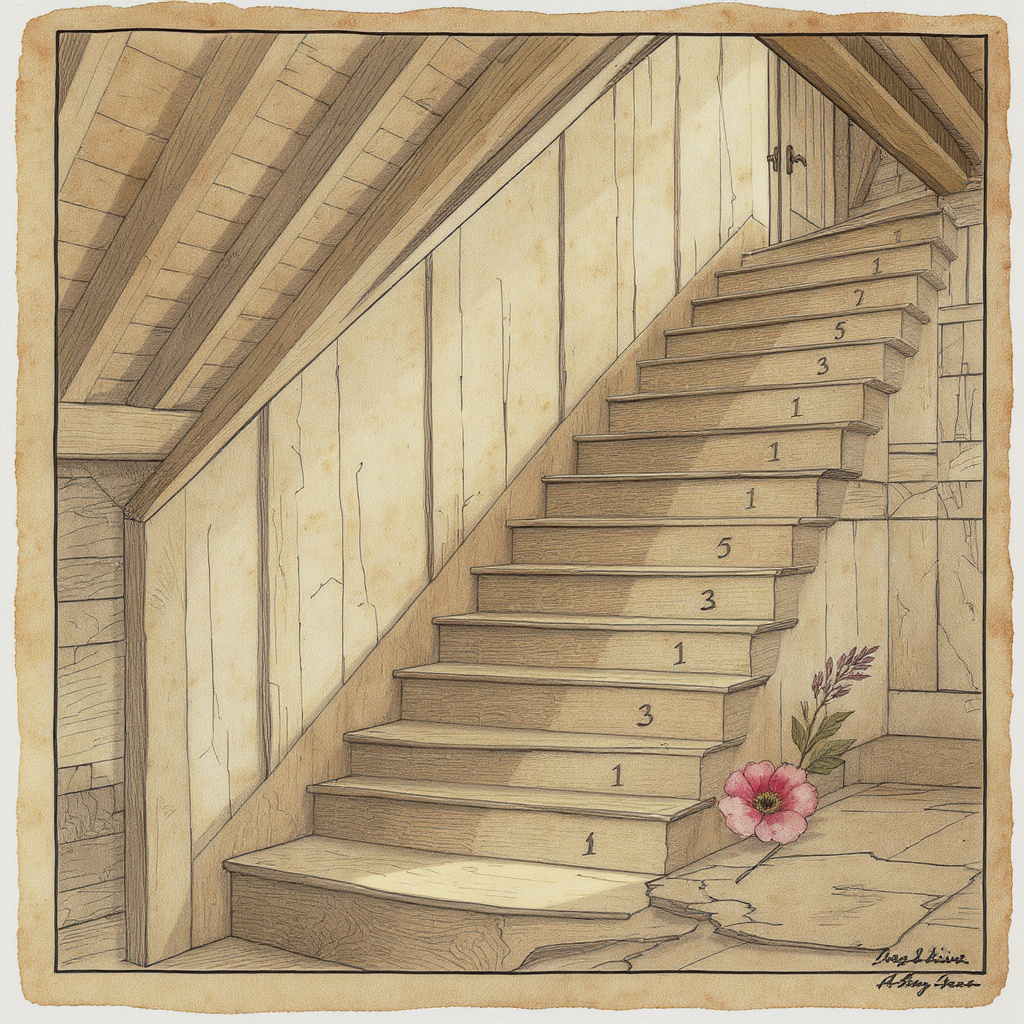
Lyric Video
Lyrics· 249 words
[Verse 1] One is the step where the wood always groaned Two and three you could skip if you were brave Four is where I sat the night the power went out Five through nine I don't remember at all
[Verse 2] Ten is crooked, it leans to the left Eleven's where I left a coin for luck Twelve and thirteen are close enough to touch the ceiling Fourteen opens into all that dust and light
[Chorus] Fourteen steps and I could climb them blind Fourteen steps and half of them are mine I'm drawing the staircase like a road on the atlas Every step a country I forgot I had a key to
[Verse 3] The house is somebody else's now, repainted, gutted, new They probably tore the staircase out for something open-plan But I can still feel twelve lean under my weight I can still hear four go quiet in the dark
[Chorus] Fourteen steps and I could climb them blind Fourteen steps and half of them are mine I'm drawing the staircase like a road on the atlas Every step a country I forgot I had a key to
[Bridge] One, two, skip, four — sit, breathe, wait for the lights Five through nine, gone, gone, gone, gone, gone Ten leans, eleven's lucky, twelve and thirteen low ceiling Fourteen — and the dust, and the light, and the boxes nobody opened
[Outro] Fourteen steps and I could climb them blind I'm still climbing, I never left
Short Story
*A story for curious minds*
There was a man in a seaside village whose job, as far as anyone could tell, was counting things that didn't need counting.
He counted the slats in every fence he passed. He counted the seconds between waves. He counted the steps of every staircase in town, and kept a small leather notebook full of these numbers, organized by address, as though the counts themselves were a kind of inheritance.
A boy once followed him for an entire afternoon, baffled, and finally worked up the nerve to ask why.
"Because numbers don't change," the counting keeper said, "even when everything around them does. The Whitlow house has nine front steps. It's had nine for sixty years. The owners have changed four times. The paint's changed colors I've lost count of. But it's always nine steps, and somehow that steadiness matters more to me than almost anything else about the place."
"That's a strange thing to care about," the boy said.
"Is it?" The counting keeper opened his notebook to a page near the back. "This is my own grandmother's attic stairway. Fourteen steps. I could climb it in the pitch dark and never miss one, because I knew it before I knew almost anything else — before I could read, before I could tie my shoes. Some of those steps I remember perfectly. The fourth one, where I sat once during a storm. The eleventh, where I left a coin for luck and never went back to check if it worked. But steps five through nine are just gone from me. Erased somehow. I've tried for years and I can't get them back."
"Doesn't that bother you? Not being able to remember?"
The counting keeper closed the notebook gently. "It used to. Now I think the missing steps are doing something useful — they're proof that I'm not just repeating a story to myself, polishing it smooth until it isn't true anymore. A memory with gaps in it is a memory that actually happened. The ones that come back whole and shining every time are the ones I'd worry about."
The boy didn't fully understand this, not then. But years later, climbing the stairs of a house that was about to be sold, trying to memorize them before they belonged to someone else, he found himself counting without meaning to, and discovered, to his surprise, that he didn't mind at all how many of the middle steps he couldn't place.
More From This Album