Chapter 03 · 3 min 17 sec
The Globe with the Worn Pacific
The invisible inheritance — what our ancestors planted in us without us knowing.
Lyric Video
Lyric Video
Lyrics· 248 words
[Verse 1] The globe sat on the bookshelf, tilted on its axis wrong We'd spin it with one finger and stop it with a thumb Wherever it landed, that's where we were going Most weeks it was always somewhere blue
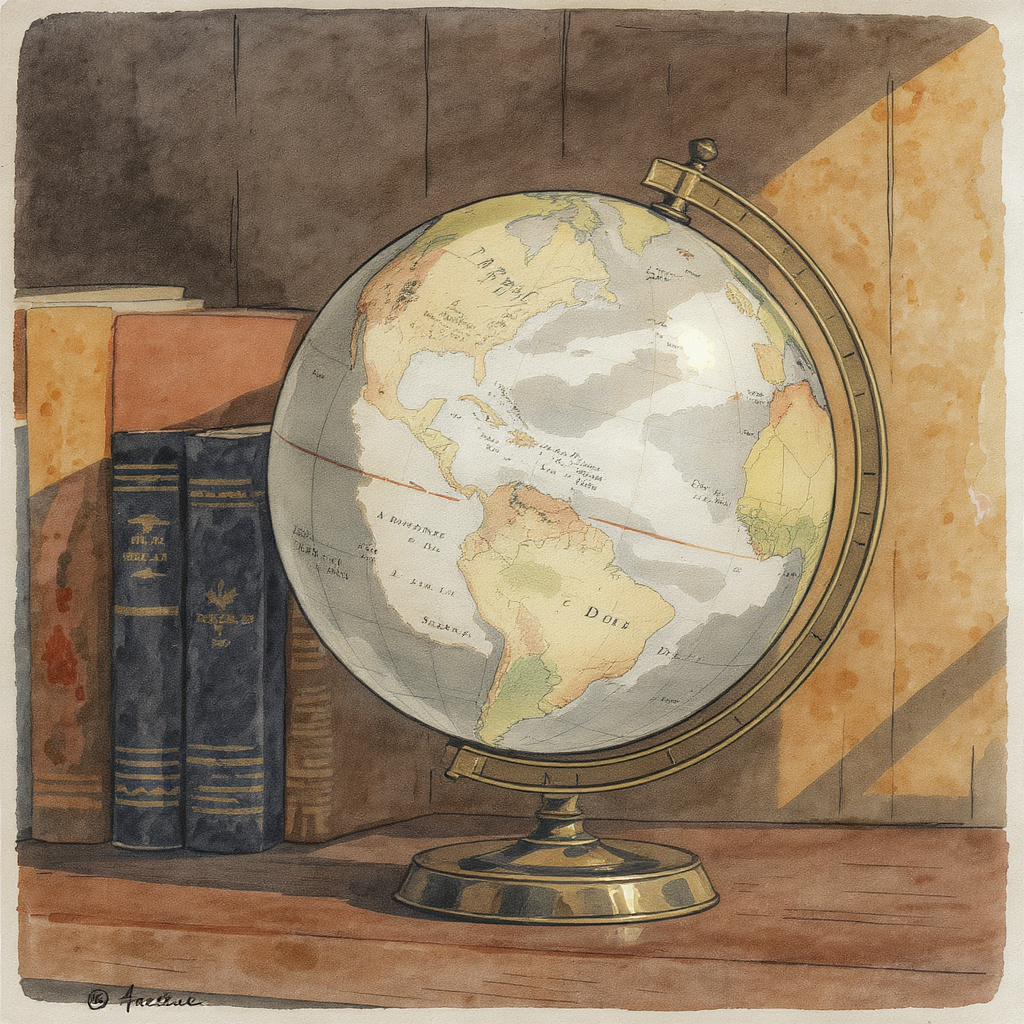
[Verse 2] The Pacific's gone pale now, the paint rubbed down to white From a thousand small hands stopping it at night Nobody painted that ocean to be touched that much But that's the only color that wore off
[Chorus] I'm mapping the places that never were real I'm mapping the want more than the land The globe doesn't turn anymore, the axis is stuck But the white spot still says how much we wished
[Verse 3] I used to think someday I'd go to all of it Now I just keep the globe on my own shelf, dust and all I don't spin it the same way, my thumb's too careful I don't want to wear out the only proof
[Chorus] I'm mapping the places that never were real I'm mapping the want more than the land The globe doesn't turn anymore, the axis is stuck But the white spot still says how much we wished
[Bridge] Pale ocean, worn smooth, no waves left in the paint Just a thumbprint history, a faded blue saint Of every place we said we'd go together And never once needed to leave the room
[Outro] Wherever it landed, that's where we were going The white spot still spins in me
Short Story
*A story for curious minds*
An antiques dealer once kept a globe in the corner of her shop that she refused to sell.
Customers asked about it often, because it was clearly old, brass-ringed and yellowed with age, and clearly broken, because the Pacific Ocean had been worn down to bare plaster, a pale scar where blue should have been. Everything else on the globe — the continents, the mountain ranges, the careful inked borders — had kept its color perfectly.
"What happened to the ocean?" a customer asked one day, running a finger over the smooth white patch.
"Hands happened to it," the dealer said. "For about forty years, in a house I never saw, somebody's children used to spin this globe and stop it with their thumb, right there, every single time. They were probably trying to land somewhere else. The mountains. The deserts. Anywhere with a name they could point to."
"But they kept landing on the ocean."
"They kept landing on the ocean," the dealer agreed, "because the ocean was the biggest target. It's hard to hit a country. It's easy to hit a whole sea."
The customer turned the globe slowly, looking for other wear, but there was none. Only the one bald patch, perfectly placed, like a wound that had healed wrong but healed all the same.
"Why won't you sell it?"
The dealer considered the question longer than the customer expected. "Because somewhere there's a person, probably grown now, who spun this exact globe as a child and wished for places they never went. If I sell it to a stranger who just wants an old globe for a shelf, that wish disappears into decoration. If I keep it here, it's still waiting. Maybe that person walks in one day. Maybe they don't. But the wanting deserves a chance to be recognized before it becomes just an object."
The customer left without buying anything that day, but she came back twice more over the following months, each time standing at the globe a little longer, turning it a little more carefully, careful — though she could not have said why — never to touch the pale place over the ocean, as though it were something that had already given enough of itself, and deserved, now, only to be looked at.
More From This Album