Chapter 06 · 3 min 59 sec
The Mirror Turned to the Wall
The grace of companionship — walking the same road without needing to speak.
Lyric Video
Lyric Video
Lyrics· 212 words
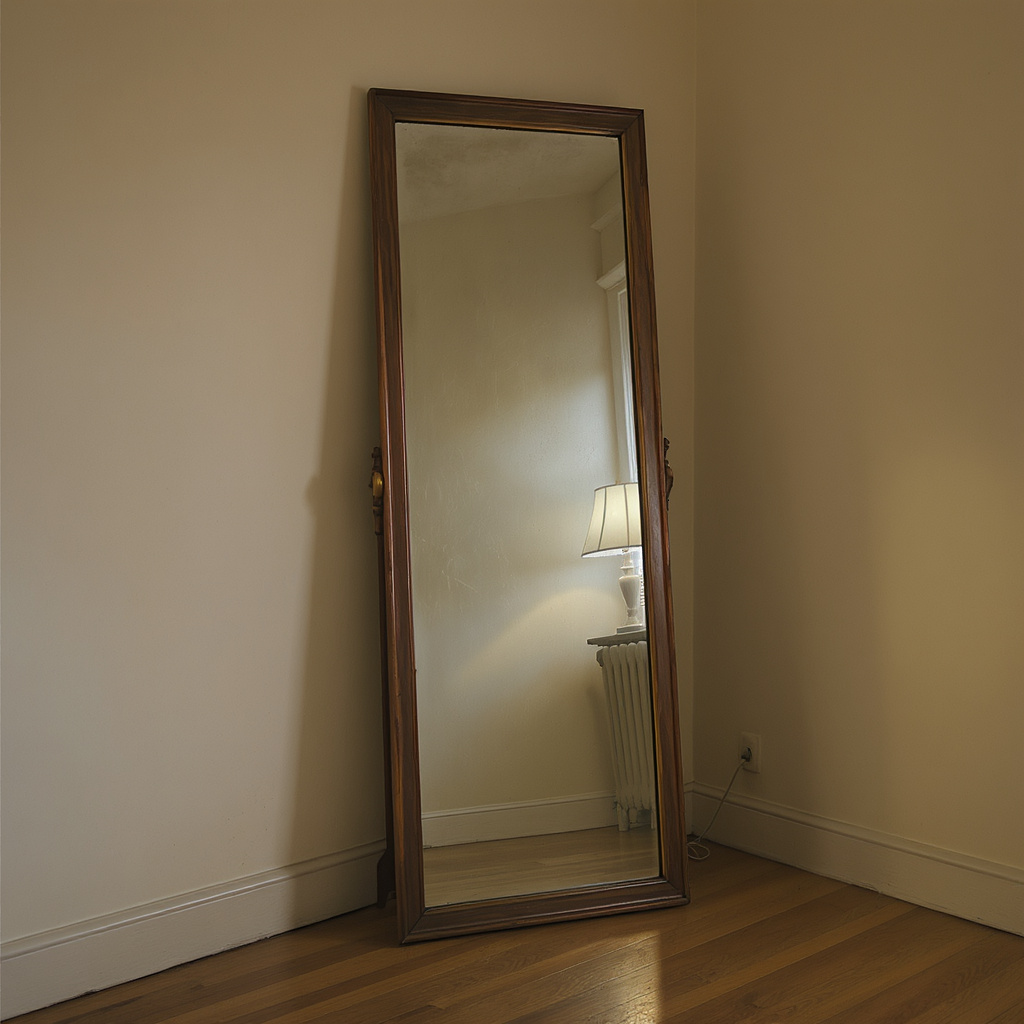
[Verse 1] There's a mirror in the corner room Facing the wall since before I can remember I dust the frame but never turn it over I tell visitors it's a design choice Somebody hung it that way on purpose That much, at least, isn't a lie
[Verse 2] I know exactly what it would show me That's not the part I'm avoiding It's not the face, I've made peace with the face It's the look on it I haven't The one I get when nobody's curating When there's no doorway to perform toward
[Verse 3 — spoken] I turned it an inch once, just to test it. Saw the edge of my own shoulder in the low light. That was enough for one year. I put it back facing the wall by morning.
[Verse 4] Visitors ask why I don't just take it down Wouldn't that be easier than the wall trick But some part of me needs it in the room Facing away, but still here, still mine A door I haven't opened yet Not a door I've thrown away
[Bridge] Maybe this year I turn it halfway Maybe I let the frame catch just the lamp light Not the whole face yet Just enough to remember I have one
Short Story
*A story for curious minds*
In a small studio above a bakery lived a sculptor named Yvet, who had, years ago, carved a statue of herself out of pale stone, then turned its face to the wall and never looked at it again. She told visitors it was unfinished. She told herself the same thing, though she knew, somewhere under the telling, that it was finished, and that the turning away was the actual unfinished part.
She dusted the statue's shoulders regularly. She never once touched its face.
A young apprentice named Domino came to study under her one spring, and on his second week, while sweeping, he asked the obvious question: why keep an unfinished statue at all, facing nothing, taking up good floor space?
"Some things you're not ready to finish," Yvet said, "but you're also not ready to throw away."
Domino accepted this the way apprentices accept most things their teachers say — politely, and without believing it completely. He noticed, over the following months, that Yvet would sometimes stand near the statue at the end of a long day, not touching it, just standing close enough that her own shadow fell across its turned shoulders.
One evening, after a difficult commission had gone badly, she nudged the statue an inch with her foot — not on purpose, she said, though Domino wasn't sure he believed that either. For just a moment, the late light caught the very edge of the statue's cheek, the part nearest the wall. Yvet looked at that sliver of stone face for the length of one held breath, then turned it carefully back.
"That's enough for tonight," she said, to no one, or to the statue, or to herself. Domino never asked what she meant.
She kept the statue facing the wall for the rest of his apprenticeship. But every year or two, Domino noticed, she'd turn it another careful inch, always putting it back by morning, always dusting the exposed sliver with more care than she dusted anything else in the studio.
Domino went on to become a sculptor himself, in a city far from the bakery, and he kept no turned statues of his own — he preferred, he said, to face things right away. But he thought of Yvet often, especially in the years when he understood, finally, that facing things right away was its own kind of luck, not a virtue, and that some people need a whole lifetime of careful inches just to look at their own face in the proper light.
More From This Album