Chapter 10 · 3 min 59 sec
Lunch at 2AM
The family home as a living thing — how spaces hold the memory of those who loved them.
Lyric Video
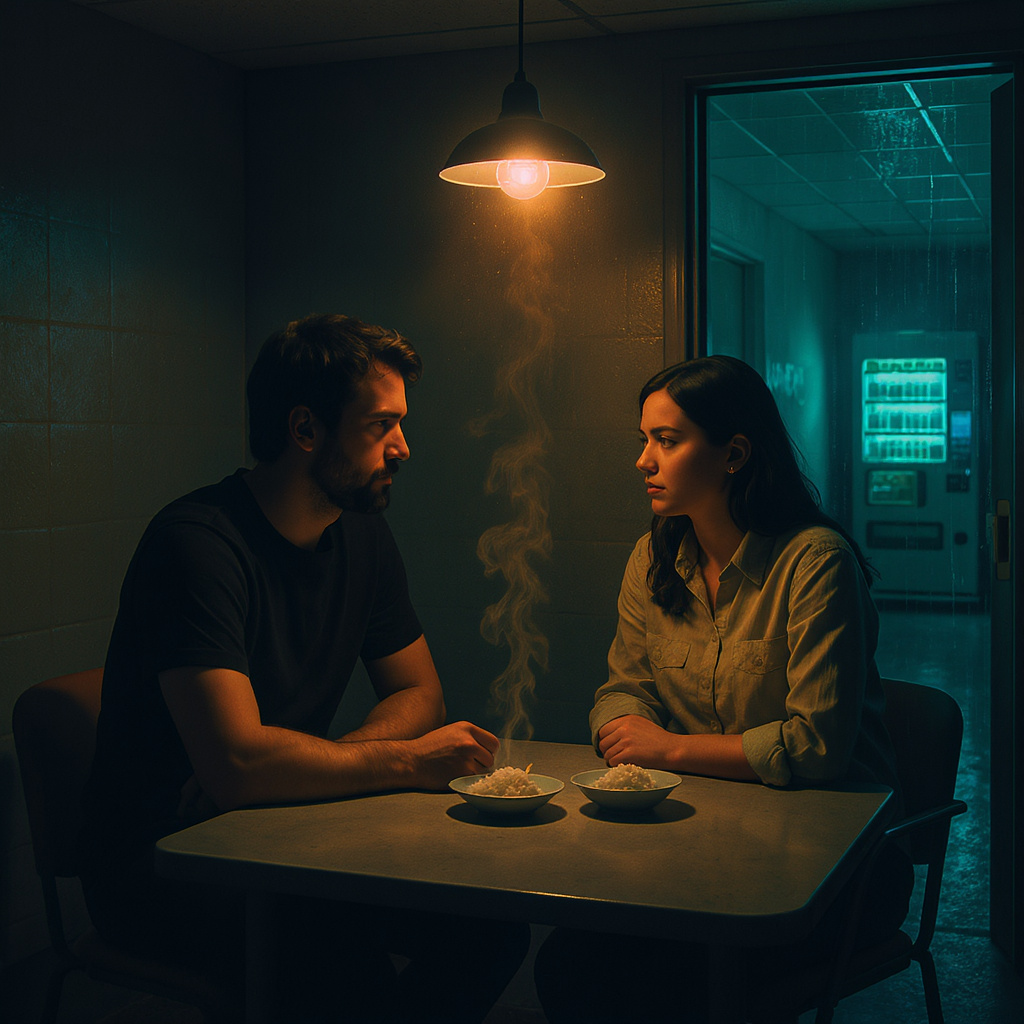
Lyric Video
Lyrics· 290 words
[Verse 1] You microwaved your mother's rice, gave half of it to me We sat under the one light that the building lets stay free Twenty-two minutes on the clock, that's all we ever get But you laughed at something stupid and I haven't forgotten it yet
[Verse 2] You told me about your daughter learning how to ride a bike I told you about the static on the line on Tuesday night Nothing that we said was big, nothing that we said was new But it felt bigger sitting here at 2 AM with you
[Chorus] Lunch at 2 AM, just the vending machine hum Lunch at 2 AM, this is where the warm part comes They can have the other hours, every minute they can keep But this one's ours, this one's ours, even half-asleep
[Verse 3] The timer on my phone went off, you sighed and put your fork down We scraped our trays and stood up slow and shuffled back toward the sound Of the floor calling us in our different directions, different aisles But you caught my eye one more time and you did that thing, that smile
[Chorus] Lunch at 2 AM, just the vending machine hum Lunch at 2 AM, this is where the warm part comes They can have the other hours, every minute they can keep But this one's ours, this one's ours, even half-asleep
[Bridge - soft, almost spoken] I don't know your last name's spelling, I don't know your whole life's story I know you save me half your rice. I know that's its own kind of glory Tomorrow we'll be tickets and codes and badge numbers again But tonight, for twenty-two minutes, we were just two people, friends
Short Story
*A story for curious minds*
At a small all-night bakery that supplied bread to half the diners in the city, two workers named Amadi and Tess were given exactly twenty minutes of unpaid break between the dough's first and second rise, which was not, technically, enough time to do much of anything.
For the first few weeks, they spent it separately — Amadi scrolling something on his phone in the corner, Tess stepping outside to breathe air that didn't smell like yeast.
One night, Tess noticed Amadi eating from a small dented tin, the kind people carried lunches in decades ago, and asked what was in it.
"My mother's stew," he said. "She still makes too much on purpose. Says I look thin." He held the tin out, almost shy about it. "There's plenty."
Tess hesitated, then sat down across from him on an overturned flour sack, and they ate from the same tin with two mismatched spoons, saying very little, because twenty minutes doesn't leave room for much beyond small, true things.
She told him about a leak in her apartment ceiling that the landlord kept promising to fix. He told her about teaching his nephew to ride a bike in a parking lot the week before, how the kid had screamed the whole first lap, more from excitement than fear, it turned out.
Neither of them said anything especially profound. That was the strange part — afterward, walking back toward the ovens, Tess realized she couldn't have repeated a single sentence from the conversation if asked. And yet something in her chest had loosened, the way a held breath loosens, without her noticing she'd been holding it.
This became, without either of them deciding it formally, a nightly arrangement. Twenty minutes, the dented tin, two spoons. Some nights they barely spoke at all and just sat in the warm smell of rising bread, comfortable in the particular silence of two tired people who don't need to perform anything for each other.
Years later, after Amadi had moved to a different bakery across town, Tess found herself glancing at the clock sometimes around two in the morning, missing not a conversation exactly, but the shape of those twenty minutes — the specific, small country they'd built together out of stew and mismatched spoons, a country with no flag and no name, that had existed only between two ovens, for twenty minutes a night, and had been, in its modest way, entirely enough.
More From This Album