Chapter 11 · 3 min 59 sec
The Old Machine Remembers My Mother
The tenderness of simplicity — a life lived without alternatives, full of its own grace.
Lyric Video
Lyric Video
Lyrics· 255 words
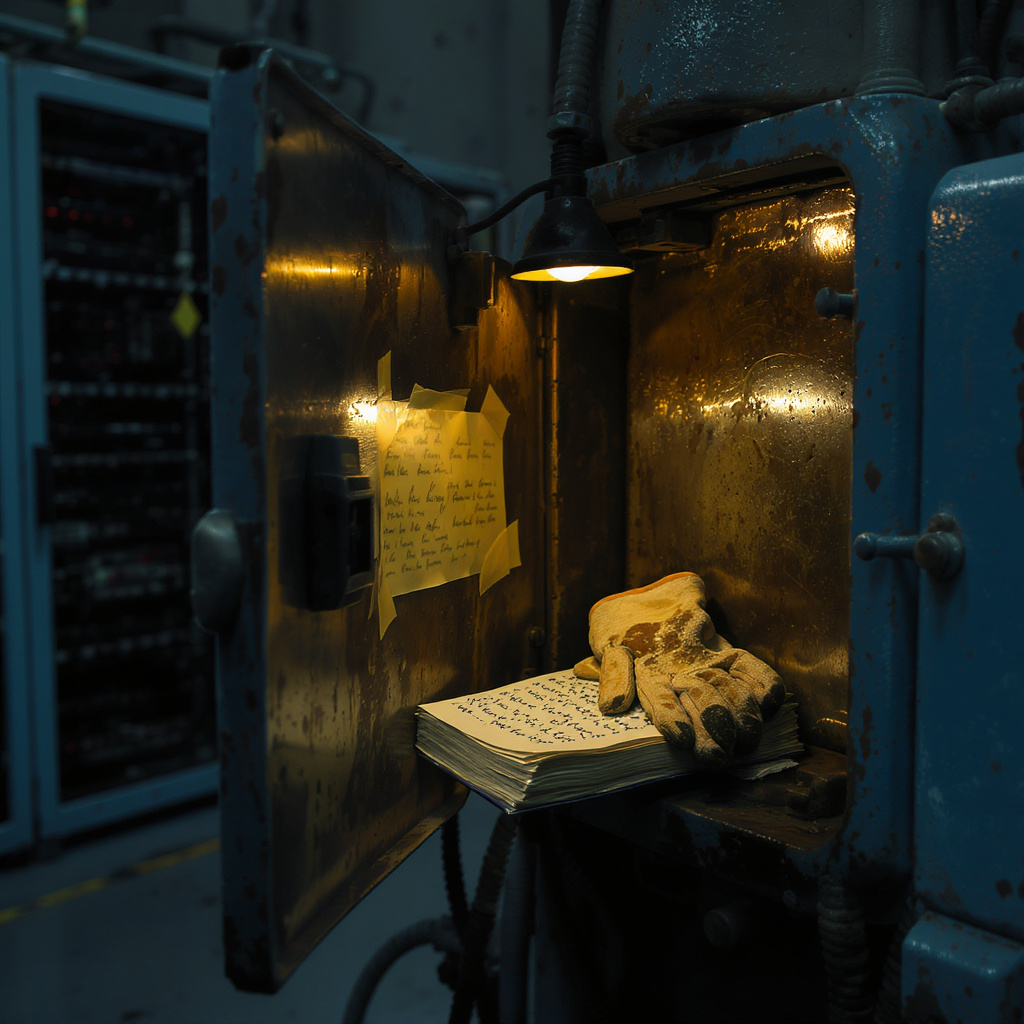
[Verse 1] I opened up the panel on the press from '94 Found a logbook taped inside the door Handwriting I knew before I knew my own My mother's careful letters, twenty years half-grown
[Verse 2] "Replaced the belt, it's running rough, be gentle with the gauge" She wrote notes like love letters to a future on this page Not to me, not to anyone, just to whoever came next I didn't know that I was reading her like a text
[Chorus] The old machine remembers my mother's hand Kept her in the oil and the grease the way nothing else can They replaced the parts, they never replaced the frame The old machine still hums a little like it knows her name
[Verse 3] I used to think she hated this place, the hours it stole away But here's her handwriting, careful, on a Tuesday She drew a little flower by a torque spec, just because Maybe this cold building held more of her than I ever was
[Chorus] The old machine remembers my mother's hand Kept her in the oil and the grease the way nothing else can They replaced the parts, they never replaced the frame The old machine still hums a little like it knows her name
[Bridge - quiet, almost broken] I added my own note below hers tonight Didn't say much, just "still running, still alright" Someday somebody's kid will open up this door And find the both of us. That's more than I thought I'd get. That's more
Short Story
*A story for curious minds*
A young mechanic named Farid was assigned to repair an old stamping press that had been running in the same factory corner since before he was born. Nobody else wanted the job — the press was outdated, finicky, due to be scrapped within the year — but Farid needed the overtime, so he climbed inside its access panel with a flashlight clenched in his teeth.
Taped to the inside of the panel door, yellowed and curling at the edges, was a small notebook he almost mistook for old packing material.
He peeled it free and opened it under his flashlight. Page after page of handwriting — careful, slanted, clearly written in a hurry between tasks, but legible: *Belt's stretching again, tightened to spec. Watch the third bearing, it sings before it fails.* And near the bottom of one page, almost an afterthought: *Cold today. Hope whoever reads this has gloves that actually fit.*
Farid didn't know who had written it. There was no name, just initials — R.V. — at the bottom of each entry, and a small habit of drawing a tiny sun in the corner of any page where a repair had gone especially well.
He found himself, against all reason, talking to the notebook as he worked. "Third bearing's still singing," he muttered, tightening a bolt. "You were right about that."
When he finished the repair, hours later than he'd planned, he sat for a moment with the notebook open on his knee. Then he found a pen in his coverall pocket and wrote, beneath R.V.'s last entry: *Still running, 30 years later. Thank you for the warning about the bearing. — F.K.*
He drew, a little self-consciously, a small sun of his own beside it.
He never learned who R.V. was — whether they still lived in the city, whether they'd long since retired, whether they were even still alive. It didn't change what he'd done. He taped the notebook back exactly where he'd found it and closed the panel.
Months later, when the press was finally scheduled for scrapping, Farid quietly asked his supervisor if he could keep one small part of it — not for any official reason, just for himself. He kept the access panel, with the notebook still taped inside, in his garage, where it leaned against the wall for years, holding two strangers' handwriting between its pages like a conversation that had taken thirty years to have, and had, in its way, never really ended.
More From This Album