Chapter 11 · 3 min 59 sec
The Drawer of Discarded Photographs
The tenderness of simplicity — a life lived without alternatives, full of its own grace.
Lyric Video
Lyric Video
Lyrics· 266 words
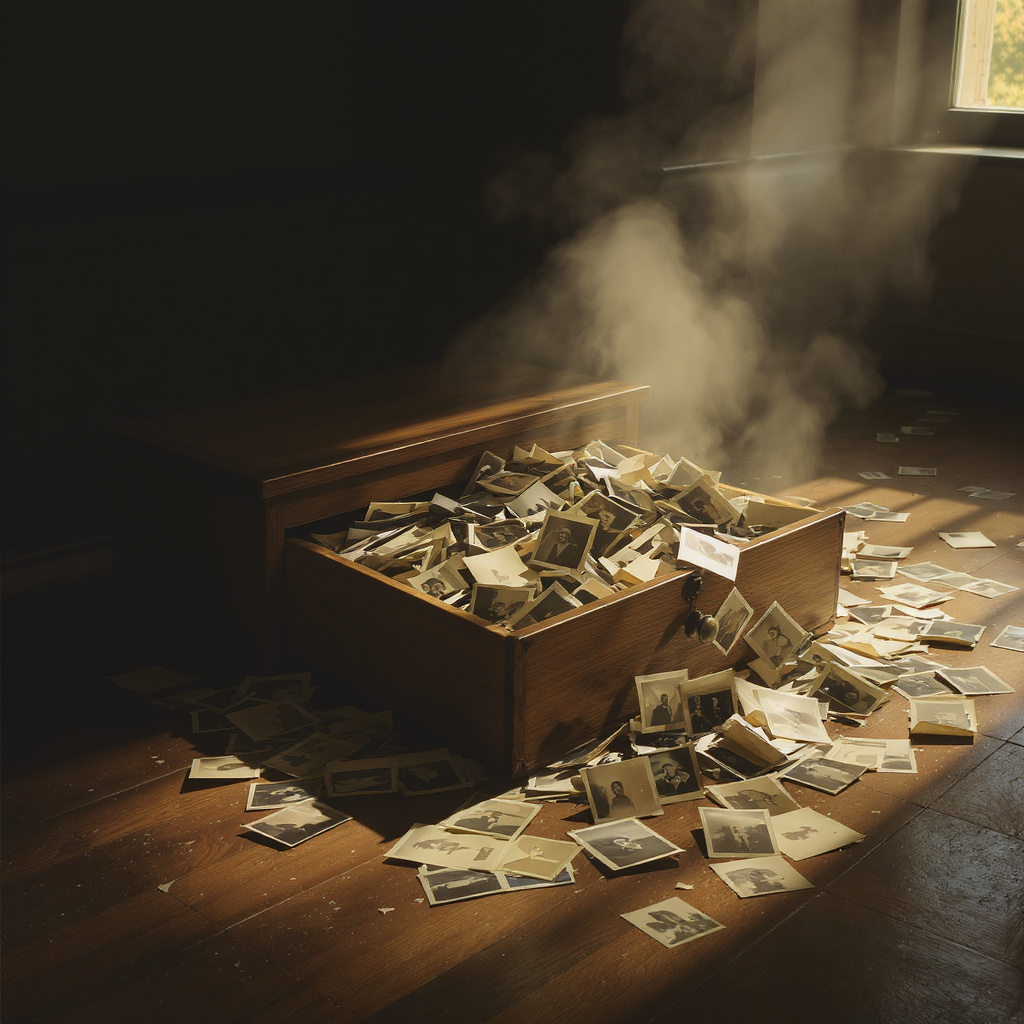
[Verse 1] This drawer doesn't have a placard It was never meant to be found Thirty years of the wrong expression The blink, the bad angle, the real one I put each one in here the day I took it That fast, that practiced, that ashamed I thought I was protecting the exhibit Turns out I was just emptying myself out
[Verse 2] Here's one from a hospital waiting room No one told me my face did that when scared Here's one laughing so hard I look unrecognizable I filed it under unfit before I even sat down I didn't know joy could fail an inspection Until I built the inspector myself Thirty years of evidence against my own face For a trial that never needed to happen
[Bridge — spoken] I'm sorry. I think I am saying that to a photograph. I think I am saying that to a girl who never did anything wrong except get caught looking like she felt something.
[Verse 3] I'm not going to frame all of these That's not what this room is for I just want to sit on the floor with the drawer open And let every discarded face look back at me once The scared one, the laughing one, the one mid-sentence The one nobody chose, the one that was always true I kept them because some part of me couldn't throw them out I think that part of me has been waiting all this time
[Outro] I'm not ready to hang them yet But I left the drawer open tonight That's the most I've got
Short Story
*A story for curious minds*
A tailor named Phineas had, for thirty years, kept a drawer in the back of his shop for garments that came out wrong — sleeves stitched a hair too short, collars that sat crooked no matter how he pressed them, buttonholes torn from impatience on a bad afternoon. He never showed these to customers. He never even mentioned the drawer existed. The moment a piece failed to meet his standard, he folded it quickly, almost guiltily, and slid it out of sight, the way you might hide a letter you regretted writing.
He told himself, for most of those thirty years, that this was simply professionalism — a tailor shows his best work, not his mistakes.
It was a slow Tuesday, well into his sixties, when his knees finally insisted he sit down properly for once, and he found himself sitting directly across from that old drawer, eye level with its handle, for the first time in longer than he could remember. On a whim, mostly to pass the time, he opened it.
He hadn't expected so much. Decades of fabric, decades of crooked collars, decades of his own hand on the wrong day, in the wrong mood, having tried anyway. He lifted out a child's coat with one sleeve visibly shorter than the other — made the week his mother had died, he remembered suddenly, his hands shaking too badly that week to measure straight. He'd been ashamed of that coat for forty years. Looking at it now, he mostly just remembered being a young man whose hands had shaken because he was grieving, not because he was careless.
He found a vest with a buttonhole torn clean through — sewn the night before his own wedding, nerves making a mess of fabric that had nothing to do with his skill at all.
He sat on the floor of his shop a long while, going through them one at a time, not fixing anything, not planning to sell any of it, just looking. Some part of him had been waiting, he realized, for exactly this — not an audience, just himself, willing to look at the crooked collars without flinching first.
He didn't hang any of the garments in his window. That wasn't what the afternoon was for. But he left the drawer unlatched when he finally closed the shop that evening, for the first time in thirty years, and somehow, walking home, his shoulders sat differently than they had in longer than he could say.
More From This Album